


Most People Asking "What Should I Invest In?" Are Overthinking It. Start With Index Funds and These 4 Stocks.
Key Points
With so many investments to choose from, getting started can be overwhelming.
It's doesn't have to be; here are three ETFs and four stocks to help you get started.
- 10 stocks we like better than Micron Technology ›
There are thousands of stocks and thousands of exchange-traded funds (ETFs) flooding the market, so knowing where to start is daunting. The overwhelming nature of it can create paralysis by analysis, or worse, it may prevent many folks from investing at all.
That would be a mistake, because the most critical aspect of building wealth is not which stock or ETF you choose, it's time in the market. The longer you invest, the more your investments have time to grow and multiply through compounding, which former Berkshire Hathaway (NYSE: BRKA) (NYSE: BRKB) CEO Warren Buffett said was one of the keys to his fortune.
Missed Nvidia in 2009? This Rare Signal Is Flashing Again. In 2009, a "Double Down" signal flashed for a little-known chipmaker called Nvidia. For the first time in years, that same "Total Conviction" signal is flashing for a company 1/100th the size of Nvidia. Continue »
So, don't overthink it, because getting started just takes a few investments, and then you can go from there. If you want to know what you should invest in, here are some simple choices.

Image source: Getty Images.
An S&P 500 ETF is a good starting point
Investing in an S&P 500 ETF is a no-brainer place to start for any investor. It is no coincidence that the three most popular ETFs in the world are S&P 500 ETFs -- the Vanguard S&P 500 ETF (NYSEMKT: VOO), the iShares Core S&P 500 ETF (NYSEMKT: IVV), and the State Street SPDR S&P 500 ETF (NYSEMKT: SPY).
Pick one of them, any one of them; they all invest in the same stocks, the 500 largest stocks that trade in the U.S. That gives you access to Nvidia (NASDAQ: NVDA), Apple (NASDAQ: AAPL), Microsoft (NASDAQ: MSFT) and all of the "Magnificent Seven" stocks, along with all of the high-flying AI stocks and everything else. The expense ratios are generally in the same ballpark, but check each to get the cheapest one.
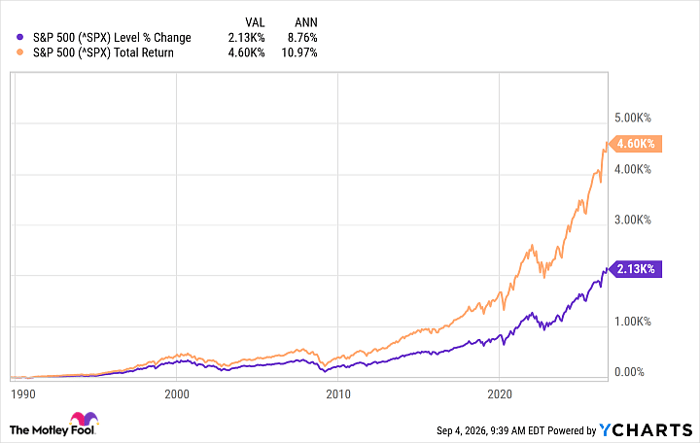
Since 1957, when the S&P 500 became what it is today, tracking the 500 largest stocks, the index has averaged an 11% return per year. Those are pretty amazing long-term results.
^SPX data by YCharts
Add some growth and value
With the S&P 500 ETF serving as your foundation, it would then be a good idea to add some growth and value to provide upside alpha and downside protection.
For a value-oriented ETF, I prefer one that is focused on higher-yield dividends, because when those higher dividends are reinvested, you get better long-term returns. Plus, you are still mostly invested in large, stable stocks that have lower valuations that tend to perform better when the larger market dips.
A good choice is the Invesco S&P Ultra Dividend Revenue ETF (NYSEMKT: RDIV). I won't go too deep into this one, but look it up. It basically invests in the 60 best large- and mid-cap stocks with the highest dividend yields, filtering out the top 5% of yields, which can be dividend traps, and the top 5% highest payout ratios, which can also be traps. Then they are weighted by the amount of revenue earned.
To show how it zigs when the market zags, the ETF returned 7% in 2022, when the S&P 500 was down 19% and the Nasdaq Composite was off 33%. Further, over the past 10 years, it has averaged an 11.3% return on an annualized basis.
On the growth end, you can pair that with a technology-focused ETF to give you added growth when the market is surging. The best option, I think, is the Vanguard Information Technology ETF (NYSEMKT: VGT). It invests in the entire gamut of the tech sector, not just large caps, with some 319 holdings. It also has a low expense ratio and has averaged a 24% return per year over the past 10 years.
Four stocks to consider
Those are three solid ETFs to start with, and I don't want to overwhelm you with a ton more, but if you want to add a few individual stocks, here are four.
Two of them I invest in -- Micron Technology (NASDAQ: MU) and Amazon (NASDAQ: AMZN) for a variety of reasons, but the common denominators are that they are both leaders in their industries, which are huge growth industries, and they are both trading at a major discount -- meaning they are cheap with tons of potential upside.
The next one would be Berkshire Hathaway. Warren Buffett is no longer running the show, but I still think it's the best value stock in the world.
Finally, you really can't go wrong with the biggest stock in the world, Nvidia. The chipmaker has been at the center of the AI boom and will likely remain there for years to come.
Should you buy stock in Micron Technology right now?
Before you buy stock in Micron Technology, consider this:
The Motley Fool Stock Advisor analyst team just identified what they believe are the 10 best stocks for investors to buy now… and Micron Technology wasn’t one of them. The 10 stocks that made the cut could produce monster returns in the coming years.
Consider when Netflix made this list on December 17, 2004... if you invested $1,000 at the time of our recommendation, you’d have $421,997!* Or when Nvidia made this list on April 15, 2005... if you invested $1,000 at the time of our recommendation, you’d have $1,413,876!*
Now, it’s worth noting Stock Advisor’s total average return is 978% — a market-crushing outperformance compared to 213% for the S&P 500. Don't miss the latest top 10 list, available with Stock Advisor, and join an investing community built by individual investors for individual investors.
See the 10 stocks »
*Stock Advisor returns as of September 7, 2026.
Dave Kovaleski has positions in Amazon and Micron Technology. The Motley Fool has positions in and recommends Amazon, Apple, Berkshire Hathaway, Micron Technology, Microsoft, Nvidia, and Vanguard S&P 500 ETF. The Motley Fool has a disclosure policy.
Recommended Articles


