


Not Nvidia, Not Micron. This Magnificent Warren Buffett Stock Could Be the Quiet Winner of the AI Arms Race -- Here's the Case.
Key Points
Nvidia and Micron dominate the AI semiconductor landscape, specializing in GPUs and high bandwidth memory, respectively.
Warren Buffett and his successor, Greg Abel, have been adding large amounts of Alphabet stock to Berkshire Hathaway's portfolio over the last few quarters.
Alphabet is a vertically integrated AI company trading at a reasonable valuation relative to its growth.
- 10 stocks we like better than Alphabet ›
When ChatGPT burst onto the scene in late 2022, investors did not waste time picking which tech companies they thought would be winners from the new artificial intelligence (AI) trend. At first, the market went shopping for pick-and-shovel companies. Nvidia (NASDAQ: NVDA) sells the graphics processing units (GPUs) that provide the computing power to train and run generative models. Micron Technology (NASDAQ: MU) sells the high bandwidth memory (HBM) and DRAM that store and rapidly supply the vast quantities of data that those processors work on.
Since the AI revolution started roughly three-and-a-half years ago, the scoreboard has been almost cartoonish. Since ChatGPT's public release, Nvidia stock has risen 1,290%, while Micron has soared 1,630%. These are not typical numbers, even for a bull market.
Missed Nvidia in 2009? This Rare Signal Is Flashing Again. In 2009, a "Double Down" signal flashed for a little-known chipmaker called Nvidia. For the first time in years, that same "Total Conviction" signal is flashing for a company 1/100th the size of Nvidia. Continue »
The reason behind their parabolic ascents is simple. Hyperscalers are spending more than $700 billion annually on AI infrastructure, and large slices of those checks are being allocated to GPUs, CPUs, HBM, and DRAM. Nvidia dominates the accelerator conversation, while Micron is one of only three companies that make the memory stacks that sit next to Nvidia's chips. As long as Amazon, Microsoft, Meta Platforms, and Alphabet (NASDAQ: GOOGL) (NASDAQ: GOOG) keep building data centers, Nvidia and Micron will continue cashing the invoices.
That story is not wrong, but it is incomplete. The quiet winner of the infrastructure cycle may be one of the companies writing a lot of these checks. Alphabet already dominates the consumer and enterprise demand side, the software side, and, increasingly, it's designing its own silicon. Wall Street has spent nearly four years treating all of that as a footnote. Warren Buffett and his new successor, Greg Abel, are not.
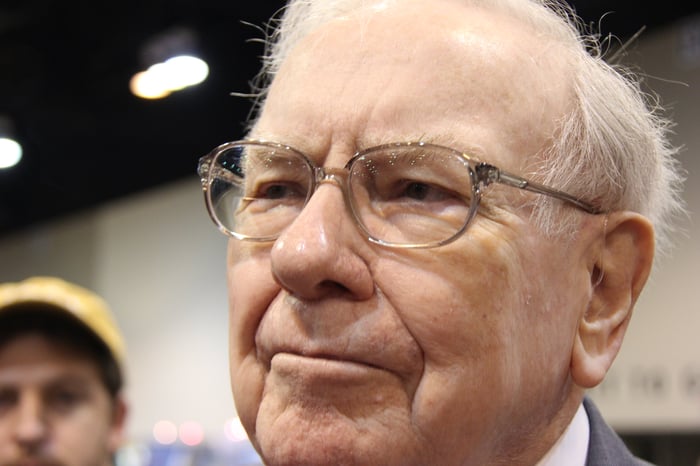
Image source: The Motley Fool.
Berkshire Hathaway is plowing into Alphabet stock
Berkshire Hathaway's first disclosed purchase of Alphabet stock showed up in the third quarter of 2025, a position of 17.8 million shares. The conglomerate sat on that stake through the end of the year before it accelerated its buying activity. During the first quarter of 2026, it nearly tripled its position in Alphabet. During the second quarter, Berkshire once again added shares on the open market and, more tellingly, wrote a $10 billion check for new shares as part of a larger private placement.
Buffett has been quite blunt about the origin story of Berkshire's position in Alphabet. "I initiated it," he told CNBC's Becky Quick during a recent interview.
Greg Abel, who succeeded Buffett as CEO at the start of 2026, has been aggressively adding to the position. Berkshire now holds around 106 million Alphabet shares worth nearly $38 billion. The position comprises about 13% of Berkshire's total stock portfolio, behind only Apple and American Express.
What makes Alphabet an attractive AI investment?
Nvidia sells the engine that powers AI models, and Micron sells the tanks for the fuel that keeps the engine running. Alphabet, by contrast, is building the car, the roads, and a growing share of alternative engines. Google Search is a money-printing machine, while YouTube draws the attention of billions of viewers. Meanwhile, Android sells smartphones and other consumer hardware around the globe. On top of these assets sit Gemini, Google Cloud, Tensor Processing Units (TPUs), and the Waymo autonomous vehicle fleet.
The recent performances of Google Cloud are something that should make chip bulls pay attention. In the first quarter, its revenue rose 63% year over year to $20 billion, with operating margins coming in at 33%. During the second quarter, sales from Google Cloud jumped 82% year over year to 24.8 billion, with an operating margin of 36%. Moreover, Google Cloud's backlog was a jaw-dropping $514 billion at the end of the second quarter. Cloud infrastructure is not a little side hustle for Alphabet -- it's turning into a second core profit engine alongside the core advertising segment.
On the silicon side of the cloud division are TPUs -- a type of custom silicon that can handle AI workloads at a lower cost than GPUs. Google designed them for its own specific AI workloads, and it used to keep the chips in-house, but now, it has started selling some to enterprise customers that want the custom silicon that trains Gemini models in their own data centers. This is another example of how Alphabet is turning what was once a cost center into a monetized product.
Waymo services now run on the order of 500,000 paid robotaxi rides a week across more than a dozen cities. A February funding round valued that business at $126 billion. As agentic AI applications enter wider production, Waymo could swiftly emerge as a business that contributes meaningful unit economics to Alphabet's broader ecosystem, much in the same way Google Cloud has scaled up over the last couple of years.
The thread stitching Alphabet's fabric together is Gemini. Search, YouTube, Android, Workspace, Cloud, and even the robotaxis increasingly run on a unified family of models. That structure is the difference between selling critical components and compounding an ecosystem.

Image source: Getty Images.
Alphabet stock looks like a bargain value
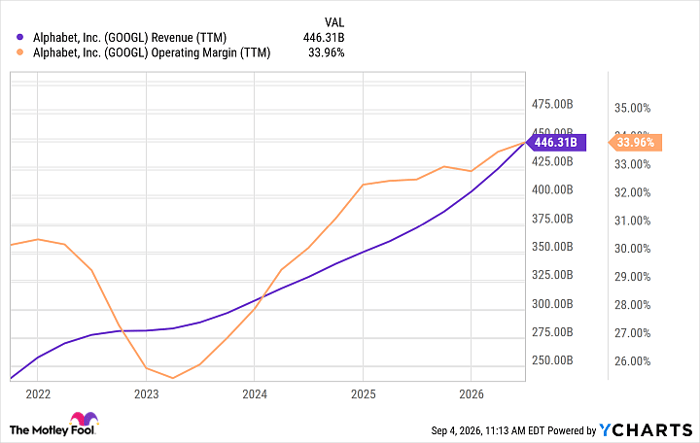
Alphabet's vertically integrated stack is how the company manages to remain consistently profitable. Cloud, which was actually losing money as recently as 2022, is now one of the juiciest parts of the company. The reason? AI has become the accelerant. Alphabet's companywide operating margin is around 34% and moving upward. That's impressive for a business that's spending like a utility building a new power grid.
GOOGL Revenue (TTM) data by YCharts.
The capital cycle is the objection everyone already knows. Alphabet has said it plans for between $195 billion and $205 billion in capital expenditures this year. While the company's free cash flow has gone temporarily negative and it has paused its stock buybacks, the bigger picture isn't as ugly as it might appear in a spreadsheet. In fact, this is simply a repeat of the same pattern Google Cloud already survived: Absorb operational pain, then watch the profit margin show up once the capacity you paid to build is fully subscribed.
On valuation, Alphabet stock is not priced like a company that is at the forefront of AI. The company trades at a forward price-to-earnings (P/E) ratio of 16. That is nearly identical to the long-run average forward P/E of the S&P 500. For a business with Search's moat, YouTube's scale, Cloud's backlog, its own accelerator roadmap, and an autonomous robotics play that has yet to contribute much more than a rounding error to its financials, this is not an expensive stock.
Don't get me wrong: Nvidia and Micron will keep winning every time a hyperscaler or neocloud orders another server. But smart investors realize they are not the only companies getting paid. Alphabet is a rare business selling the infrastructure, running frontier models, owning multiple distribution channels, and still generating the kind of profits Buffett spent a lifetime buying. Against this backdrop, I see Alphabet as a no-brainer opportunity to buy hand over fist and hold onto throughout the AI infrastructure era.
Should you buy stock in Alphabet right now?
Before you buy stock in Alphabet, consider this:
The Motley Fool Stock Advisor analyst team just identified what they believe are the 10 best stocks for investors to buy now… and Alphabet wasn’t one of them. The 10 stocks that made the cut could produce monster returns in the coming years.
Consider when Netflix made this list on December 17, 2004... if you invested $1,000 at the time of our recommendation, you’d have $421,997!* Or when Nvidia made this list on April 15, 2005... if you invested $1,000 at the time of our recommendation, you’d have $1,413,876!*
Now, it’s worth noting Stock Advisor’s total average return is 978% — a market-crushing outperformance compared to 213% for the S&P 500. Don't miss the latest top 10 list, available with Stock Advisor, and join an investing community built by individual investors for individual investors.
See the 10 stocks »
*Stock Advisor returns as of September 7, 2026.
American Express is an advertising partner of Motley Fool Money. Adam Spatacco has positions in Alphabet, Amazon, Microsoft, and Nvidia. The Motley Fool has positions in and recommends Alphabet, Amazon, American Express, Apple, Meta Platforms, Micron Technology, Microsoft, and Nvidia. The Motley Fool has a disclosure policy.
Recommended Articles


