


Social Security's Grim Reality: The Most Popular Solution, Taxing the Rich, Won't Fix the Problem
Key Points
Sweeping Social Security benefit cuts are an estimated six years away for retired workers and survivors of deceased workers.
Several ongoing demographic shifts, not congressional theft or undocumented workers, are responsible for Social Security’s $29.3 trillion (and growing) unfunded obligation.
The public overwhelmingly favors increasing payroll taxation on high earners to resolve Social Security’s funding shortfall.
However, an analysis from the Social Security Administration’s Office of the Actuary shows that additional measures will be needed to avoid benefit cuts.
- The $23,760 Social Security bonus most retirees completely overlook ›
In July, more than 71 million traditional beneficiaries received a Social Security benefit. For many of these individuals, especially retirees, Social Security income is indispensable. Yet this foundational retirement program for our aging workforce is floundering.
Although Social Security is in no danger of going bankrupt or halting benefits, the program's existing payout schedule is at risk of sweeping benefit cuts in as little as six years.
Missed Nvidia in 2009? This Rare Signal Is Flashing Again. In 2009, a "Double Down" signal flashed for a little-known chipmaker called Nvidia. For the first time in years, that same "Total Conviction" signal is flashing for a company 1/100th the size of Nvidia. Continue »
The popular solution to "fix" Social Security, which I'll explain in detail shortly, is to tax the rich and ensure they pay their fair share. But the most popular solution to a problem isn't always the best one. As you're about to see, it'll take a lot more than opening the wallets of the well-to-do a bit wider to resolve Social Security's funding shortfall.

Image source: Getty Images.
Sweeping Social Security benefit cuts of up to 22% are an estimated six years away
Before we can discuss how to fix Social Security, we first need to understand the "how" and "why" behind the program's shortcomings.
Every year since 1940, the Social Security Board of Trustees has published a report detailing the previous year's income collected and the program's outlays. More importantly, this report uses a laundry list of variables to estimate the short- and long-term (75-year) financial health of America's leading retirement program.
Since 1985, the Board of Trustees has warned annually of a long-term unfunded obligation. In plain English, projected income collected through the year 2100 is forecast to be insufficient to cover outlays, which primarily means benefits but also includes the administrative expenses to oversee Social Security. As of the 2026 report, this long-term unfunded obligation had ballooned to $29.3 trillion.
However, the more immediate issue is the expected depletion of Social Security's Old-Age and Survivors Insurance trust fund's (OASI) asset reserves by the fourth quarter of 2032. These asset reserves represent the excess income collected since inception that's invested in special-issue, interest-bearing government bonds, as required by law.
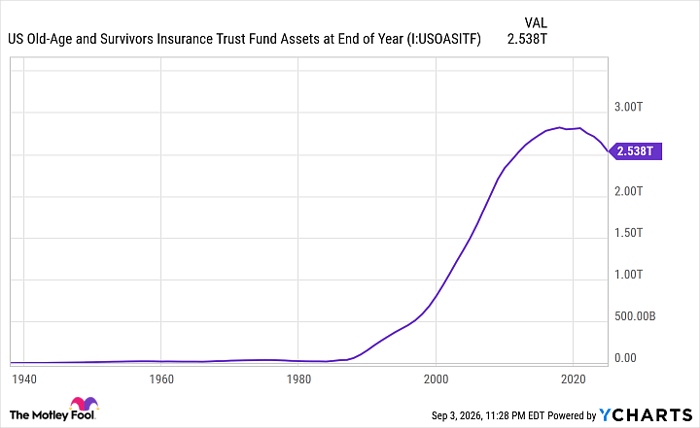
US Old-Age and Survivors Insurance Trust Fund Assets at End of Year data by YCharts
To reiterate, the OASI doesn't need a cent in its asset reserves to continue paying benefits. But once this excess capital is gone, sweeping benefit cuts of up to 22% may be necessary for retired workers and survivors of deceased workers to sustain payouts without any further near-term reductions.
Now for the all-important question: How did Social Security's financial outlook become so poor?
The answer is absolutely, 100% not because of congressional theft or undocumented workers. While these are common online message board scapegoats, there isn't any evidence to support either theory.
Rather, Social Security's mammoth funding shortfall can be traced to several ongoing demographic shifts, including:
- The retirement of baby boomers, which is weighing on the worker-to-beneficiary ratio.
- Increased longevity since retired-worker benefits began in January 1940.
- A historically low U.S. birth rate that threatens to further pressure the worker-to-beneficiary ratio.
- A decline in net legal migration into the U.S. Migrants tend to be younger and will spend decades in the labor force, contributing to Social Security via the 12.4% payroll tax on earned income.
- Rising income inequality, with considerably more earned income (wages and salaries) escaping the payroll tax over the last four decades.

Image source: Getty Images.
Statistically, taxing the rich buys Social Security time, but it won't fix its funding shortfall
Lawmakers in Washington, D.C., including President Donald Trump, are well aware of these demographic changes and the need to shore up Social Security over the long run. At the same time, all "fixes" would result in some group of beneficiaries being worse off than they were before. In other words, there's the risk of losing seats in Congress for the party that steps up and strengthens Social Security.
While no shortage of solutions has been proposed in Washington, D.C., the American public overwhelmingly favors increasing payroll taxation on the well-to-do.
In 2026, earned income between $0.01 and $184,500 is subject to the 12.4% payroll tax, while earnings above this figure (known as the earnings tax cap) are exempt. Approximately 94% of Americans earn less than the earnings tax cap, meaning they're subject to the payroll tax on every dollar they earn.
If the most popular solution were employed and the earnings tax cap were raised or completely removed, it would only affect roughly 6% of working Americans. This largely explains why taxing the rich is such a popular solution.
Social Security hits the wall in 2032.
— Kurt S. Altrichter, CRPS® (@kurtsaltrichter) September 1, 2026
When the trust fund runs dry, benefits get cut 22% automatically, for every retiree at once. The program already spends more than it collects, and the shortfall widens to nearly 7% of every taxable paycheck by the 2080s.
There are 3 ways… pic.twitter.com/Sy6ImL8jEK
But what's popular isn't always the best fix. According to the Social Security Administration's Office of the Actuary, via a December 2021 Congressional Research Service (CRS) report, eliminating the earnings tax cap and subjecting all earned income to the payroll tax would extend the solvency of the combined OASI and Disability Insurance trust fund by "about 35 years."
Setting aside the fact that Social Security's unfunded obligation has notably worsened since the CRS's report was published in December 2021, taxing the well-to-do would give policymakers roughly three decades to debate solutions without cutting benefits. What taxing the rich doesn't do is come anywhere close to resolving the aforementioned $29.3 trillion (and growing) unfunded obligation.
What's more, a strong argument can be made that high earners are already paying their fair share into Social Security. Just as there's an earnings cap applicable to the payroll tax, there's a National Average Wage Index-adjusted maximum monthly benefit at full retirement age for top earners.
Furthermore, Social Security has always been primarily supported by taxing earned income. While some individuals favor subjecting all forms of income, including investments, to Social Security's payroll tax, this isn't how the formula works or how benefits are calculated. Investment income has always been off the table.
Social Security's grim reality is that taxing high earners more can kick the can further down the road, but tougher decisions will eventually need to be made. This could include increasing the full retirement age for future generations of workers, raising the payroll tax for all working Americans, means-testing benefits for the well-to-do, or perhaps biting the bullet and somewhat reducing future Social Security payouts.
Regardless of how the puzzle pieces are eventually arranged, taxing the rich, by itself, won't be the answer.
The $23,760 Social Security bonus most retirees completely overlook
If you're like most Americans, you're a few years (or more) behind on your retirement savings. But a handful of little-known "Social Security secrets" could help ensure a boost in your retirement income.
One easy trick could pay you as much as $23,760 more... each year! Once you learn how to maximize your Social Security benefits, we think you could retire confidently with the peace of mind we're all after. Join Stock Advisor to learn more about these strategies.
View the "Social Security secrets" »
The Motley Fool has a disclosure policy.
Recommended Articles


