


ASML vs. Taiwan Semiconductor: Which Semiconductor Monopoly Is the Safer Investment?
Key Points
TSMC's production capacity is unmatched by its competitors.
ASML's semiconductor-making equipment has no comparison.
- 10 stocks we like better than Taiwan Semiconductor Manufacturing ›
In the chip world, there's really only one monopoly: ASML Holding (NASDAQ: ASML). ASML makes a machine that no one else in the world has the technology to make, and it's vital to the production process of every advanced chip manufacturer, including Taiwan Semiconductor Manufacturing (NYSE: TSM).
While Taiwan Semiconductor isn't considered a monopoly, it's the only company in the world with the foundry capacity to produce the chips needed to power the AI build-out, which gives it a pseudo-monopoly due to its size, position, and influence in the industry.
Missed Nvidia in 2009? This Rare Signal Is Flashing Again. In 2009, a "Double Down" signal flashed for a little-known chipmaker called Nvidia. For the first time in years, that same "Total Conviction" signal is flashing for a company 1/100th the size of Nvidia. Continue »
These two are some of the most powerful companies on Earth, and they're available to invest in. They've already delivered a great return to investors, but which one can deliver moving forward? Let's find out.
Image source: Getty Images.
Taiwan Semiconductor is reducing its investment risk
ASML's extreme ultraviolet (EUV) lithography machines are incredible. They cost hundreds of millions of dollars and, fully assembled, are about the size of a bus. As a result, ASML doesn't make a ton of these machines each quarter, which can make results lumpy. But when you have a technological monopoly on a machine that makes one of the most important products in the world, the company can nearly charge whatever it wants.
Right now, business is booming for ASML because the chipmakers are ramping up production capacity to meet demand caused by AI chips. However, if excess chip-building capacity is built out for the AI arms race, it could harm ASML's business five to 10 years from now if chip demand has fallen compared to the peak.
Taiwan Semiconductor may seem like a no-brainer investment, but many investors are worried about Taiwan's relationship with mainland China. There have been rumors of military action to bring Taiwan back under the control of China for years, although nothing has happened yet. An attack could send shares tumbling, but considering how many of the world's chips come from the tiny island, it would also plunge the markets into turmoil.
However, Taiwan Semiconductor is reducing the risk of this single point of failure by increasing production capacity elsewhere. TSMC announced an additional $100 billion investment in Arizona during its Q2 conference call, bringing its total to around $265 billion.
There will always be strong demand for various products, even if the peak of AI chip demand is unmatched. As a result, I think the longevity of AI business gains favors Taiwan Semiconductor, but that's not all there is to consider.
ASML is an expensive stock
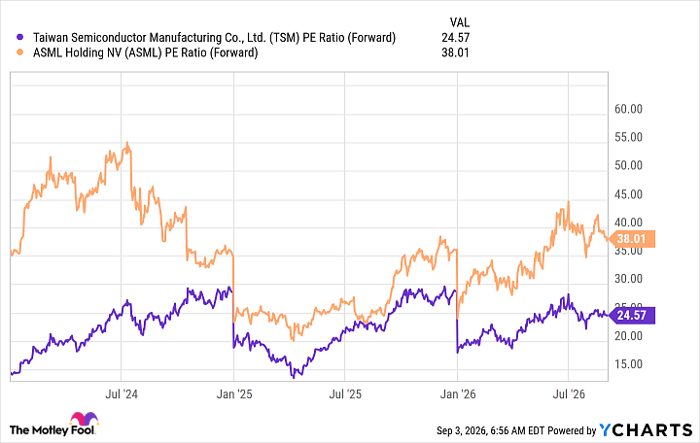
Both stocks have performed well in 2026, with TSMC rising around 35% and ASML up nearly 60%. However, that has caused ASML's valuation to swell, while Taiwan Semiconductor's remains more moderate.
TSM PE Ratio (Forward) data by YCharts
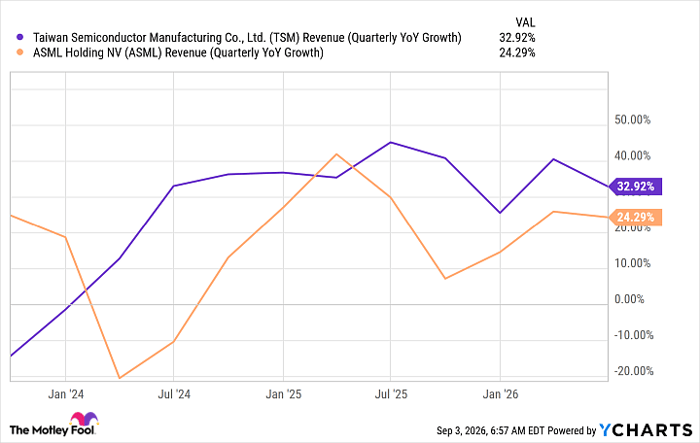
At nearly 25 times forward earnings, Taiwan Semiconductor is reasonably priced, whereas ASML looks pretty expensive at nearly 40 times forward earnings. Normally, companies with higher valuations are associated with faster growth rates, but that's not always the case. Taiwan Semiconductor has grown faster than ASML in nearly every quarter, and that likely won't change.
TSM Revenue (Quarterly YoY Growth) data by YCharts
This means that most of the premium which investors pay for ASML stock is due to its technological monopoly, which isn't necessarily wrong; it's just expensive.
Instead, I think I'd rather own Taiwan Semiconductor, which has created a large moat around its business by having far greater production capacity than anyone else. With TSMC diversifying its production footprint beyond Taiwan, the risk associated with the stock is also declining. As a result, I think it's the better stock to buy now.
Should you buy stock in Taiwan Semiconductor Manufacturing right now?
Before you buy stock in Taiwan Semiconductor Manufacturing, consider this:
The Motley Fool Stock Advisor analyst team just identified what they believe are the 10 best stocks for investors to buy now… and Taiwan Semiconductor Manufacturing wasn’t one of them. The 10 stocks that made the cut could produce monster returns in the coming years.
Consider when Netflix made this list on December 17, 2004... if you invested $1,000 at the time of our recommendation, you’d have $421,997!* Or when Nvidia made this list on April 15, 2005... if you invested $1,000 at the time of our recommendation, you’d have $1,413,876!*
Now, it’s worth noting Stock Advisor’s total average return is 978% — a market-crushing outperformance compared to 213% for the S&P 500. Don't miss the latest top 10 list, available with Stock Advisor, and join an investing community built by individual investors for individual investors.
See the 10 stocks »
*Stock Advisor returns as of September 5, 2026.
Keithen Drury has positions in Taiwan Semiconductor Manufacturing. The Motley Fool has positions in and recommends ASML and Taiwan Semiconductor Manufacturing. The Motley Fool has a disclosure policy.
Recommended Articles


