


If You're Holding Nvidia Stock Into September, History Has a Clear Warning
Key Points
Over the last several decades, the S&P 500, Nasdaq Composite, and Dow Jones Industrial Average have all generated negative monthly returns during September.
Nvidia's returns during the month of September have been mixed throughout the artificial intelligence (AI) revolution.
Despite a seasonally weak time of year, investors should zoom out and think about the long-term picture as it pertains to Nvidia's position in the AI infrastructure landscape.
- 10 stocks we like better than Nvidia ›
Every year, as Labor Day fades and portfolio managers return from vacation, the same conversation starts: Stocks tend to wobble in the ninth month, so maybe it's time to play a little defense. If you own shares of Nvidia (NASDAQ: NVDA), this discussion may hit a bit harder.
Nvidia has been the market's artificial intelligence (AI) engine for four years now. Since OpenAI launched ChatGPT to the public on Nov. 30, 2022, shares of Nvidia have climbed by 1,200%, and the company has become the most valuable business in the world by market cap.
Missed Nvidia in 2009? This Rare Signal Is Flashing Again. In 2009, a "Double Down" signal flashed for a little-known chipmaker called Nvidia. For the first time in years, that same "Total Conviction" signal is flashing for a company 1/100th the size of Nvidia. Continue »
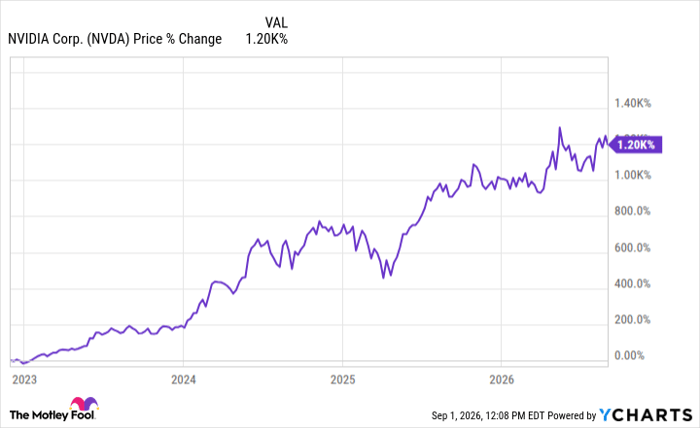
NVDA data by YCharts.
Sounds great, right? Well, what this also means is Nvidia can be one of the first names institutional funds sell when they want to take gains off the table. While the calendar is not destiny, it is not background noise either.
Let's dig into what the September Effect actually is, how it lines up with Nvidia, and what smart investors can do instead of guessing over the next several weeks.
What is the September Effect?
The September Effect is financial jargon used to describe a historical pattern: Over the long run, stocks have posted weaker returns in September than in any other month. In fact, September is the only month that shows a negative average across the major indexes.
Since 1928, the S&P 500 (SNPINDEX: ^GSPC) has averaged declines of about 1.1% in September and finished the month lower than it started roughly 56% of the time. The Dow Jones Industrial Average (DJINDICES: ^DJI) shows a similar pattern over an even longer stretch, with an average September drop of around 1.1% and a winning month rate of only 42%. Lastly, the Nasdaq Composite (NASDAQINDEX: ^IXIC) has averaged a decline of about 0.9% in September over the last several decades.
Interestingly, the Nasdaq has actually finished higher 52% of the time in September since 1971. But when it does decline, those slides have been large enough to outweigh the slightly large quantity of wins and pull the long-run average below zero.
Understanding these patterns matters. The stock market is far from guaranteed to slump in the month of September. As the analysis shows, many Septembers end in the green.
Nevertheless, the month tends to attract outsize selling. Money managers come back from summer breaks and rebalance portfolios. Investor psychology also plays a role: After a few ugly Septembers, many people simply expect another one and act accordingly. When you layer on a Federal Reserve meeting, jobs data, and inflation prints, you get a month that feels much heavier than August.
The important thing to keep in mind here is perspective. A 1% average monthly loss does not constitute a bear market. It's a seasonal headwind. Treating the September Effect as a definite prophecy is one way that people wind up selling good stocks at the wrong time.
Image source: Getty Images.
What Nvidia investors need to know in September
If you've been paying attention to the artificial intelligence (AI) revolution, you know by now that Nvidia doesn't trade like a sleepy blue chip stock. Instead, the semiconductor giant is a high-expectation, high-volatility growth stock touching the biggest capital-spending infrastructure cycle in modern technology history.
Here is how Nvidia stock has fared over the last few Septembers:
- September 2023: (10.3%)
- September 2024: 1.7%
- September 2025: 7.1%
Nvidia investors have clearly experienced at least one nasty September in the recent past, but they have also enjoyed better Septembers as the AI story continues to accelerate. This dichotomy is my whole point. Nvidia's month-to-month performance is less about the calendar and more about whether investors are in the mood to own one of the most crowded, profitable names in the AI ecosystem.
When institutional funds want to lock in some gains, Nvidia is one of the easiest stocks for them to sell because it is liquid, has a large weight in indexes, and has already delivered the kind of generational run that makes profit-taking feel both responsible and inevitable.
Underneath these buying and selling dynamics, Nvidia's business is the real story: Demand for data center chips remains intense, profit margins have been robust, and the company has kept beating estimates that Wall Street once thought were impossible to meet. At the end of the day, some seasonal selling does not erode Nvidia's dominance. It just means the stock can become briefly cheaper for reasons unrelated to the volumes of GPU shipments.
There's one more wrinkle for 2026: This is a midterm year. Some of the market's best Septembers came during midterm election cycles.
With that said, there is some important nuance to examine here. According to Scott Rubner of Citadel Securities, midterm election years have amplified the September Effect in more recent history, with "the average path weakening through month-end before recovering in October and accelerating higher around Election Day into year-end." Ultimately, the upcoming elections don't necessarily make September safe, but history proves that the "September is always terrible" moniker is a fractured argument.
The warning Nvidia investors should be aware of
My warning to investors is not to confuse a seasonal average with a long-term trading plan. Sure, Nvidia stock can fall sharply in a month when the market is already nervous about interest rates, valuations, or concentration in a handful of megacap names.
If you are holding a massive position in Nvidia stock because you think it will never go down, September is a good time to admit that it does. Even a 5% drawdown would not be entirely shocking in a company this massive and widely owned.
If your thesis remains that Nvidia will continue to be a pick-and-shovel winner in AI infrastructure over the next several years, a weak September is nothing more than a weather report. It's far from a reason to abandon the stock.
Against this backdrop, long-term investors should stay the course and treat any dips as rare opportunities to add if their position size still makes sense relative to the rest of their portfolio. Alternatively, if Nvidia has become an outsize slice of your net worth, it may be wise to use weakness to rebalance rather than trying to time the bottom.
Selling now and buying back in October may look neat on a chart, but in real life, it means hoping you can make two perfect decisions in a row, paying extra taxes, and risking missing the bounce that almost inevitably will show up once the seasonal selling fades.
Ultimately, the best strategy is to exercise patience and have a firm plan. Remember why you own Nvidia stock to begin with, and figure out how much of a position you can own and still stomach watching it fall. Then let the mechanics of September play out.
The investors who make the most money over the long term are not the ones who try to outsmart the calendar. They are simply the ones who weathered the ugly months and kept themselves invested in quality businesses throughout.
Should you buy stock in Nvidia right now?
Before you buy stock in Nvidia, consider this:
The Motley Fool Stock Advisor analyst team just identified what they believe are the 10 best stocks for investors to buy now… and Nvidia wasn’t one of them. The 10 stocks that made the cut could produce monster returns in the coming years.
Consider when Netflix made this list on December 17, 2004... if you invested $1,000 at the time of our recommendation, you’d have $446,157!* Or when Nvidia made this list on April 15, 2005... if you invested $1,000 at the time of our recommendation, you’d have $1,377,357!*
Now, it’s worth noting Stock Advisor’s total average return is 984% — a market-crushing outperformance compared to 212% for the S&P 500. Don't miss the latest top 10 list, available with Stock Advisor, and join an investing community built by individual investors for individual investors.
See the 10 stocks »
*Stock Advisor returns as of September 3, 2026.
Adam Spatacco has positions in Nvidia. The Motley Fool has positions in and recommends Nvidia. The Motley Fool has a disclosure policy.
Recommended Articles


