


Gold soars as Waller's dovish tone hurts Fed hike bets ahead of NFP
- Gold rallies above $4,480 as Waller tempers Fed hike bets.
- ISM Services strength contrasts with softer low-firing labor backdrop.
- NFP and Hammack speech could reset September rate expectations.
Gold (XAU/USD) rallies more than 2% on Thursday following dovish comments by Federal Reserve (Fed) Governor Christopher Waller, who advocated holding rates steady if inflation data shows the disinflation process continues. At the same time, US data was mixed, with jobless claims remaining at familiar levels while business activity improved. At the time of writing, XAU/USD trades at $4,487.
XAU/USD jumps as Waller’s neutral tilt offsets firm services activity
Fed Governor Christopher Waller shifted to a more neutral stance, as he has been vocal about stubbornly high inflation. On Thursday, he said that if inflation cools, he will support keeping rates unchanged. However, he didn’t close the door on a hike if prices come hotter than foreseen.
In the meantime, the resumption of hostilities in the Middle East has weighed on the US Dollar, which has been pressured since Wednesday amid speculation of an intervention to boost the Japanese Yen.
The release of US jobs data on Thursday showed that the labor market is in a low-firing, low-hiring environment. Initial Jobless Claims for the week ending August 29 rose from 204K to 206K, a tick above the 205K projected by Wall Street’s economists.
The ISM Services PMI indicated business activity in the services sector is solid, though input costs remain high. The index rose to 55.4 from 54.1, exceeding estimates of 54.3. The Prices Paid sub-component jumped from 70.3 to 72.6, the highest since August 2022.
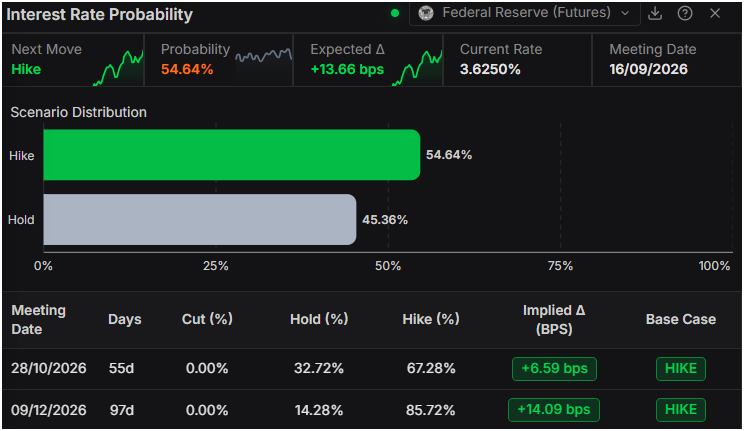
Given the backdrop, but mostly influenced by Waller’s comments, money markets priced in a lower chance that the Federal Reserve will raise interest rates by 25 basis points at the September 16 meeting. The odds stand at 54%, while for holding rates near 46%, according to Prime Terminal.
Ahead, traders eye speeches by Cleveland Fed Beth Hammack and also Friday’s Nonfarm Payrolls for August, which are expected to improve from a -23K contraction to 56K, while the Unemployment Rate is foreseen at 4.1%, unchanged, compared to the previous print.
XAU/USD technical outlook: Gold reclaims $4,400, buyers target 200-day SMA
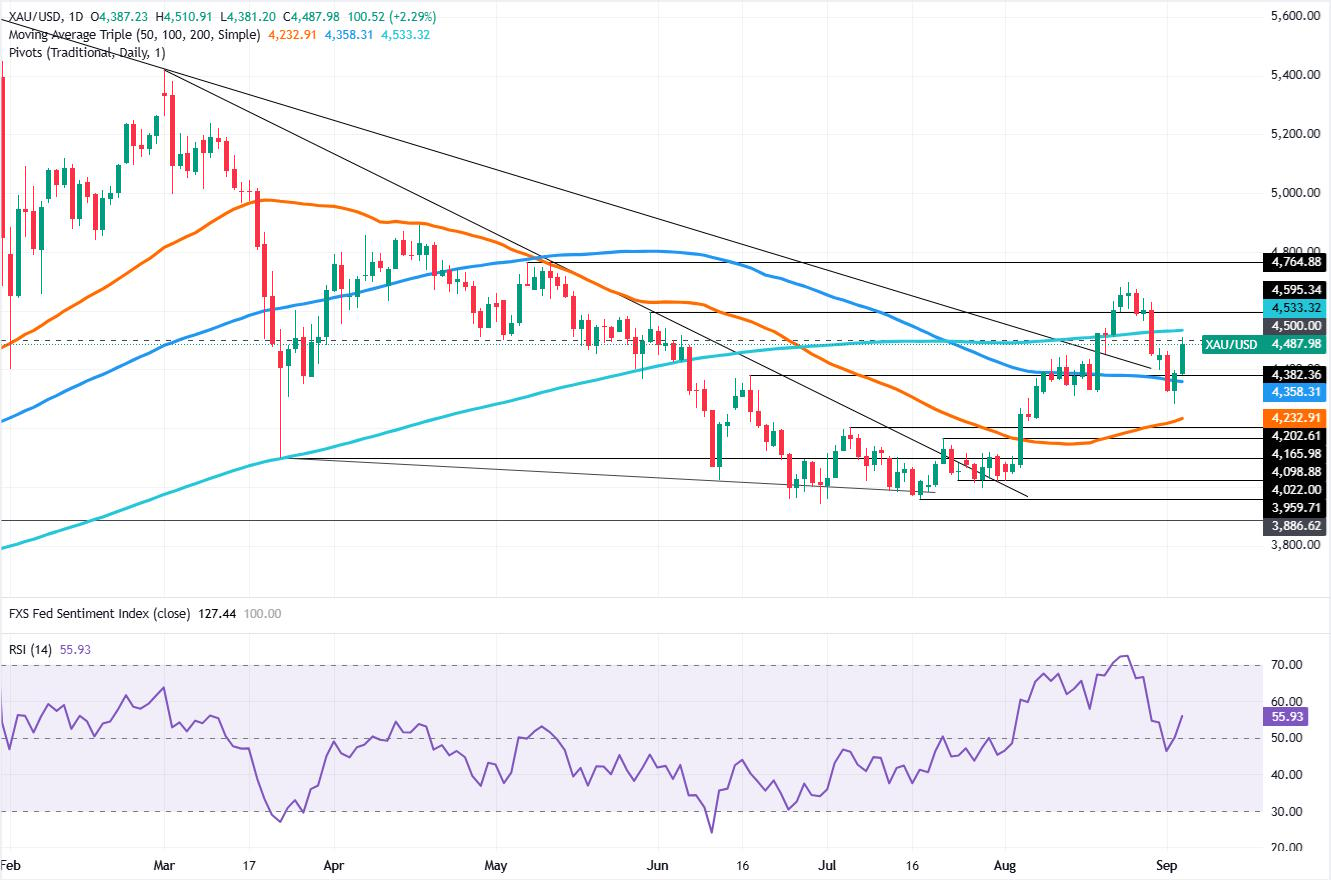
Gold price shifted gears and climbed above the September 1 high of $4,461, further accelerating toward $4,500 as traders stepped in amid broad US Dollar weakness.
Momentum has shifted to moderately bullish as depicted by the Relative Strength Index (RSI). The RSI signals that buyers are gaining strength, an indication that bullion prices might continue to trend higher.
If XAU/USD clears $4,500, the next resistance would be the 200-day Simple Moving Average (SMA) at $4.533. Once surpassed, the next stop is the $4,600 milestone, with the next area to watch being the August monthly high of $4,697.
Downwards, Gold’s first support is the $4,400 mark. Below that is the 100-day SMA at $4,358. On further weakness, the next floor level is $4,300, followed by the 50-day SMA at $4,232.
Gold FAQs
Gold has played a key role in human’s history as it has been widely used as a store of value and medium of exchange. Currently, apart from its shine and usage for jewelry, the precious metal is widely seen as a safe-haven asset, meaning that it is considered a good investment during turbulent times. Gold is also widely seen as a hedge against inflation and against depreciating currencies as it doesn’t rely on any specific issuer or government.
Central banks are the biggest Gold holders. In their aim to support their currencies in turbulent times, central banks tend to diversify their reserves and buy Gold to improve the perceived strength of the economy and the currency. High Gold reserves can be a source of trust for a country’s solvency. Central banks added 1,136 tonnes of Gold worth around $70 billion to their reserves in 2022, according to data from the World Gold Council. This is the highest yearly purchase since records began. Central banks from emerging economies such as China, India and Turkey are quickly increasing their Gold reserves.
Gold has an inverse correlation with the US Dollar and US Treasuries, which are both major reserve and safe-haven assets. When the Dollar depreciates, Gold tends to rise, enabling investors and central banks to diversify their assets in turbulent times. Gold is also inversely correlated with risk assets. A rally in the stock market tends to weaken Gold price, while sell-offs in riskier markets tend to favor the precious metal.
The price can move due to a wide range of factors. Geopolitical instability or fears of a deep recession can quickly make Gold price escalate due to its safe-haven status. As a yield-less asset, Gold tends to rise with lower interest rates, while higher cost of money usually weighs down on the yellow metal. Still, most moves depend on how the US Dollar (USD) behaves as the asset is priced in dollars (XAU/USD). A strong Dollar tends to keep the price of Gold controlled, whereas a weaker Dollar is likely to push Gold prices up.
Recommended Articles


