


AI Optical Communication Trio Comparison: Coherent, Lumentum, AAOI, Which Has More Investment Value?
TradingKey - The impact of the AI computing power race has spread from core components such as GPUs and HBM to optical communications and data center interconnects. As the scale of AI data centers expands, data transmission demands between GPU clusters continue to climb, steadily elevating the strategic importance of 800G and 1.6T high-speed optical modules and related optical components.
Under this trend, Coherent (COHR), Lumentum (LITE), and Applied Optoelectronics (AAOI) are three representative players in the U.S. AI optical communications sector. All three benefit from AI data center construction, but they differ significantly in business scale, product portfolio, and earnings elasticity.
Why AI Data Centers Drive Optical Communication Demand
AI training and inference rely on large-scale GPU clusters working together; the larger the cluster, the more intensive the data exchange between chips. As traditional copper connections face greater challenges in transmission distance, bandwidth, and power consumption, optical communication has become the mainstream solution for high-speed interconnects in AI data centers.
This means that the expansion of AI data centers not only drives demand for GPUs and HBM, but also fuels growth in demand for high-speed optical modules, lasers, and related optical components.
Coherent: Integrated Optical Communications Manufacturer
[Source: TradingView]
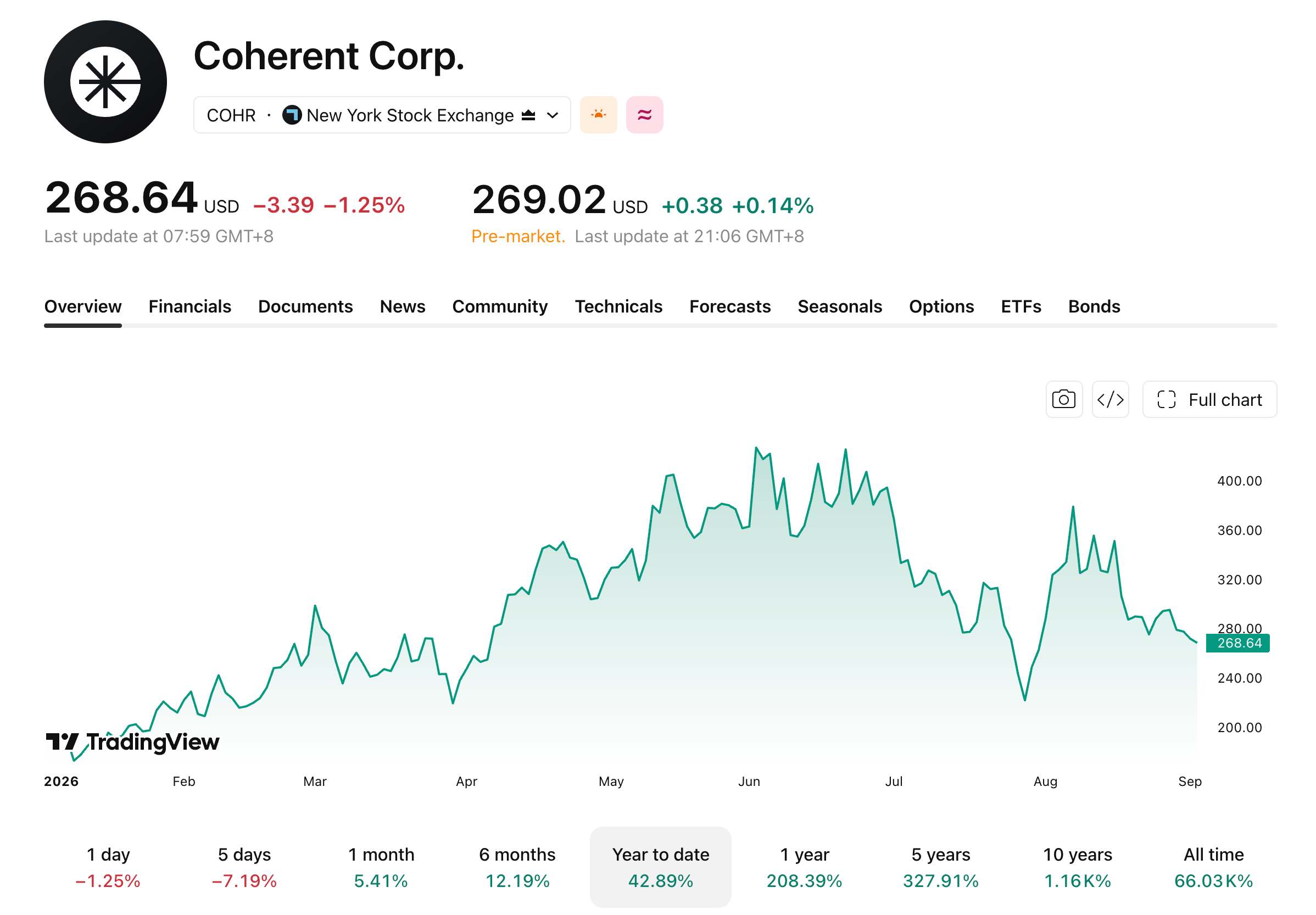
Coherent has the largest business scale and the broadest product coverage among the three companies. In the fourth quarter of fiscal 2026, the company generated revenue of $2.05 billion, up 34% year-over-year to a quarterly record high, with the data center and communications business contributing approximately $1.6 billion, accounting for nearly 80% of the total.
The company expects revenue for the first quarter of fiscal 2027 to be between $2.2 billion and $2.4 billion, and projects single-quarter revenue to exceed $3 billion by the end of fiscal 2027.
Coherent's business spans lasers, optical components, and optical modules, featuring a high degree of vertical integration, with the volume production ramp of its 1.6T products progressing faster than previously expected.
It should be noted that given the company's large scale and its stock gaining more than 200% over the past year, the market has relatively high baseline expectations for its growth rate, meaning an earnings beat may not necessarily continue to push the stock price higher.
Lumentum: High-Speed Optical Communications Resilience Stands Out
[Source: TradingView]
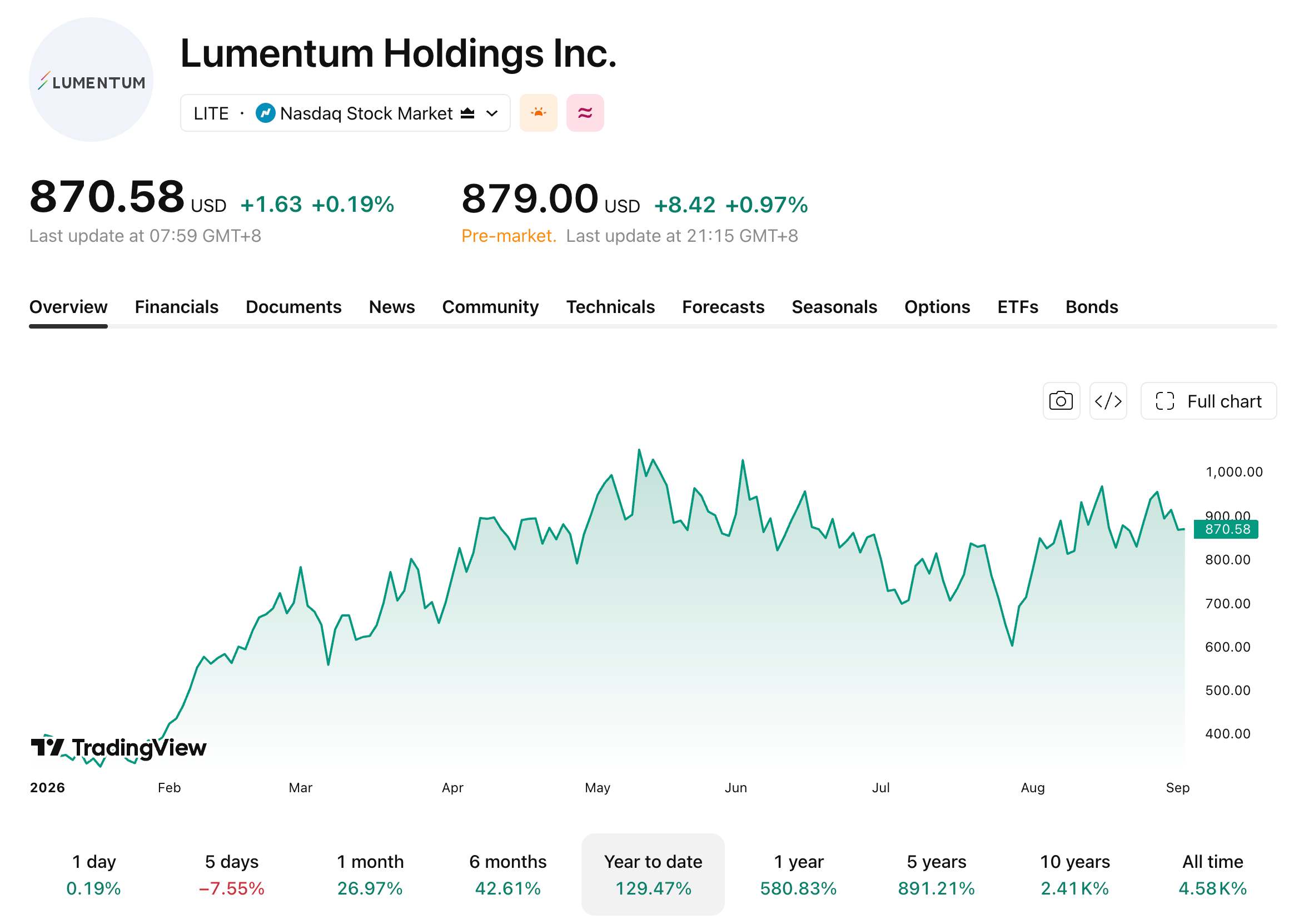
Lumentum has delivered the strongest recent earnings growth among the three companies. In the fourth quarter of fiscal 2026, the company reported revenue of $1.006 billion, up 109% year-over-year; non-GAAP gross margin rose to 50.4%, and non-GAAP EPS was $3.23, all exceeding market expectations.
For the first quarter of fiscal 2027, the company expects revenue of $1.225 billion to $1.275 billion and non-GAAP EPS of $4.05 to $4.35.
Lumentum's core competitiveness lies in high-speed laser devices (EMLs). Shipments of both its 100G and 200G EMLs reached record highs, with 200G EML currently accounting for approximately 25% of the EML product portfolio, supplying 800G optical modules while supporting 1.6T upgrades.
The company has begun delivering 1.6T optical modules, with adoption expected to accelerate in fiscal 2027, and is expanding production capacity in the US and Japan. It should be noted that the pace of capacity expansion, supply chain stability, and high valuation could increase stock price volatility.
AAOI: High Growth Elasticity and High Risk Coexist
[Source: TradingView]
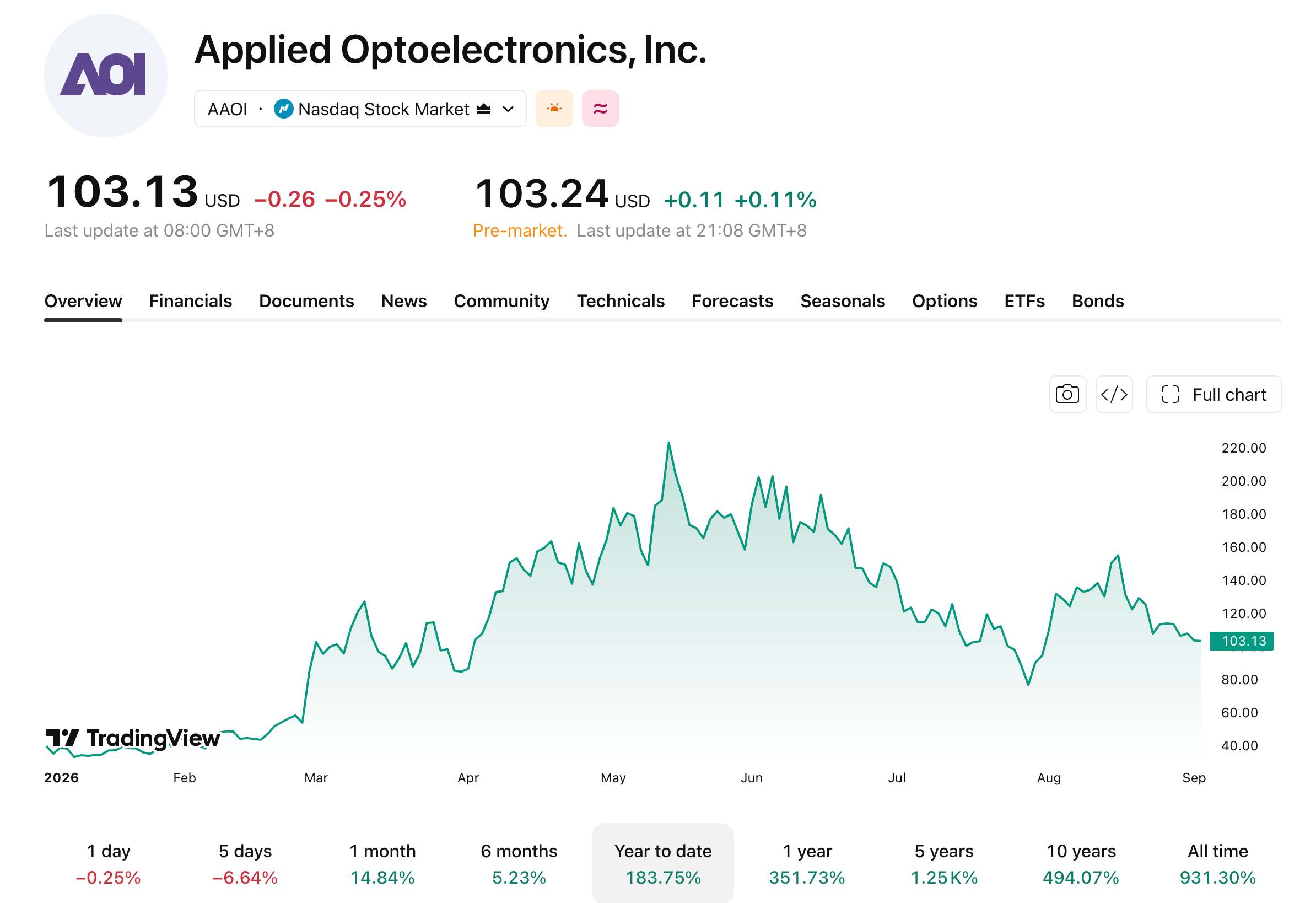
Compared with Coherent and Lumentum, AAOI operates on a smaller scale, making the impact of high-speed optical module volume ramping on its performance more significant. In the second quarter of 2026, the company posted record revenue of $192 million, up 86% year-over-year, and returned to non-GAAP profitability. The company expects third-quarter revenue of $255 million to $290 million.
AAOI has secured over $200 million in 1.6T optical module orders from a major cloud provider, with shipments expected to begin in the third quarter and contribute over $70 million in revenue in the fourth quarter.
In terms of capacity, monthly production capacity for 800G and 1.6T modules is close to 200,000 units, and is expected to increase to approximately 650,000 units by the end of 2026 and exceed 930,000 units by the end of 2027. The main highlight for AAOI is the earnings elasticity driven by the volume ramp-up of 800G and 1.6T modules; however, with high customer concentration and an ongoing capacity expansion phase, its earnings uncertainty and stock price volatility risk are higher than those of Coherent and Lumentum.
Comparison of Three Optical Communication Manufacturers
Company | Core Strengths | Key Highlights in AI Optical Communications | Key Risks |
Coherent | Broad product coverage, relatively large business scale | 800G, 1.6T, high-speed optical interconnects | High baseline for market expectations |
Lumentum | Leading in high-speed optical components and EML technology | 800G, 1.6T, EML, AI data centers | Capacity and supply chain volatility |
AAOI | Small scale, high elasticity | 800G, 1.6T, capacity expansion | High customer concentration, earnings uncertainty |
From a risk-reward perspective, Coherent is more of a comprehensive industry leader, Lumentum focuses more on growth in high-speed optical communications, while AAOI represents a high-elasticity, high-risk target.
Institutional attention is also rising. Deutsche Bank recently initiated coverage on several AI infrastructure hardware companies, assigning "Buy" ratings to both Lumentum and Coherent, and listing them as top picks.
Deutsche Bank analyst Gianmarco Conti believes that AI infrastructure construction is shifting from the first phase of "compute expansion" to the next phase of "connectivity expansion." Whether pluggable optical modules or co-packaged optics (CPO) architectures are adopted in the future, lasers from both companies will remain indispensable core components.
Currently, both companies face strong demand alongside partial supply constraints. In March 2026, Nvidia invested $2 billion each in Lumentum and Coherent, securing procurement commitments for advanced lasers and optical networking products, as well as rights to future production capacity.
Future Key Focus Areas for the Optical Communication Sector
Key metrics to watch for the optical communications sector going forward include 800G shipments, the pace of 1.6T volume ramp, laser supply, CPO commercialization progress, and vendor capacity expansion.
Overall, investors prioritizing scale and diversification can track Coherent; those bullish on high-speed optical components and the 1.6T upgrade cycle may focus on Lumentum; while those seeking higher earnings elasticity can consider AAOI, albeit while taking on higher volatility risk.
The pace of 1.6T penetration, CPO commercialization progress, and shifts in hyperscale data center capital expenditures will serve as key metrics to evaluate the industry's outlook.
Recommended Articles


