


Where Will GE Vernova Be in 10 Years?
Key Points
GE Vernova’s backlog has surged to $176 billion.
Electrification could become GE Vernova’s biggest long-term growth engine.
Nuclear could become a much bigger business by 2036.
- 10 stocks we like better than GE Vernova ›
GE Vernova (NYSE: GEV) was spun off from General Electric a little more than two years ago. By 2036, we'll look back at that breakup as one of the better corporate decisions GE ever made.
If you're unfamiliar, GE Vernova sells gas turbines, wind turbines, nuclear technology, transformers, grid equipment, and the software and services needed to keep much of it running. That means the company doesn't have to predict exactly how the U.S. will generate electricity 10 years from now, because it can make money from nearly all of it. And with electricity demand accelerating, that's a very good business to be in.
Missed Nvidia in 2009? This Rare Signal Is Flashing Again. In 2009, a "Double Down" signal flashed for a little-known chipmaker called Nvidia. For the first time in years, that same "Total Conviction" signal is flashing for a company 1/100th the size of Nvidia. Continue »
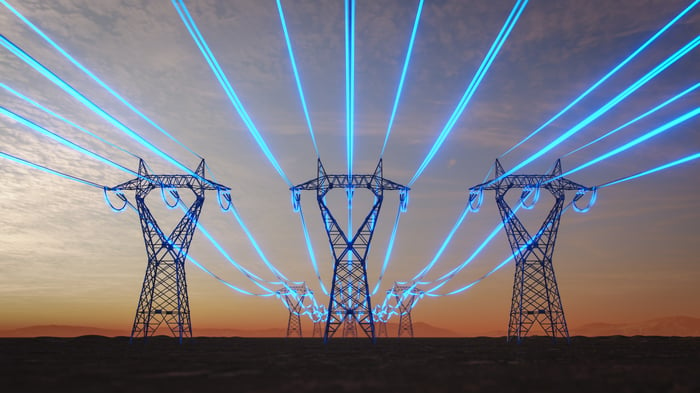
Image source: Getty Images.
The numbers are already getting big
GE Vernova generated $38 billion in revenue in 2025. Management now expects $45.5 billion to $46.5 billion in 2026, representing a pretty dramatic increase in just one year.
More recently, the company ended the second quarter with a huge $176 billion backlog. Orders reached $24.2 billion during the quarter, up 88%, with particularly strong demand coming from the Power and Electrification businesses.
That backlog gives you something many industrial companies don't have: visibility. GE Vernova already has customers lining up years in advance for the equipment they'll need to generate and move electricity. And, of course, artificial intelligence (AI) adds another catalyst.
Data center-related orders exceeded $5 billion during the first half of 2026, more than double the company's total for all of 2025. If AI continues driving the construction of enormous data centers, utilities will need more generating capacity, transformers, substations, switchgear, and transmission equipment. GE Vernova sells all of it.
The natural gas angle
GE Vernova's gas turbine backlog and slot reservations reached 116 gigawatts during the second quarter, up from 100 gigawatts just three months earlier. Management expects that number to reach at least 125 gigawatts by year-end.
The company is responding by expanding annual gas-turbine output from 20 gigawatts in 2026, with plans to reach 30 gigawatts by 2030. GE Vernova has more than 7,000 gas turbines installed worldwide, creating a deep recurring service business, too. Its total services backlog now stands at $88.5 billion. And I suspect that in 10 years, services will account for an even larger share of total revenue.
The grid could be the real winner
Electrification may ultimately become GE Vernova's most important growth engine. Its equipment backlog in that business reached $35 billion in 2025, more than quadrupling in four years. Management expects it to roughly double again by 2028.
This is one of the easiest parts of the GE Vernova thesis to understand. Whether electricity comes from natural gas, solar, wind, or nuclear, somebody still has to move it from the power plant to the customer. The grid needs transformers, switchgear, and high-voltage equipment. GE Vernova supplies those products.
And then there's nuclear
GE Vernova Hitachi's BWRX-300 small modular reactor (SMR) is now under construction in Ontario. The company expects to finish construction on this first SMR by the end of 2029 and begin commercial operations by the end of 2030.
If that project proves SMRs can be built economically and on schedule, GE Vernova could enter the 2030s with another substantial growth business. That's not something I'm factoring heavily into the stock today. But by 2036, nuclear power could be considerably more important to this company than the market currently appreciates.
Not everything will work
GE Vernova's Wind business had a $275 million loss on an adjusted EBITDA (earnings before interest, taxes, depreciation, and amortization) basis during the second quarter, compared with a $165 million loss a year earlier. Wind orders also fell roughly 40%. That's a reminder that growth hasn't been uniform.
The bigger concern, though, is valuation. GE Vernova today isn't the same bargain it was shortly after the 2024 spinoff. But I'm much more interested in what the business could look like in 2036 than what investors are willing to pay for it next quarter. By then, I expect GE Vernova to be a substantially larger company with a much bigger installed base, significantly more recurring service revenue, and major businesses spanning gas, grid infrastructure, and potentially nuclear.
I wouldn't be surprised to see annual revenue well above $70 billion by then. That's my estimate, not management's expectation, and it doesn't require spectacular growth. Going from roughly $46 billion in 2026 to $70 billion in 2036 requires only about 4.3% annualized growth.
The bigger opportunity, though, could come from margins and cash flow. GE Vernova is already targeting a 20% adjusted EBITDA margin by 2028, with revenue of $38 billion and an 8.4% adjusted EBITDA margin in 2025. If management can combine moderate long-term revenue growth with that level of profitability, GE Vernova could generate enormous cash flows during the next decade. And that's ultimately why I'm bullish on the stock for the long haul.
Should you buy stock in GE Vernova right now?
Before you buy stock in GE Vernova, consider this:
The Motley Fool Stock Advisor analyst team just identified what they believe are the 10 best stocks for investors to buy now… and GE Vernova wasn’t one of them. The 10 stocks that made the cut could produce monster returns in the coming years.
Consider when Netflix made this list on December 17, 2004... if you invested $1,000 at the time of our recommendation, you’d have $435,803!* Or when Nvidia made this list on April 15, 2005... if you invested $1,000 at the time of our recommendation, you’d have $1,334,577!*
Now, it’s worth noting Stock Advisor’s total average return is 966% — a market-crushing outperformance compared to 211% for the S&P 500. Don't miss the latest top 10 list, available with Stock Advisor, and join an investing community built by individual investors for individual investors.
See the 10 stocks »
*Stock Advisor returns as of September 3, 2026.
Jeff Siegel has no position in any of the stocks mentioned. The Motley Fool has positions in and recommends GE Vernova. The Motley Fool has a disclosure policy.
Recommended Articles


