


Why Tesla Stock Surged 18% in August -- and Why the Robotaxi Story Is Just Getting Started
Key Points
Market sentiment shifted from robotaxi fleet size and cities toward software development and miles driven under unsupervised robotaxi.
Expectations have now been reset, and positive developments in robotaxi are likely to be better received.
- These 10 stocks could mint the next wave of millionaires ›
Shares in Tesla (NASDAQ: TSLA) rose by 18.2% in August, according to data from S&P Global Market Intelligence. The move comes as the narrative around the stock, notably its robotaxi rollout, improved throughout the month. And the good news is there's a real possibility of more good news flowing in the future.
Tesla's reset of expectations
To be clear, Tesla's second-quarter report released at the end of July wasn't great. A good recovery in electric vehicle (EV) deliveries was accompanied by a strong increase in costs associated with incentivizing sales, robotaxi and Optimus development, commodity costs, and AI initiatives. These costs and an unfavorable EV sales mix (relatively more sales of lower-margin vehicles) led to margin compression.
Missed Nvidia in 2009? This Rare Signal Is Flashing Again. In 2009, a "Double Down" signal flashed for a little-known chipmaker called Nvidia. For the first time in years, that same "Total Conviction" signal is flashing for a company 1/100th the size of Nvidia. Continue »
At the same time, Tesla is ramping capital expenditures, partly to support the ramp in its robotaxi business, and investors are concerned that the rollout isn't progressing as planned.
A change in narrative for Tesla
Narratives matter in investing, and they matter a lot for growth stocks, whose main value-creating events lie ahead. There's a reason why many management teams emphasize underpromising and overdelivering: it often leads to a significant rerating of the stock.
However, in Tesla's case, it's fair to argue that the robotaxi rollout hasn't met the expectations previously laid out by CEO Elon Musk, neither in terms of fleet size nor city deployment. Robotaxis did not cover half the U.S. population by the end of 2025. With only six cities with unsupervised robotaxis (Bay Area robotaxis are supervised) so far in 2026, Tesla looks highly unlikely to be deployed in "dozens of cities, dozens of major cities by the end of the year," as Musk said they would be in January.
That said, it's important to recognize how technologically challenging the rollout is, and the critical need to achieve a level of safety and operational functioning so that its robotaxi, including the dedicated robotaxi, Cybercab, can be scaled. Any scaling of a flawed model will only magnify and increase the absolute number of incidents.
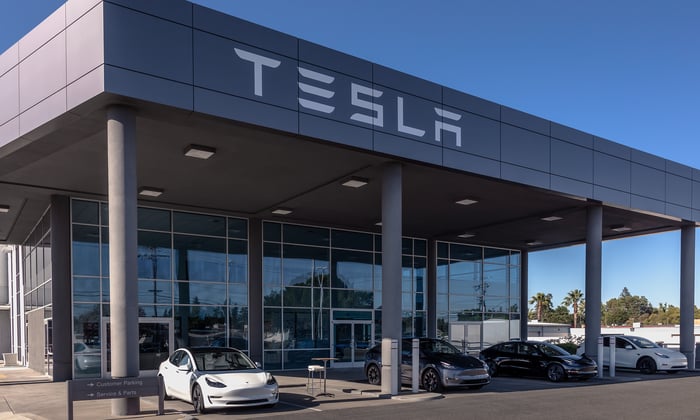
Image source: Tesla.
Moreover, management spent the last two earnings calls redirecting the narrative away from fleet size and city expansions and toward the development of its next major version of full self-driving (FSD) software, v15, and overall miles driven under unsupervised robotaxi operations. All told, the narrative around robotaxis has arguably shifted to focus on v15 and miles driven, rather than fleet size and city deployments.
This change in narrative means it's likely the market will now reward any positive development on robotaxi/Cybercab, and that's exactly what's happened recently.
Positive robotaxi developments
Fortunately, Tesla has had good news to report on it lately:
- Nevada lifted the cap on robotaxi vehicles in Clark County from 10 to 5,000 vehicles in August
- Tesla announced the launch event for the Cybercab, which just took place.
- Safety data on unsupervised robotaxis (updated in mid August and current through mid July) arguably show an exemplary safety record, albeit with a relatively small data set compared to Waymo.
These events helped raise confidence in Tesla's robotaxi rollout, and with expectations now reset, more positive news flow on robotaxi is likely to be rewarded by the market.
Don’t miss this second chance at a potentially lucrative opportunity
Ever feel like you missed the boat in buying the most successful stocks? Then you’ll want to hear this.
On rare occasions, our expert team of analysts issues a “Double Down” stock recommendation for companies that they think are about to pop. If you’re worried you’ve already missed your chance to invest, now is the best time to buy before it’s too late. And the numbers speak for themselves:
- Nvidia: if you invested $1,000 when we doubled down in 2009, you’d have $564,667!*
- Apple: if you invested $1,000 when we doubled down in 2008, you’d have $62,021!*
- Netflix: if you invested $1,000 when we doubled down in 2004, you’d have $435,803!*
Right now, we’re issuing “Double Down” alerts for three incredible companies, available when you join Stock Advisor, and there may not be another chance like this anytime soon.
See the 3 stocks »
*Stock Advisor returns as of September 3, 2026.
Lee Samaha has no position in any of the stocks mentioned. The Motley Fool has positions in and recommends Tesla. The Motley Fool has a disclosure policy.
Recommended Articles


