


If a Stock Market Crash Is Coming, History Says This Is the Smartest Move Investors Can Make
Key Points
The S&P 500 has been climbing this year, even reaching record levels.
Concerns about the economy are brewing -- and these could weigh on stock market performance.
- 10 stocks we like better than S&P 500 Index ›
With the S&P 500 delivering a double-digit gain so far this year and sitting near record levels, you may not be thinking about market crashes right now. Or, just the opposite, you might worry that after such gains, the market may be due for a decline -- and that may even turn into a crash. But, regardless of the current market situation, it's always a good idea to prepare for such happenings. That's because the stock market never rises in a straight line forever, and eventually, a crash will take place.
But here's the good news: Crashes have never lasted forever or permanently damaged the investing landscape. They are a part of the investing story, occurring from time to time, and there are ways you can prepare for them in order to minimize the impact on your portfolio. So, if a stock market crash is coming, don't worry -- history says this is the smartest move investors can make.
Missed Nvidia in 2009? This Rare Signal Is Flashing Again. In 2009, a "Double Down" signal flashed for a little-known chipmaker called Nvidia. For the first time in years, that same "Total Conviction" signal is flashing for a company 1/100th the size of Nvidia. Continue »

Image source: Getty Images.
Today's market environment
Before diving in, let's take a look at the current market environment. Stocks have soared as investors cheered outstanding corporate earnings and piled into the artificial intelligence (AI) players that have driven this bull market. AI has fueled the S&P 500 and other major indexes over the past three years on optimism about the technology's potential to transform the way business is done -- and generate gains in efficiency and revenue for companies across industries.
In the most recent quarter, S&P 500 companies delivered a 52% earnings growth rate, the highest since the second quarter of 2021, according to FactSet Insight. And players in the AI space continued to offer the same message they delivered in recent quarters: Demand for AI remains high. This has translated into tremendous growth for those offering AI products and services, such as chip leader Nvidia and cloud giant Amazon.
Amid this excitement, though, economic concerns are brewing. President Donald Trump's tariffs and the conflict in Iran have driven inflation higher, and investors worry that the Federal Reserve may soon increase interest rates to favor price stability. The CME Group FedWatch tool shows a 67% probability that the Fed will lift rates during its September meeting.
Though the corporate earnings picture and AI story remain bright, these economic factors could weigh on appetite for stocks -- and push the S&P 500 lower.
What you can do now
Before you worry about that scenario, or even a potential market crash on the way, let's talk about what you can do as of right now to protect your portfolio. The smartest move investors can make is to continue investing throughout all market environments. This doesn't mean you should buy poor-quality stocks or companies trading at ridiculously high valuations. Instead, what's important to note is that the opportunity to find a great stock for a reasonable price always exists -- in bull markets, bear markets, and particularly during market crashes, as many investors flee the market.
If you sell positions at the start of a crash, you may avoid a short-term loss (at least on paper), but history shows us you could miss out on a major longer-term gain. For example, tech giant Amazon slipped during the coronavirus market crash in March of 2020, but it went on to deliver fantastic returns later in the year and over the long term.
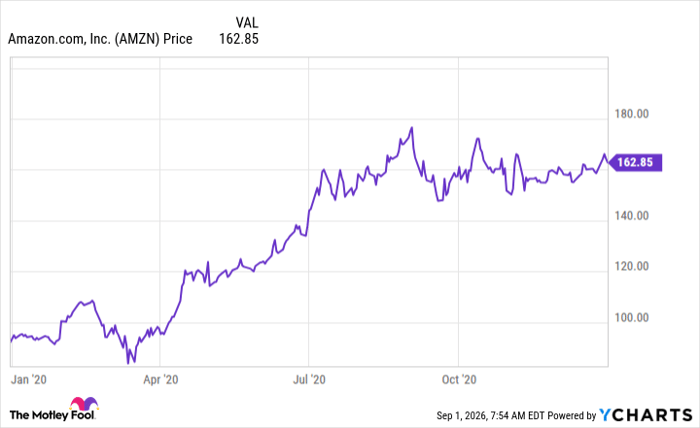
AMZN data by YCharts
The importance of time
It's important to remember that the most significant stock market wins happen over a period of years -- not a few weeks or months. In fact, even investing at what may be seen as the worst possible time, right before a market crash, has resulted in gains over time, according to history.
An investment on Oct. 9, 2007, ahead of the global financial crisis would have resulted in a 109% cumulative return over the following 10 years, and an investment on Feb. 19, 2020, ahead of the coronavirus market crash would have resulted in a 25% increase over the year to follow, Daniel Prince, U.S. head of product at iShares, wrote in a note.
So, selling quality stocks and avoiding the market in general could be a big mistake ahead of or during a market crash. History shows us that the one thing that supports success over time is the decision to remain in the market throughout its various phases and pick up stocks when opportunity arises -- as mentioned, this can happen at any time, and you'll only be able to take advantage of it if you're present.
All of that means that, if a stock market crash is coming, the smartest move you can make is to keep investing and hold on for the long term.
Should you buy stock in S&P 500 Index right now?
Before you buy stock in S&P 500 Index, consider this:
The Motley Fool Stock Advisor analyst team just identified what they believe are the 10 best stocks for investors to buy now… and S&P 500 Index wasn’t one of them. The 10 stocks that made the cut could produce monster returns in the coming years.
Consider when Netflix made this list on December 17, 2004... if you invested $1,000 at the time of our recommendation, you’d have $435,803!* Or when Nvidia made this list on April 15, 2005... if you invested $1,000 at the time of our recommendation, you’d have $1,334,577!*
Now, it’s worth noting Stock Advisor’s total average return is 966% — a market-crushing outperformance compared to 211% for the S&P 500. Don't miss the latest top 10 list, available with Stock Advisor, and join an investing community built by individual investors for individual investors.
See the 10 stocks »
*Stock Advisor returns as of September 3, 2026.
Adria Cimino has positions in Amazon. The Motley Fool has positions in and recommends Amazon and Nvidia. The Motley Fool has a disclosure policy.
Recommended Articles


