


If a Bear Market Starts Tomorrow, Here's the 1 Move That History Says Always Wins Out
Key Points
The S&P 500 has delivered 10% annualized returns since 1928, overcoming world-historic crises.
Investors who are worried about high valuations in S&P 500 tech stocks might want to consider small-cap or mid-cap ETFs.
The State Street SPDR S&P Midcap 400 ETF Trust has delivered 11.3% annualized returns since 1995.
- These 10 stocks could mint the next wave of millionaires ›
The S&P 500 index (SNPINDEX: ^GSPC) reached an all-time high in August, but many investors are feeling antsy. One widely watched valuation metric, the Shiller CAPE ratio, suggests that the benchmark index is historically expensive, which could be a warning sign for a new dot-com-style stock market crash and a prolonged bear market.
U.S. stocks have been on a strong run for the past 17 years. Ever since the depths of the Great Recession in January 2009, the S&P 500 has delivered a total return of 1,090%. Can this strong bull market possibly continue much longer? Anyone who follows the markets knows that good times don't last forever.
Missed Nvidia in 2009? This Rare Signal Is Flashing Again. In 2009, a "Double Down" signal flashed for a little-known chipmaker called Nvidia. For the first time in years, that same "Total Conviction" signal is flashing for a company 1/100th the size of Nvidia. Continue »
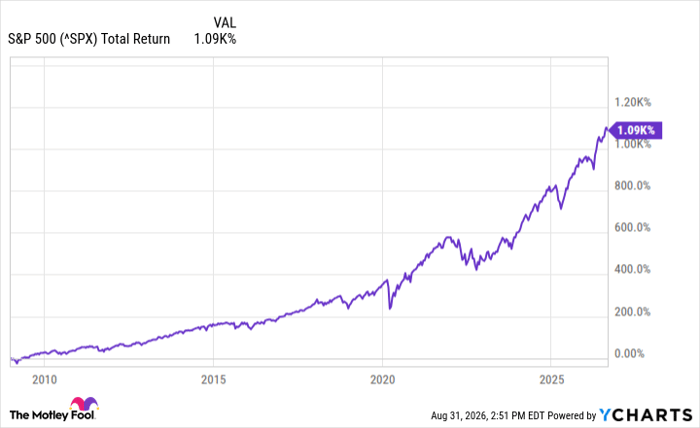
^SPX data by YCharts.
Here's the biggest lesson of stock market history: Long-term investors tend to win. If you can avoid the temptation to speculate or time the market -- if you buy a diversified portfolio of quality stocks and leave your money alone to grow for five to 10 years or more -- you're likely to keep building wealth. That holds true even if there is a big stock market crash and a bear market that starts tomorrow, and even if you invest at what feels like the worst possible time.
Let's look at the big picture of how long-term investors can position themselves for success today.

Image source: Getty Images.
S&P 500: Average annual return of 10% for (almost) 100 years
Since 1928, the S&P 500 has delivered 10% average annual returns. That long-term average includes some of the worst events in human history, including World War II and the Great Depression. Even though terrible things were happening in the economy and in everyday life, in the long run, companies figured out how to adapt and innovate. People were resilient and creative. The economy healed, grew, and unleashed new wealth and opportunities.
In recent years, the S&P 500 has delivered even richer returns than this long-term average. The Vanguard S&P 500 ETF (NYSEMKT: VOO), an exchange-traded fund that tracks the index, has delivered annualized returns of about 15% in the 16 years since its inception in September 2010, and a one-year return of more than 19.5%. In that light, 10% annualized returns might not seem so impressive. But that 10% rate is enough to get rich from steady, long-term investing. If you keep investing $600 per month in stocks that earn a 10% average annual return, after 30 years, you'll have $1.18 million.
Diversifying away from tech stocks and the AI trade
If you are worried that trillion-dollar tech giants make up an outsized percentage of the S&P 500, or that artificial intelligence (AI) stocks have gotten overhyped, you might want to diversify your portfolio beyond the S&P 500. One way to do this is to buy stocks of smaller companies -- specifically ETFs that focus on like mid-cap and small-cap stocks.
The State Street SPDR S&P Midcap 400 ETF Trust (NYSEMKT: MDY) holds 400 mid-sized company stocks, and only 14.5% of the fund is invested in tech stocks. This mid-cap ETF has delivered average annual returns (by net asset value) of 11.3% for the past 31 years, and about 20.5% in the past year.
Want to go even smaller? The Vanguard Russell 2000 ETF (NASDAQ: VTWO) is a low-cost small-cap ETF that tracks the Russell 2000 index. This Vanguard ETF holds 1,997 stocks of small-cap companies with a median market cap of $3.6 billion. It has delivered average annual returns (by net asset value) of 11.3% since September 2010, and a whopping 34.25% return in the past year.
What investors should do before the next bear market starts
What if there's an artificial intelligence (AI) bubble that bursts? What if stocks go down 20% in 2027? What if we're about to start a scary, years-long bear market?
Well ... if you're a long-term investor, you shouldn't worry too much. Buying a low-cost S&P 500 ETF like VOO is a good choice for many people. Just "set it and forget it," and let the stock market do what it does. Stay focused on living your life, earning money, saving money, and buying more stocks at every payday.
If you want to diversify your money into a few different parts of the stock market, like small-cap and mid-cap stocks, now could be a good chance. If you're worried that the large-caps of the S&P 500 are overvalued and due for a sell-off, these smaller companies might have more room to grow.
Where to invest $1,000 right now
When our analyst team has a stock tip, it can pay to listen. After all, Stock Advisor’s total average return is 978%* — a market-crushing outperformance compared to 213% for the S&P 500.
They just revealed what they believe are the 10 best stocks for investors to buy right now, available when you join Stock Advisor.
See the stocks »
*Stock Advisor returns as of September 1, 2026.
Ben Gran has no position in any of the stocks mentioned. The Motley Fool has positions in and recommends Vanguard S&P 500 ETF. The Motley Fool has a disclosure policy.
Recommended Articles


