


A Rate Move Helps One Half of a Bank's Balance Sheet and Hurts the Other. Here's What It Does to the Stock.
Key Points
Interest rate hikes benefit banks when the yield curve is steep.
However, while rate hikes are helpful for net interest income, they're less helpful for other bank businesses, such as investment banking.
- These 10 stocks could mint the next wave of millionaires ›
The common belief is that higher interest rates are good for bank stocks.
While that's not technically incorrect, there's more nuance to it. Yes, higher rates can help banks, but only under the right circumstances. Additionally, they only help what is typically one-half or a significant portion of a bank's revenue, a line item called net interest income (NII).
Missed Nvidia in 2009? This Rare Signal Is Flashing Again. In 2009, a "Double Down" signal flashed for a little-known chipmaker called Nvidia. For the first time in years, that same "Total Conviction" signal is flashing for a company 1/100th the size of Nvidia. Continue »
Net interest income is essentially the spread banks make from the interest they pay on deposits and other interest-bearing liabilities and the interest they earn on loans and other interest-earning assets.
Here's what higher rates do for bank stocks.

Image source: Getty Images.
When higher rates actually help bank stocks
Higher rates help banks, but only in certain circumstances.
The typical way banks generate NII is by borrowing short-term money and lending it out long-term. This refers to a steep yield curve, in which the yields on shorter-duration bonds are lower than those on longer-duration bonds.
Yields are correlated to all sorts of financial assets, such as loan and deposit rates.
However, interest rates can rise on both ends of the yield curve. In fact, following the COVID-19 pandemic, the U.S. economy experienced the longest inverted yield curve in history, with short-term rates surpassing longer-term rates.
If you think about it literally, banks would be paying higher rates on shorter-term deposits than they'd be earning on longer-term loans.
Not only has an inverted yield curve historically predicted a recession, which would likely lead to higher loan losses for banks, but it has also disrupted bank balance sheets, particularly after the pandemic.
During the pandemic, there was an ultra-low-interest-rate environment. Banks had excess deposits to put to work, so many banks purchased longer-dated bonds that yielded more. But when the Federal Reserve had to raise interest rates quickly to rein in inflation, which jumped to 9% in 2022, those bond positions fell deeply underwater.
The situation reached a boiling point in 2023, when several banks experienced deposit runs, forcing them to sell bonds at a loss and thereby destroy equity. So, as you can see, higher interest rates aren't always good for bank stocks; it's about the shape of the yield curve.
One other thing to understand is that banks run many different kinds of businesses aside from lending. There's investment banking, wealth management, payments, and more.
Higher interest rates can stunt mortgage demand and freeze the capital markets, which are responsible for a lot of investment banking activity. Higher rates, particularly on a steep yield curve, specifically benefit NII for most banks.
How higher rates impact bank stocks
As you can see, bank stocks are at some of their highest levels since the Great Recession.
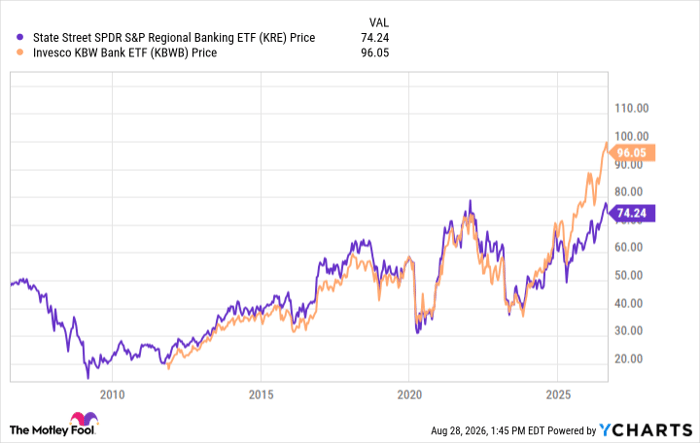
KRE data by YCharts
That also coincides with a steepening yield curve.
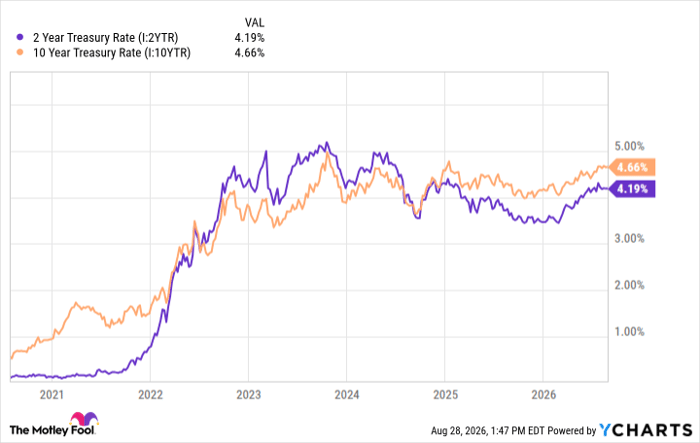
2 Year Treasury Rate data by YCharts
The banking business is cyclical and heavily tied to the economy because they lend to consumers and just about every sector in the economy across different lending categories, from residential to commercial to equipment lending.
So, while the yield curve is important, bank investors must also understand what's driving it. This year, longer-term yields have soared due to inflation from the Iran war, as well as concerns about the ever-growing U.S. national debt.
It's also worth pointing out that the longer interest rates remain high, especially in the world we live in today, where asset prices have ballooned, the greater chance the economy could tip into a recession, which would likely cause investors to sell bank stocks due to fears of higher loan losses.
Longer-term yields rising due to expected economic expansion is a good thing for bank stocks, while yields up on debt and recessionary concerns are a negative.
So, in general, rising interest rates on a steep yield curve should lift bank stocks.
But what if concerns about runaway debt, higher inflation expectations, and a lack of response from the Fed lead to soaring long-term yields? Even if the yield curve remains steep, it's not a guarantee that bank stocks will perform well, because other doubts are likely to creep into investors' minds.
Like most investing topics, very little is black and white.
Where to invest $1,000 right now
When our analyst team has a stock tip, it can pay to listen. After all, Stock Advisor’s total average return is 978%* — a market-crushing outperformance compared to 213% for the S&P 500.
They just revealed what they believe are the 10 best stocks for investors to buy right now, available when you join Stock Advisor.
See the stocks »
*Stock Advisor returns as of September 1, 2026.
Bram Berkowitz has no position in any of the stocks mentioned. The Motley Fool has no position in any of the stocks mentioned. The Motley Fool has a disclosure policy.
Recommended Articles


