


Prediction: This Investment Could Crush the Market Over the Next 20 Years
Key Points
The VanEck Semiconductor ETF has an average annualized return of 32% over the past 10 years.
With the AI boom in its early stages, it should continue to generate market-beating returns for years to come.
- 10 stocks we like better than VanEck ETF Trust - VanEck Semiconductor ETF ›
Where will the markets be in 20 years? It is hard to make even educated guesses, given how rapidly the artificial intelligence (AI) computing revolution is changing how so many organizations do business and how so many people live their lives. What makes it even harder is that AI is just in the early stages of its impact.
If I were going to make a few bets on an investment 20 years out, I'd probably invest in an S&P 500 ETF for broad exposure to large caps. I'd also probably stay invested in the MarketDesk Focused US Momentum ETF (NASDAQ: FMTM), an actively managed quant fund that seeks out stocks with the most momentum, even during downturns.
Missed Nvidia in 2009? This Rare Signal Is Flashing Again. In 2009, a "Double Down" signal flashed for a little-known chipmaker called Nvidia. For the first time in years, that same "Total Conviction" signal is flashing for a company 1/100th the size of Nvidia. Continue »
I'd also have a few more diversifiers, maybe a dividend-income fund, an international ETF, and perhaps a value fund. But for pure alpha, I would strongly consider the VanEck Semiconductor ETF (NASDAQ: SMH).
This ETF has blown away the S&P 500, the Nasdaq Composite, and all of the other major tech and growth-oriented ETFs on the market across the past 15 years, and it is well-positioned to maintain its dominance.

Image source: Getty Images.
The picks and shovels of the AI gold rush
Semiconductors have been the technology that has benefited most from the AI revolution. Semiconductor chips are the picks and shovels of the AI boom, meaning they are a necessary component to enable AI computing. Without them, hyperscalers building AI infrastructure can't adequately process the data and information required for AI computing.
And because of the incredibly high demand for this technology, supply is tight, which drives up demand, margins, and prices -- all benefiting chip stocks. Furthermore, there are many different types of chipmakers needed for various AI-related tasks. There are CPU and GPU makers like Intel and Nvidia, memory and storage chip stocks like Micron Technology and Sandisk, chip foundries and equipment makers like Taiwan Semiconductor Manufacturing and ASML, and networking chip manufacturers like Broadcom, to name a few.
And as AI computing expands beyond big tech to smaller companies and throughout all of the sectors of the economy, demand will only increase. New AI innovations will require new chip solutions, likely expanding the need for semiconductor chips even more.
The names may change over the next 20 years, but semiconductor stocks should remain the picks and shovels for the AI gold rush.
VanEck has blown away the competition
The VanEck Semiconductor ETF has capitalized on this high demand with its portfolio of only semiconductor stocks.
The top three holdings are Nvidia, Taiwan Semiconductor, and Broadcom. It only holds 26 stocks, so it is highly concentrated and should only represent a relatively small percentage of your overall portfolio due to the short-term volatility it will experience.
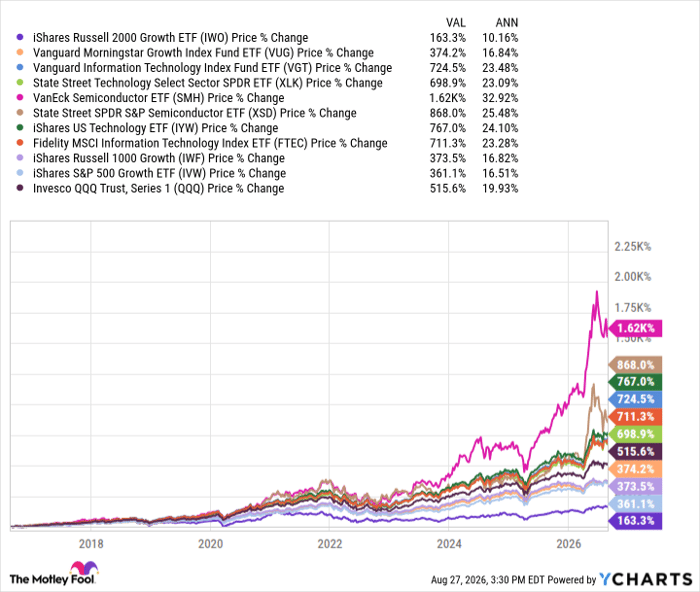
Data by YCharts.
But over the longer term, like a 10- or 20-year period, this ETF's highs should outweigh its lows.
Over the past 10 years, it has posted an average annualized return of about 32%, which beats all major ETF competitors, as the above chart shows. This year alone, it has returned about 58% year to date as of Aug. 27.
With AI expected to continue to transform economies over the next decade or more, the highly concentrated VanEck Semiconductor ETF should continue to generate high long-term returns that outperform the competition.
Should you buy stock in VanEck ETF Trust - VanEck Semiconductor ETF right now?
Before you buy stock in VanEck ETF Trust - VanEck Semiconductor ETF, consider this:
The Motley Fool Stock Advisor analyst team just identified what they believe are the 10 best stocks for investors to buy now… and VanEck ETF Trust - VanEck Semiconductor ETF wasn’t one of them. The 10 stocks that made the cut could produce monster returns in the coming years.
Consider when Netflix made this list on December 17, 2004... if you invested $1,000 at the time of our recommendation, you’d have $440,710!* Or when Nvidia made this list on April 15, 2005... if you invested $1,000 at the time of our recommendation, you’d have $1,335,252!*
Now, it’s worth noting Stock Advisor’s total average return is 978% — a market-crushing outperformance compared to 213% for the S&P 500. Don't miss the latest top 10 list, available with Stock Advisor, and join an investing community built by individual investors for individual investors.
See the 10 stocks »
*Stock Advisor returns as of August 30, 2026.
Dave Kovaleski has positions in Ea Series Trust - MarketDesk Focused U.s. Momentum ETF and Micron Technology. The Motley Fool has positions in and recommends ASML, Broadcom, Intel, Micron Technology, Nvidia, Taiwan Semiconductor Manufacturing, and Vanguard Morningstar Growth ETF. The Motley Fool has a disclosure policy.
Recommended Articles


