


Forget the Cloud: Apple's Latest Mac Upgrades Prove It's the Quiet AI Winner
Key Points
Apple just upgraded its Mac Mini and Mac Studio computers with new processors and better AI processing.
The company has not been participating in the massive AI spending spree that is dominating much of the tech industry right now.
Apple's focus on creating high-performance consumer devices for AI is winning the company a niche in the AI market.
- 10 stocks we like better than Apple ›
Most of Wall Street is hyper-focused on the tech companies that are building out data center capacity for artificial intelligence computing.
And there's nothing wrong with betting on the AI cloud. Microsoft has been a huge winner in this space, with AI fueling its Azure revenue growth -- which reached $100 billion annually in its fiscal 2026.
Missed Nvidia in 2009? This Rare Signal Is Flashing Again. In 2009, a "Double Down" signal flashed for a little-known chipmaker called Nvidia. For the first time in years, that same "Total Conviction" signal is flashing for a company 1/100th the size of Nvidia. Continue »
But Apple (NASDAQ: AAPL) is taking a decidedly different approach to AI. The company's latest upgrades to its Mac Mini and Mac Studio computers are a potentially lucrative bet on the deskside AI market in which developers scoop up powerful computers to run their own artificial intelligence software and agents.
And by focusing on what it does best -- selling powerful, high-margin devices to consumers -- Apple is quietly benefiting from the AI boom without spending hundreds of billions of dollars on data center build-outs.
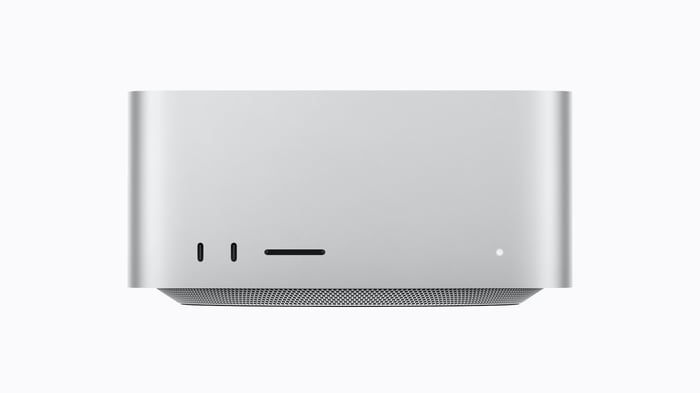
Image source: Apple.
Apple's deskside AI revolution
If you're unfamiliar with the term, deskside AI refers to developers and companies using powerful computers to build AI agents and AI software and power them locally on their own computers, rather than outsourcing those workloads to servers in the cloud.
The benefits of doing so are that it's cheaper than paying per-token rates for running AI models, can deliver faster performance, and it allows developers to maintain more privacy over their AI projects.
And for Apple, providing deskside AI has been a quiet success story. Its Mac Minis and Mac Studios have been in demand since the AI boom took off, with developers clamoring for their own devices upon which to produce AI software. The proliferation of open-weight AI models -- which can be downloaded and run on personal computers -- has added more fuel to that demand.
Apple was already having a difficult time keeping up with demand, with many of its Mac Mini and Mac Studio models on a several-week delivery delay. And then the company upgraded its computers to make them even more powerful, with enhanced focus on their AI capabilities.
Apple said in a recent press release that its new Mac Mini allows users to "tackle more advanced AI workflows like photo and video upscaling, and running large diffusion models faster than ever," and the new Mac Studio delivers a "monumental leap in AI performance."
Apple says the new M6 Mac Mini delivers up to 4 times faster AI performance and 4.8 times faster LLM prompt processing than previous models. And the company's new M5 Ultra Mac Studio achieves up to 4 times faster LLM prompt processing than its M3 predecessor. Apple says the new Mac Studios can handle "AI inference with frontier-class models."
In short, the recent upgrades to the Studio and Mini show that Apple is leaning into its position as an important deskside AI player, and its marketing these devices as integral to AI development.
Apple's approach to AI is paying off
Apple's peers have gone all-in on building AI data centers and developing their own AI models, with an estimated $1 trillion or more expected to be spent next year alone on AI infrastructure.
Apple has, instead, doubled down on its long-standing approach of selling high-end devices to customers. And that approach is working.
Even large companies are seeing the advantages of using Macs for their AI needs/ For example, Apple noted on its recent earnings call that Disney's creative teams are "increasingly turning to Mac for on-device AI workflows that reduce overall cloud token costs and keep their IP secure."
Apple's Mac sales rose 29% to $10.4 billion in its fiscal third quarter, and the company's product gross margins were 40%. While other tech companies are burning through cash to build out AI, Apple is creating a sticky, high-margin AI business that's attracting both small and large customers.
And the latest Mac Mini and Mac Studio upgrades could drive further growth in Apple's Mac business as customers seek the most capable devices to run their AI.
Should you buy stock in Apple right now?
Before you buy stock in Apple, consider this:
The Motley Fool Stock Advisor analyst team just identified what they believe are the 10 best stocks for investors to buy now… and Apple wasn’t one of them. The 10 stocks that made the cut could produce monster returns in the coming years.
Consider when Netflix made this list on December 17, 2004... if you invested $1,000 at the time of our recommendation, you’d have $439,308!* Or when Nvidia made this list on April 15, 2005... if you invested $1,000 at the time of our recommendation, you’d have $1,286,826!*
Now, it’s worth noting Stock Advisor’s total average return is 964% — a market-crushing outperformance compared to 212% for the S&P 500. Don't miss the latest top 10 list, available with Stock Advisor, and join an investing community built by individual investors for individual investors.
See the 10 stocks »
*Stock Advisor returns as of August 28, 2026.
Chris Neiger has positions in Apple. The Motley Fool has positions in and recommends Apple, Microsoft, and Walt Disney. The Motley Fool has a disclosure policy.
Recommended Articles


