


Billionaire Ken Griffin Is Shifting His AI Bets. Here's What He's Buying and Selling.
Key Points
Amazon Web Services had its fastest growth in more than four years in the latest quarter.
Microsoft generated $19.6 billion in free cash flow in the fourth quarter of fiscal 2026.
Griffin's Citadel funds sold shares in several other top AI companies, including Nvidia, Broadcom, and Micron.
- These 10 stocks could mint the next wave of millionaires ›
Ken Griffin is one of the best-known investors in the world, having founded the hedge fund Citadel Advisors in 1990 and turnng it into one of the world's largest investment firms. Citadel currently has about $77 billion in assets under management and is one of the most profitable hedge funds of all time based on net gains since inception.
Citadel has a vast portfolio with more than 6,500 holdings, so it's interesting to get a glimpse of which companies it's most bullish on and which it's selling. One thing that I'm struck by from the most recent Form 13F with the Securities and Exchange Commission is a shift in Griffin's artificial intelligence (AI) investing strategy.
Missed Nvidia in 2009? This Rare Signal Is Flashing Again. In 2009, a "Double Down" signal flashed for a little-known chipmaker called Nvidia. For the first time in years, that same "Total Conviction" signal is flashing for a company 1/100th the size of Nvidia. Continue »
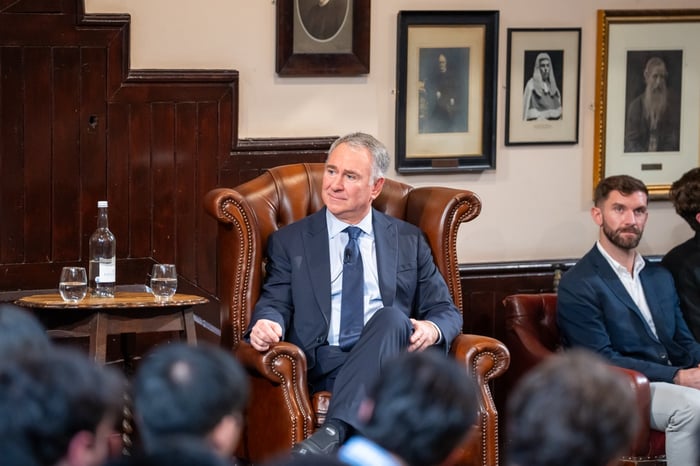
Citadel founder and CEO Ken Griffin. Image source: Getty Images.
Griffin sold 6.8 million shares of Nvidia stock in the second quarter, lowering Citadel's exposure by 36%. And he sold nearly 11% of his Broadcom stock (356,000 shares) and 4 million shares of Micron Technology (87% of Citadel's shares).
In the same quarter, he added to Citadel's position in two key AI stocks that are proving to be early winners in the "show-me" phase of the AI build-out. Those companies are Amazon (NASDAQ: AMZN) and Microsoft (NASDAQ: MSFT), both of which are top five holdings in Citadel's portfolio.
Let's look at what Amazon and Microsoft are doing well and possibly why they've attracted Griffin's attention.
|
Citadel Top Five Holdings |
Percentage of Portfolio |
Shares Owned |
Value |
Q2 Activity |
|---|---|---|---|---|
|
iShares Core S&P 500 |
7.6% |
17.7 million |
$13.2 billion |
Purchased 13.6 million shares |
|
Amazon |
1.49% |
10.9 million |
$2.6 billion |
Purchased 2.8 million shares |
|
Nvidia |
1.36% |
11.8 million |
$2.4 billion |
Sold 6.8 million shares |
|
Apple |
1.21% |
7.3 million |
$2.1 billion |
Bought 2.1 million shares |
|
Microsoft |
0.81% |
3.8 million |
$1.4 billion |
Bought 1.1 million shares |
Data source: Hedgefollow.com. Data as of June 30, 2026.
Amazon's AI investments are paying off
I'll confess -- I wasn't hugely bullish on Amazon at the beginning of the year. I ranked it near the bottom of my list of best "Magnificent Seven" stocks to buy because I thought the skimpy profit margins on the e-commerce side of the business would drag Amazon stock down this year.
But Jeff Bezos and Andy Jassy showed they know what they're doing. Amazon Web Services recorded its fastest growth in more than four years, and the company's AI business topped an annual run rate of $25 billion. In addition, Amazon's chips business, which includes custom-built Trainium AI chips that Amazon is using as an alternative to Nvidia GPUs, also achieved a $25 billion annual run rate.
Amazon's revenue in the quarter topped $200 billion, up nearly 20% from a year ago, and AWS generated $16.6 billion in operating income, which was up from $10.2 billion a year ago.
Microsoft is building an AI powerhouse while staying cash-positive
One of the biggest challenges for big tech companies right now is paying billions for data centers, hardware, and connectivity to build out AI infrastructure without going deep into debt. Major hyperscalers have committed to spending $760 billion this year and are expected to increase that to more than $1 trillion next year.
Microsoft is one of those spending a lot -- it projected it would pay $175 billion this calendar year -- but so far, it's managing to thread the needle. The company reported in its most recent earnings report (for the fourth quarter of fiscal 2026 ended June 30) that it had $19.6 billion in free cash flow. Even better, the company expects to remain free cash flow positive in fiscal 2027.
Overall revenue was $90 billion, up 18% from a year ago, and Microsoft Azure topped $100 billion in revenue for the fiscal year for the first time.
Citadel's AI bets are paying off
Even though Griffin and Citadel sold Nvidia, Micron, and Broadcom in the quarter, Griffin is far from bearish on AI in general. After all, Nvidia is still a top-five holding.
However, Amazon and Microsoft's success in their most recent quarters shows that the market is rewarding companies that are demonstrating results in their AI spending. And Citadel's Q2 purchases have paid off nicely, as Amazon and Microsoft are up 15% and 27%, respectively, since reporting earnings in late July.
Don’t miss this second chance at a potentially lucrative opportunity
Ever feel like you missed the boat in buying the most successful stocks? Then you’ll want to hear this.
On rare occasions, our expert team of analysts issues a “Double Down” stock recommendation for companies that they think are about to pop. If you’re worried you’ve already missed your chance to invest, now is the best time to buy before it’s too late. And the numbers speak for themselves:
- Nvidia: if you invested $1,000 when we doubled down in 2009, you’d have $544,464!*
- Apple: if you invested $1,000 when we doubled down in 2008, you’d have $59,793!*
- Netflix: if you invested $1,000 when we doubled down in 2004, you’d have $439,308!*
Right now, we’re issuing “Double Down” alerts for three incredible companies, available when you join Stock Advisor, and there may not be another chance like this anytime soon.
See the 3 stocks »
*Stock Advisor returns as of August 28, 2026.
Patrick Sanders has positions in Nvidia. The Motley Fool has positions in and recommends Amazon, Apple, Broadcom, Micron Technology, Microsoft, and Nvidia. The Motley Fool has a disclosure policy.
Recommended Articles


