


GE Aerospace's LEAP Engine Deliveries Jumped 41% This Year. Here's Why Boeing and Airbus Both Need That Number to Keep Climbing.
Key Points
An increased pace of LEAP engine deliveries is crucial for Boeing and Airbus as they ramp up their aircraft production.
Order backlogs for the most widely used jets remain high, and engine supply is a key bottleneck controlling the pace of new aircraft deliveries.
- 10 stocks we like better than Boeing ›
GE Aerospace's (NYSE: GE) joint venture with France's Safran, CFM International, manufactures the LEAP engine, which is the sole engine option on the Boeing (NYSE: BA) 737 MAX and one of two options for powering the Airbus A320neo family of aircraft. It's the most critical component of the global supply chain for the commercial aerospace industry, so the fact that LEAP engine deliveries are ramping up reflects strength across the industry as a whole. Still, it comes with nuances that investors need to consider.
Boeing and Airbus need more LEAP deliveries
Both aircraft manufacturers have multiyear backlogs for their most important jets, namely the 737 MAX and A320neo narrowbodies, which are the workhorses of global commercial aviation. For example, Boeing currently has a firm backlog of 4,381 orders for the 737 MAX, and given that it has only just increased its production rate for the aircraft to 47 per month, that backlog represents 7.8 years of work at the current rate. Airbus has an order backlog of about 7,500 A320s, and based on its target of producing at least 70 a month by the end of 2027, this backlog amounts to almost 9 years of production.
Missed Nvidia in 2009? This Rare Signal Is Flashing Again. In 2009, a "Double Down" signal flashed for a little-known chipmaker called Nvidia. For the first time in years, that same "Total Conviction" signal is flashing for a company 1/100th the size of Nvidia. Continue »
The good news is that CFM International is ramping up deliveries of its LEAP engines -- it delivered 41% more in the first half of 2026 than in the same period in 2025 -- following a difficult period during which supply-chain bottlenecks created significant challenges for the aerospace industry. Simply put, Boeing and Airbus won't be able to further ramp up their production rates and clear their backlogs (note that backlogs grow when the manufacturers receive new orders that exceed their pace of deliveries) unless CFM delivers more engines.
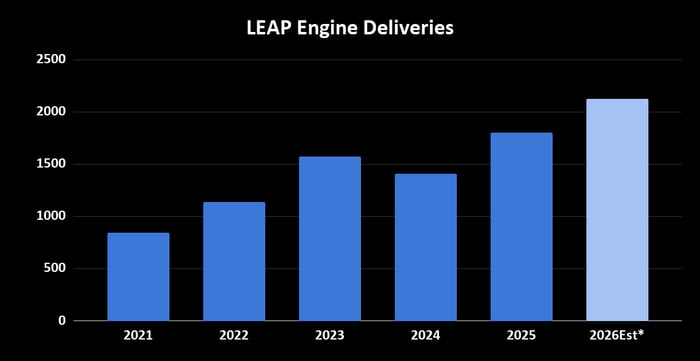
Data source: GE Aerospace presentations. *Assumes 18% growth in line with management's guidance for "high-teens" growth in LEAP deliveries.
Profit margins and cash flow matter, too
It's not only an issue of delivering aircraft to grow revenue; the reality is that the best way aircraft manufacturers can grow their profit margins is by lowering unit production costs through increased production rates.
There's also a significant cash flow consideration at play. If Boeing and Airbus manufacture aircraft that end up almost complete, but can't be finished because they're waiting for engines, they are effectively tying up cash in "gliders" until the engines arrive and the aircraft can finally be delivered, upon which they receive payment.
Relationships with airlines
Boeing and Airbus also need to maintain a strong pace of deliveries to maintain their relationships with airlines, not least because the latter are desperate to switch to flying newer, more fuel-efficient aircraft with newer engines. Moreover, airlines plan their fleets based on assumptions about the types of aircraft they will have in their fleet (the Airbus A321neo is a particularly popular variant), and any delivery delays will negatively impact them.

Image source: Getty Images.
In addition, if CFM and Pratt & Whitney (a subsidiary of RTX and the producer of the rival geared turbofan engine that is the other option usable on the A320neo family) can't provide enough spare engines to meet demand for replacements on older planes, it could lead to aircraft being grounded or airlines having to pay high prices to rent spare engines.
GE Aerospace considerations
The growing volume of LEAP engine deliveries is a huge positive for GE Aerospace, but it also adds some nuance to how we should view its near-term earnings reports. The typical business model for aircraft engine manufacturers is to sell new engines at a loss, but with lucrative long-term service agreements attached. The real money is made from the aftermarket revenue generated by servicing the engines over their operational lives, which can run to over 40 years. In addition, sales of spare engines are profitable.
As CFM International delivers a greater number of engines for new aircraft, relative to spare-engine sales and aftermarket revenue, GE Aerospace will experience some margin pressure. All told, the current ramp up in LEAP engine deliveries will put pressure on its near-term profitability, but will also lead to greater long-term profitability.
Good news for the aerospace industry
Beyond the near-term impact on GE Aerospace margins, more LEAP deliveries are good news for Boeing and Airbus. The increased availability of those engines should lead to greater revenues, profit margins, and cash flow, as well as help them keep their relationships with airlines healthy. This is also great news for airlines that need new aircraft with better operational efficiency, and for the travelers who will fly on those newer planes. And it will benefit companies across the aerospace industry supply chain that rely on the construction of new aircraft to generate their own sales.
Should you buy stock in Boeing right now?
Before you buy stock in Boeing, consider this:
The Motley Fool Stock Advisor analyst team just identified what they believe are the 10 best stocks for investors to buy now… and Boeing wasn’t one of them. The 10 stocks that made the cut could produce monster returns in the coming years.
Consider when Netflix made this list on December 17, 2004... if you invested $1,000 at the time of our recommendation, you’d have $439,308!* Or when Nvidia made this list on April 15, 2005... if you invested $1,000 at the time of our recommendation, you’d have $1,286,826!*
Now, it’s worth noting Stock Advisor’s total average return is 964% — a market-crushing outperformance compared to 212% for the S&P 500. Don't miss the latest top 10 list, available with Stock Advisor, and join an investing community built by individual investors for individual investors.
See the 10 stocks »
*Stock Advisor returns as of August 28, 2026.
Lee Samaha has no position in any of the stocks mentioned. The Motley Fool has positions in and recommends Boeing, GE Aerospace, RTX, and Safran. The Motley Fool has a disclosure policy.
Recommended Articles


