


What Does Bond Market Volatility Mean for Your Portfolio? Here's What Investors Need to Know.
Key Points
Bonds are a form of debt, but they can have a big impact on equities.
Some bond yields are used as the risk-free rate in a standard valuation model.
Many other sectors are rate-sensitive.
- These 10 stocks could mint the next wave of millionaires ›
Bond yields have surged, and bond prices have fallen, since the beginning of the Iran war at the very end of February. The yield on the 10-year U.S. Treasury note is now at 4.70%, up from 3.96% on Feb. 27, the day before the U.S. first began bombing Iran.
Bonds are quite different from stocks, but the bond market can impact the stock market and vice versa, particularly as long-term bonds hit their highest level in decades.
Missed Nvidia in 2009? This Rare Signal Is Flashing Again. In 2009, a "Double Down" signal flashed for a little-known chipmaker called Nvidia. For the first time in years, that same "Total Conviction" signal is flashing for a company 1/100th the size of Nvidia. Continue »
Here's what bond market volatility means for your portfolio.

Image source: Getty Images.
Why bonds impact stocks and what they say about the economy
There are a few different ways that bonds impact the stock market.
The first concerns the technique that fundamental investors across Wall Street and beyond use to value stocks. Many analysts and institutional investors set price targets for stocks using a discounted cash flow (DCF) analysis. A DCF analysis links a company's future cash flows to the present to estimate the intrinsic value of its equity. However, there are inputs within the formula, including the cost of equity, which relies on a risk-free rate. Many investors use the 10-year Treasury yield as the risk-free rate.
The cost of equity helps determine the discount rate, which is used to discount cash flows to their present value. When yields rise, the discount rate rises as well, leading to lower future cash flows and, therefore, a lower equity valuation.
Obviously, this is technical, and the market doesn't always react as expected, but mechanically, equity valuations should decline when the discount rate rises.
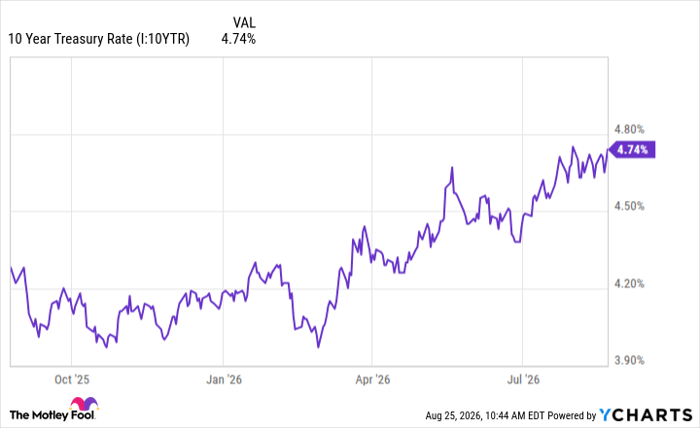
Data by YCharts.
Yields also serve as a key data point for investors when evaluating the macroenvironment. Long-term bond yields are influenced by economic growth assumptions, inflation assumptions, supply and demand, and now the country's mounting debt, which recently topped $40 trillion.
The Iran war has lifted inflation expectations. Meanwhile, investors are concerned about the country's fiscal situation. Some, like U.S. Treasury Secretary Scott Bessent, believe the U.S. can grow its way out of the debt. But if that's possible, it would also likely lead to more inflation.
Rising bond yields are also more impactful for some industries than others. For instance, a rising 10-year yield is typically bad for the housing market and, therefore, for real estate companies, because it makes mortgages more expensive.
Rising bond yields also create higher financing costs for other types of loans and debt, which is bad for the companies that finance them. On the other hand, lower rates can also benefit these more interest rate-sensitive sectors, although the effects vary by sector.
Don't become too distracted by the bond market
Stock investors should certainly take time to learn the bond market. If you're truly going to be a great investor, you need to know how it works and how it impacts equities.
But just as investors can get too obsessed with near-term company-specific events, long-term investors needn't be too reactive to moves in the bond market, either. For one, the market doesn't always react as expected. The 30-year U.S. Treasury bond yield recently surpassed 5.3%, though it has since declined. Several months ago, many experts might have told you that bond yields at this level would lead to a big sell-off for stocks.
But that hasn't happened yet, not that stocks couldn't come under pressure in the future.
Furthermore, yields can change quickly, particularly at the longer end of the curve, which is more influenced by the broader market. Just look at how much yields have changed in a matter of months this year.
In addition, there are many things impacting the bond market, so trying to predict any near-term move is quite difficult, arguably more difficult than trying to predict the near-term move of an individual stock.
Long-term investors should still focus on the broader thesis for an individual company and whether it remains intact.
It's certainly a good idea to understand how rising or falling bond yields might impact an individual company's business, but generally speaking, a solid long-term thesis will likely not be broken by near-term volatility in the bond market.
Where to invest $1,000 right now
When our analyst team has a stock tip, it can pay to listen. After all, Stock Advisor’s total average return is 973%* — a market-crushing outperformance compared to 213% for the S&P 500.
They just revealed what they believe are the 10 best stocks for investors to buy right now, available when you join Stock Advisor.
See the stocks »
*Stock Advisor returns as of August 27, 2026.
The Motley Fool has a disclosure policy.
Recommended Articles


