


If a Recession Is Coming, History Is Clear About What Long-Term Investors Can Expect
Key Points
Trying to time recessions can mean missing major rebounds.
Strong businesses are better positioned to survive economic downturns.
History has consistently rewarded patient investors.
- These 10 stocks could mint the next wave of millionaires ›
There are legitimate reasons to worry about a recession right now. But there's a big difference between recognizing those risks and dumping your stocks because you think one is right around the corner.
The U.S. economy is showing signs of slowing. Employers unexpectedly cut 23,000 jobs in July, and hiring has been considerably weaker in 2026 than during the expansion that followed the loosening of pandemic restrictions. Consumer spending has shown some weakness, too, with retail sales falling 0.6% in July and the measure used to estimate quarterly consumer spending declining 0.4%.
Missed Nvidia in 2009? This Rare Signal Is Flashing Again. In 2009, a "Double Down" signal flashed for a little-known chipmaker called Nvidia. For the first time in years, that same "Total Conviction" signal is flashing for a company 1/100th the size of Nvidia. Continue »
Then there's inflation. The Federal Reserve is still holding its benchmark interest rate at 3.5% to 3.75%, while economists surveyed by Reuters expect inflation to average about 3.5% this year and remain above the Fed's 2% target through at least 2028. Higher energy prices, tariffs, and other inflationary pressures could make it harder for the Fed to cut rates aggressively if the economy weakens. That's not exactly an ideal combination.
Is a recession imminent?
Recessions often begin when several manageable problems start feeding off one another. Businesses become more cautious. Hiring slows. Consumers pull back. Corporate profits weaken. Companies cut more workers, causing consumers to spend even less.
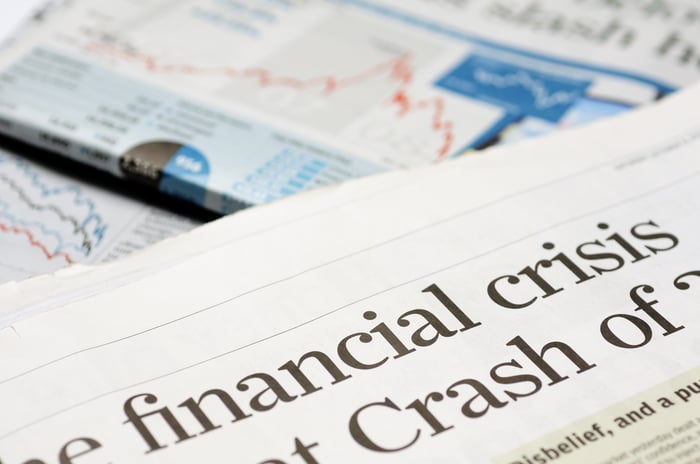
Image source: Getty Images.
There are hints of that first stage today. But make no mistake: A recession isn't imminent.
Initial unemployment claims recently fell to 206,000, suggesting that layoffs remain historically low. The unemployment rate is also just 4.1%. In other words, companies may not be hiring aggressively, but they aren't firing aggressively, either.
There are also economists who argue that the economy isn't necessarily deteriorating. The Federal Reserve Bank of San Francisco recently noted that business investment, particularly in artificial intelligence (AI) infrastructure, was the largest contributor to economic growth in the first quarter, helping offset softer consumer spending.
History favors staying invested
Even if a recession does arrive, selling stocks now creates another problem. You'd have to know when to get back in. And history shows that's extraordinarily difficult, because stocks often begin recovering before the economy does.
Since 1950, the U.S. has experienced 11 recessions. According to Fidelity, those recessions lasted an average of just 11 months. Even more interesting, the S&P 500 actually produced positive total returns during five of those 11 recessions. That's because the stock market doesn't wait for economists to announce that everything is OK again.
Historically, stocks have bottomed an average of seven months after a recession begins, and the S&P 500 has returned an average of 38% during the 12 months following those bottoms. Consider 2020 -- when unemployment was soaring, businesses were shutting down, and the country was officially in recession. Yet after bottoming on March 23, the S&P 500 rallied approximately 70% through the end of that year. Those who waited for the economy to look healthy again missed much of the recovery. That's the danger of trying to time recessions.
Own companies that can survive a recession
That doesn't mean recessions don't matter; they absolutely do. Weak businesses can fail. Highly leveraged companies can struggle to refinance debt. Cyclical companies can watch profits disappear surprisingly quickly. That's why quality matters.
The companies generally better equipped to survive downturns are those with strong balance sheets, durable competitive advantages, healthy cash flow, and manageable debt. Some can even use recessions to take market share, acquire weaker competitors, or continue investing while competitors pull back. And history suggests investors willing to own those businesses through difficult periods have been rewarded.
Since 1980, the S&P 500 has experienced a decline of at least 10% during nearly half of all calendar years. Yet its average calendar-year return over that period was still 13.3%, including dividends.
Yes, there will eventually be another recession. Maybe today's economic weakness develops into one; maybe it doesn't. Nobody knows. But if you're investing money you won't need for years, trying to predict the exact beginning and end of the next recession isn't your best strategy. Owning quality companies, and giving them enough time to compound through the next one, probably is.
Where to invest $1,000 right now
When our analyst team has a stock tip, it can pay to listen. After all, Stock Advisor’s total average return is 973%* — a market-crushing outperformance compared to 213% for the S&P 500.
They just revealed what they believe are the 10 best stocks for investors to buy right now, available when you join Stock Advisor.
See the stocks »
*Stock Advisor returns as of August 27, 2026.
Jeff Siegel has no position in any of the stocks mentioned. The Motley Fool recommends Thomson Reuters. The Motley Fool has a disclosure policy.
Recommended Articles


