


If I Had $5,000 to Invest Today, Here's the Growth Stock I'd Buy Instead of SpaceX
Key Points
Space Exploration Technologies (SpaceX) has plenty of long-term potential, but its stock trades at a hefty valuation, which could limit its upside.
Netflix might be a much better investment, based on its attractive valuation and its exceptional streaming business.
Netflix has captured just 7% of its $670 billion global opportunity across streaming subscriptions, advertising, and more, leaving room for growth.
- 10 stocks we like better than Netflix ›
Elon Musk's Space Exploration Technologies (NASDAQ: SPCX) went public on June 12. Investors were initially enthusiastic about the company's space transportation, satellite internet, and artificial intelligence (AI) businesses, so its stock quickly surged to a peak of $225. However, it has since plummeted by 39% and closed at just $136.97 on Friday, Aug. 21.
SpaceX still has a market capitalization of $1.86 trillion, and based on the company's trailing 12-month revenue of $23 billion, its stock remains at a sky-high price-to-sales (P/S) ratio of 80.8. Therefore, it's still a whopping 13 times as expensive as the Nasdaq-100 technology index.
Missed Nvidia in 2009? This Rare Signal Is Flashing Again. In 2009, a "Double Down" signal flashed for a little-known chipmaker called Nvidia. For the first time in years, that same "Total Conviction" signal is flashing for a company 1/100th the size of Nvidia. Continue »
That hefty valuation leaves plenty of room for more downside in SpaceX stock, so if I had $5,000 to invest today, I'd probably be looking elsewhere. Here's why I think Netflix (NASDAQ: NFLX) stock could perform far better over the long term.
Image source: The Motley Fool.
Netflix dominates the streaming industry
Netflix has over 325 million paying subscribers, placing it miles ahead of its nearest competitors, Amazon Prime and Warner Bros. Discovery (the owner of Discovery+ and HBO Max), which have 200 million and 140 million members, respectively. To keep its leadership position, Netflix maintains one of the highest annual content budgets in the industry, so its slate of movies and television shows is always fresh. It also offers flexible membership options to appeal to consumers of all income levels.
Four years ago, Netflix launched a heavily discounted subscription tier supplemented by advertising, and it has become one of the company's biggest growth drivers. At just $8.99 per month, it's a fraction of the price of the Standard and Premium plans, which cost $19.99 per month and $26.99 per month, respectively. However, since Netflix can charge businesses more money for advertising slots over time, the value of each ad-tier member is constantly increasing.
Ad slots are particularly valuable during live events, which is why Netflix is investing big money in sports content from across the National Football League (NFL), Major League Baseball (MLB), boxing, and World Wrestling Entertainment (WWE). Businesses will typically pay a premium to get their products in front of large, highly engaged audiences, which is exactly what live sports content attracts.
According to management's latest guidance, Netflix is on track to generate somewhere between $51 billion and $51.4 billion in total revenue this year, which would be a record. Revenue from selling advertising slots is expected to make up just $3 billion of that total, but it would be double the 2025 result of $1.5 billion. If the advertising segment continues to grow at this pace, it won't take long to become a significant part of Netflix's overall business.
Netflix looks like a bargain compared to SpaceX
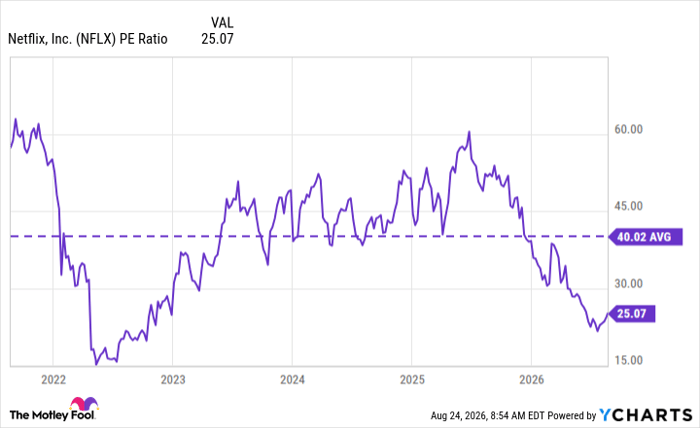
Netflix generated earnings of $3.18 per share over the last four quarters, placing its stock at a price-to-earnings (P/E) ratio of 25.1. Not only is that a steep discount to its five-year average of 40, but it also makes Netflix cheaper than the Nasdaq-100 index, which has a P/E ratio of 34.1. In other words, the streaming giant looks heavily undervalued compared to a basket of its big-tech peers.
NFLX PE Ratio data by YCharts.
Netflix also has a price-to-sales (P/S) ratio of 7, placing it at a slight premium to the Nasdaq-100, which has a P/S ratio of 6.2. However, as I highlighted earlier, SpaceX has a significantly higher P/S of 80.8, so Netflix looks like a bargain from that perspective.
Netflix has only captured around 7% of its $670 billion global opportunity across streaming subscriptions, advertising, gaming, and more, according to Chief Financial Officer Spencer Neumann, so it has a very long runway for potential growth. Given the sheer size of that opportunity, it's a little surprising that Netflix stock trades at a discount to the broader tech market right now, so this might be a great chance for investors to pounce.
Personally, I think there is a much higher chance that Netflix will deliver positive returns over the next few years compared to SpaceX based on their respective valuations and fundamentals, so it's the stock I'd prefer to buy right now.
Should you buy stock in Netflix right now?
Before you buy stock in Netflix, consider this:
The Motley Fool Stock Advisor analyst team just identified what they believe are the 10 best stocks for investors to buy now… and Netflix wasn’t one of them. The 10 stocks that made the cut could produce monster returns in the coming years.
Consider when Netflix made this list on December 17, 2004... if you invested $1,000 at the time of our recommendation, you’d have $443,461!* Or when Nvidia made this list on April 15, 2005... if you invested $1,000 at the time of our recommendation, you’d have $1,307,633!*
Now, it’s worth noting Stock Advisor’s total average return is 973% — a market-crushing outperformance compared to 213% for the S&P 500. Don't miss the latest top 10 list, available with Stock Advisor, and join an investing community built by individual investors for individual investors.
See the 10 stocks »
*Stock Advisor returns as of August 26, 2026.
Anthony Di Pizio has no position in any of the stocks mentioned. The Motley Fool has positions in and recommends Amazon, Netflix, and Warner Bros. Discovery. The Motley Fool has a disclosure policy.
Recommended Articles


