


Not Palantir. Not SoundHound AI. This Software Specialist Could Be the Biggest Winner of the AI Productivity Boom
Key Points
Twilio's growth is accelerating due to increasing customer adoption of its AI tools.
The cloud communications specialist is also benefiting from increased spending by existing customers.
Twilio's attractive valuation suggests that it can continue to head higher after a solid performance so far this year.
- 10 stocks we like better than Twilio ›
The demand for artificial intelligence (AI) software is rising rapidly, with Gartner projecting a 60% increase in AI software spending this year to $453 billion, followed by a 41% jump next year to more than $638 billion.
This terrific growth isn't surprising, as integrating AI-focused software tools into business operations is boosting productivity. A Morgan Stanley research report noted earlier this year that companies using AI for at least a year have experienced an 11.5% increase in productivity. Not surprisingly, companies such as Palantir Technologies and SoundHound AI that sell enterprise AI software solutions have been experiencing healthy revenue growth.
Missed Nvidia in 2009? This Rare Signal Is Flashing Again. In 2009, a "Double Down" signal flashed for a little-known chipmaker called Nvidia. For the first time in years, that same "Total Conviction" signal is flashing for a company 1/100th the size of Nvidia. Continue »
However, both stocks have been underperforming this year. While Palantir stock is down 3% in 2026, SoundHound AI has dropped 29%. Cloud communications specialist Twilio (NYSE:TWLO), meanwhile, has clocked impressive gains of 57% in 2026, driven by growing demand for its AI tools.
Let's see why that has been the case, and check if Twilio can sustain its impressive rally in the future and make investors richer.

Image source: The Motley Fool.
Twilio's AI tools have improved its growth trajectory
Twilio released its Q2 results on Aug. 6. The company's revenue increased 22% year over year to $1.5 billion. Its organic revenue increased by 17% year over year. What's more, Twilio reported non-GAAP earnings per share of $1.47, up by 23% from the year-ago period.
There's no doubt that Twilio's growth is nowhere near the phenomenal performance of SoundHound and Palantir, but it has been stepping on the gas lately. For instance, its revenue increased by 13% year over year in the same quarter last year. The improvement in Twilio's growth rate is driven by increasing adoption of its AI solutions.
The company has traditionally provided application programming interfaces (APIs) that help its clients stay in touch with their customers across various channels, including voice, text, email, chat, and video. However, it has now expanded beyond its core business, offering clients AI tools to predict customer behavior, build AI agents and conversational AI solutions, automate workflows, and improve security.
The good news is that these offerings are becoming popular among customers. For example, an automotive fintech company that used Twilio's conversational AI platform to build an AI assistant has witnessed a 1.6x jump in lead conversion. This client signed a seven-figure deal with Twilio to implement its conversational AI offerings.
Importantly, this wasn't the only customer deploying Twilio's AI offerings. Management noted on the earnings call that it has "signed an 8-figure deal with a leading AI company and other key wins with All Nippon Airways, Atlassian, Eltropy, Kixie, Lirio, Medibank, Olo, OpenEvidence, Orionai Solutions, Vozzi and Xplor Technologies."
Another important point to note is that Twilio isn't just winning new customers. Its existing customers are also spending more on its services. This is evident from the increase in the dollar-based net expansion rate, which compares customer spending in a quarter to that of the same customer cohort in the year-ago period..
Twilio's dollar-based net expansion rate increased by eight percentage points year over year in Q2 to 116%. Additionally, increased spending by existing customers is improving the company's profit margin.
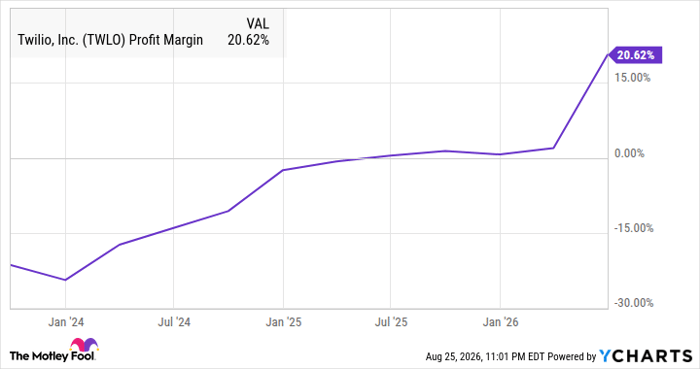
TWLO Profit Margin data by YCharts
Moreover, Twilio's guidance suggests that it expects its solid growth trajectory to continue. The company has raised its full-year revenue growth guidance to a range of 18% to 18.5%, up from the earlier range of 14% to 15%. Not surprisingly, even analysts have become bullish about Twilio's growth prospects.
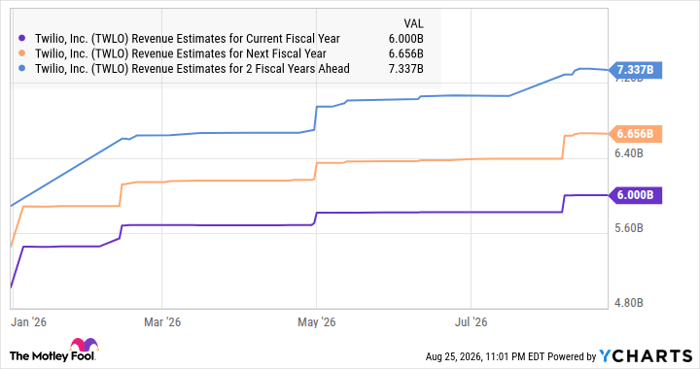
TWLO Revenue Estimates for Current Fiscal Year data by YCharts
The valuation makes Twilio a solid AI pick
Twilio trades at an attractive 6.3 times sales despite its impressive rally in 2026. Its price-to-earnings ratio of 31 isn't expensive either, given the expensive multiple Palantir trades at.
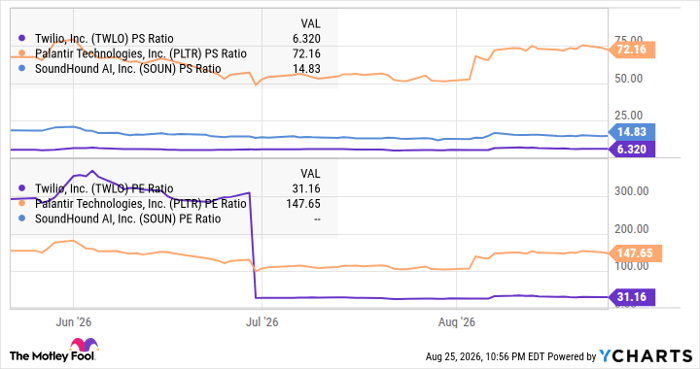
TWLO PS Ratio data by YCharts
The chart given above makes it clear that Twilio is a value play right now. It is delivering robust growth and is significantly cheaper than its peers that command significant premiums. Assuming Twilio's revenue indeed increases to $7.34 billion in 2028, and it trades at even 10 times sales at that time, which will be a significant discount to its peers, its market cap could jump to $73 billion.
That's just over double Twilio's current market cap. On the other hand, the expensive valuations of Palantir and SoundHound AI could weigh on their performance, which is why I think Twilio could be the better AI stock to buy among the three companies discussed in this article.
Should you buy stock in Twilio right now?
Before you buy stock in Twilio, consider this:
The Motley Fool Stock Advisor analyst team just identified what they believe are the 10 best stocks for investors to buy now… and Twilio wasn’t one of them. The 10 stocks that made the cut could produce monster returns in the coming years.
Consider when Netflix made this list on December 17, 2004... if you invested $1,000 at the time of our recommendation, you’d have $443,461!* Or when Nvidia made this list on April 15, 2005... if you invested $1,000 at the time of our recommendation, you’d have $1,307,633!*
Now, it’s worth noting Stock Advisor’s total average return is 973% — a market-crushing outperformance compared to 213% for the S&P 500. Don't miss the latest top 10 list, available with Stock Advisor, and join an investing community built by individual investors for individual investors.
See the 10 stocks »
*Stock Advisor returns as of August 26, 2026.
Harsh Chauhan has no position in any of the stocks mentioned. The Motley Fool has positions in and recommends Palantir Technologies, SoundHound AI, and Twilio. The Motley Fool recommends Gartner. The Motley Fool has a disclosure policy.
Recommended Articles


