


Billionaires Stanley Druckenmiller and Dan Loeb Both Sold Broadcom and Piled Into This Virtual Monopoly Artificial Intelligence (AI) Stock Instead
Key Points
While Broadcom supplies critical components to AI data centers, the stock's valuation is a bit rich.
Meanwhile, Druckenmiller and Loeb both piled into the same "Magnificent Seven" stock.
This suggests that they see more value in AI ecosystems rather than component suppliers.
- These 10 stocks could mint the next wave of millionaires ›
Stanley Druckenmiller and Dan Loeb are two of Wall Street's most closely watched investors. Druckenmiller is a macro specialist who previously worked as a portfolio manager under George Soros. Today, he runs his own family office.
Loeb is the founder of the hedge fund Third Point. He's earned a reputation for being an activist investor and event-driven operator with a keen eye for identifying catalysts and pressing management for change.
Missed Nvidia in 2009? This Rare Signal Is Flashing Again. In 2009, a "Double Down" signal flashed for a little-known chipmaker called Nvidia. For the first time in years, that same "Total Conviction" signal is flashing for a company 1/100th the size of Nvidia. Continue »
Smart investors pay attention to Druckenmiller and Loeb because each has repeatedly demonstrated an ability to rotate capital into the next leg of growth before the consensus catches on. Perhaps unsurprisingly, their latest 13F filings show a shared pivot: Druckenmiller and Loeb both completely exited Broadcom (NASDAQ: AVGO) while building positions in Alphabet (NASDAQ: GOOG) (NASDAQ: GOOGL).
Below, I'll dig into why this rotation offers a valuable window into how two of the brightest minds on Wall Street are positioning for the next phase of the artificial intelligence (AI) revolution.

Image source: Getty Images.
Exiting Broadcom at a strategic juncture in the AI chip cycle
Broadcom is undoubtedly a central supplier to the AI infrastructure buildout. The company designs custom accelerators and also supplies high-performance networking silicon that links clusters of processors inside data center servers. Demand for these components has fueled Broadcom's revenue growth as AI hyperscalers race to expand capacity.
Yet the decision by both Druckenmiller and Loeb to fully exit their positions suggests they see better risk-reward elsewhere in the AI ecosystem. Despite some compression, Broadcom's valuation still prices in lofty expectations.
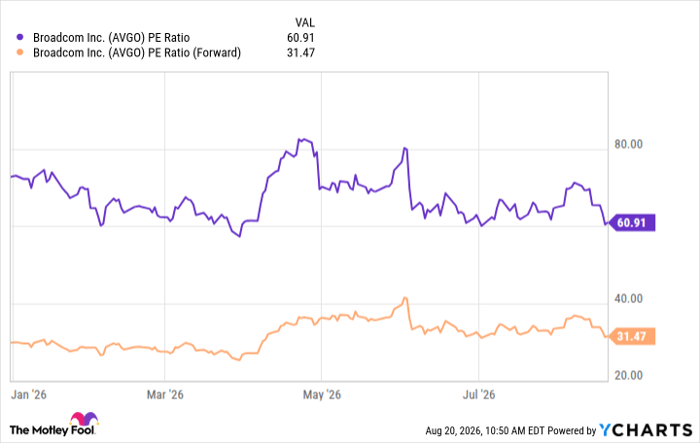
AVGO PE Ratio data by YCharts
Meanwhile, new GPU architectures from Nvidia and Advanced Micro Devices bring continued layers of competitive intensity to the equation. Lastly, capex cycles can shift quickly once capacity catches up with demand -- making Broadcom's long-term prospects questionable.
The thesis around Alphabet
Alphabet's appeal lies in its complete vertical integration. The company designs its own silicon, known as Tensor Processing Units (TPUs) and operates vast data center and fiber networks. Alphabet also develops AI models through its DeepMind lab under the Gemini family and distributes these capabilities at global scale across Google Search, YouTube, Android, and Workspace.
The theme here is that AI is not an add-on feature for Alphabet. Rather, the company's near-monopoly position in online search helps Alphabet weave AI features deeper into the fabric of every other major property the company owns. Search now surfaces AI Overviews to billions of users, while YouTube leverages generative tools for more personalized content recommendations and advertising.
Google Cloud is in a unique position because it sells both the infrastructure (TPUs) and enterprise services that feed usage directly data back into model improvement. This closed loop playbook creates compounding advantages that frontier model developers or merchant-chip suppliers struggle to replicate at scale.
Alphabet's AI strategy is producing impressive results. During the second quarter, the company reported total revenue of $119.8 billion -- an increase of 24% year over year. Google Cloud accelerated sharply, with revenue surging 82% to $24.8 billion. Meanwhile, backlog in the cloud segment reached $514 billion. Operating income for the company rose 30% to $40.8 billion, expanding Alphabet's operating margin to 34%.
Should you buy Alphabet stock right now?
Alphabet's vertical stack gives the company structural cost advantages, unparalleled distribution reach, and multiple monetization levers that competitors simply don't match. The company's recent earnings validate that the AI investments are generating both top-line acceleration and expanding margins -- translating into measurable traction rather than remaining an open-ended research experiment.
While blindly copying the trades of two billionaires is never wise, I think the logic behind this particular rotation is sound. Druckenmiller's and Loeb's simultaneous moves simply reinforce that two of the market's most successful capital allocators already identified the same opportunity.
Investors who believe the next wave of AI will reward platform businesses that own the full stack -- from model development, hardware, and software -- rather than component suppliers have a reasonable case for adding Alphabet to their portfolio.
Where to invest $1,000 right now
When our analyst team has a stock tip, it can pay to listen. After all, Stock Advisor’s total average return is 965%* — a market-crushing outperformance compared to 212% for the S&P 500.
They just revealed what they believe are the 10 best stocks for investors to buy right now, available when you join Stock Advisor.
See the stocks »
*Stock Advisor returns as of August 23, 2026.
Adam Spatacco has positions in Alphabet and Nvidia. The Motley Fool has positions in and recommends Advanced Micro Devices, Alphabet, Broadcom, and Nvidia. The Motley Fool has a disclosure policy.
Recommended Articles


