


Applied Digital vs. TeraWulf: Which AI Data Center Stock Is the Better Buy?
Key Points
Applied Digital and TeraWulf have been signing long-term deals to lease compute to tech giants, which makes their future revenues more predictable and enables them to get financing at better terms.
Applied Digital has more contracted power and a stronger pipeline than TeraWulf.
The companies have similar market caps even though Applied Digital is growing faster.
- 10 stocks we like better than Applied Digital ›
Applied Digital (NASDAQ: APLD) and TeraWulf (NASDAQ: WULF) are two of the top AI stocks riding the data center wave. Both neocloud companies develop and operate facilities that serve hyperscalers, but their stock returns have been a little different this year.
TeraWulf is up by 36%, while Applied Digital has gained just 11%. Is that gap just a fluke, or is it a sign of things to come? Here's what investors should consider.
Missed Nvidia in 2009? This Rare Signal Is Flashing Again. In 2009, a "Double Down" signal flashed for a little-known chipmaker called Nvidia. For the first time in years, that same "Total Conviction" signal is flashing for a company 1/100th the size of Nvidia. Continue »
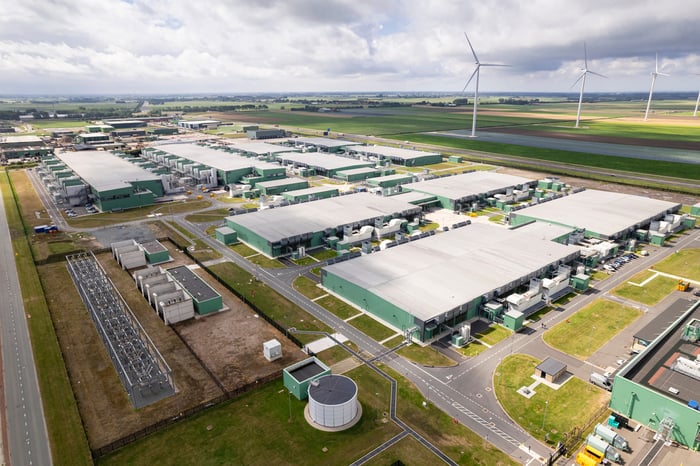
Image source: Getty Images
Applied Digital has the advantage with gigawatts
Gigawatts are the name of the game when it comes to analyzing neocloud and colocation providers that offer IT capacity to hyperscalers. The more gigawatts a company has, the more revenue it can make.
Applied Digital has secured 1.4 gigawatts of contracted critical IT load, which comes to roughly $36 billion in total contracted lease revenue. Most of these contracts have 15-year terms, including two deals for 300 megawatts at the company's Delta Forge 1 and Polaris Forge 3 sites.
TeraWulf only has 839 megawatts of leased capacity. Most of that came from a 20-year deal with Anthropic for $19 billion that covers 401 megawatts.
Neither of these companies is able to deliver all of this capacity yet. TeraWulf told investors that revenue from the Anthropic deal will start to materialize in the second half of 2027, while revenue generation across all 401 megawatts is expected by early 2028.
Applied Digital also has the bigger pipeline
Not only does Applied Digital have more contracted power, but it also has the bigger pipeline. Secured deals make it easier for neocloud and colocation providers to secure financing to build out their infrastructure, while pipelines increase the number of gigawatts, which can result in more lucrative contracts in the future. Further price improvements seem likely as demand for compute capacity continues to expand rapidly.
Applied Digital has an active pipeline of roughly 3 gigawatts, while TeraWulf's is about 2.1 gigawatts. These figures do not include power or land for which they are still in the early stages of discussion and due diligence, so the size of the gap between them could change quickly. Earlier in the year, TeraWulf announced the acquisition of a Kentucky site that exceeded 1 gigawatt. Another deal like that for Terawulf that could completely close the gap, while a similar deal for Applied Digital would meaningfully expand it.
All of those secured gigawatts can only be transformed into revenue-producing assets if the neoclouds can secure lease deals for their services. That part isn't a problem since demand for compute is so high, but both companies have to ensure they are getting good terms for their capacity.
TeraWulf is aiming to boost its contracted capacity by 250 megawatts to 500 megawatts each year. That would give it between 1 gigawatt and 2 gigawatts of additional contracted power by 2030, which would put its total between 2 gigawatts and 3 gigawatts. Applied Digital has outlined a path to 3 gigawatts of contracted power by 2031, assuming it can lease at least 500 megawatts per year.
The companies have similar market caps
Applied Digital has a larger gigawatt pipeline and more capacity under contract, so one might be surprised that their market caps are very similar. Applied Digital's is $7.8 billion, compared to Terawulf's $7.7 billion.
Applied Digital's valuation lead should be larger, especially since its revenue and net income are also higher than Terawulf's. It also has a higher revenue growth rate than Terawulf as more contract revenue gets recognized.
Both companies are at the center of the AI boom and have long-term deals fueling their growth and access to competitive financing. However, Applied Digital has more going for it right now. More contracted power, a deeper gigawatt pipeline, higher revenue, and lower losses highlight the bullish thesis when comparing these two growth stocks.
TeraWulf could have been the better pick if their valuations were miles apart, but the fact that Applied Digital's market cap is barely more than TeraWulf's makes Applied Digital the better pick.
Should you buy stock in Applied Digital right now?
Before you buy stock in Applied Digital, consider this:
The Motley Fool Stock Advisor analyst team just identified what they believe are the 10 best stocks for investors to buy now… and Applied Digital wasn’t one of them. The 10 stocks that made the cut could produce monster returns in the coming years.
Consider when Netflix made this list on December 17, 2004... if you invested $1,000 at the time of our recommendation, you’d have $429,223!* Or when Nvidia made this list on April 15, 2005... if you invested $1,000 at the time of our recommendation, you’d have $1,317,883!*
Now, it’s worth noting Stock Advisor’s total average return is 965% — a market-crushing outperformance compared to 212% for the S&P 500. Don't miss the latest top 10 list, available with Stock Advisor, and join an investing community built by individual investors for individual investors.
See the 10 stocks »
*Stock Advisor returns as of August 23, 2026.
Marc Guberti has no position in any of the stocks mentioned. The Motley Fool has no position in any of the stocks mentioned. The Motley Fool has a disclosure policy.
Recommended Articles


