


If We're in an AI Bubble, History Says This Is the Best Way to Recession-Proof Your Portfolio
Key Points
During the most recent bear market in stocks, the S&P 500 strongly outperformed the tech-heavy Nasdaq-100.
The State Street SPDR Portfolio S&P 500 ETF has delivered annualized returns of 11.26% since November 2005.
This ultra-low-cost S&P 500 ETF could be a good choice for long-term investors who are concerned about short-term risks of an AI bubble.
- These 10 stocks could mint the next wave of millionaires ›
The stock market has had a pretty good year so far in 2026. The S&P 500 index (SNPINDEX: ^GSPC) recently reached all-time highs and is up about 12% year to date. But one cause for concern among investors is the question of whether or not we're in an artificial intelligence (AI) bubble. Investors have been enthusiastic about the potential of AI. But what if major tech companies have been overly optimistic and have spent too much on AI data centers? If the AI trade is overhyped, there could be a recession coming soon.
There's no 100% recession-proof strategy for investing. The stock market is unpredictable, and even if you know what is going to happen next with the economy (which no one does for sure), there's no way of knowing how the stock market will react.
Missed Nvidia in 2009? This Rare Signal Is Flashing Again. In 2009, a "Double Down" signal flashed for a little-known chipmaker called Nvidia. For the first time in years, that same "Total Conviction" signal is flashing for a company 1/100th the size of Nvidia. Continue »
But if you're worried about a stock market sell-off from a possible future recession, one smart move is to just keep buying a well-diversified portfolio of stocks. Keep buying strong stocks with solid fundamentals, and your money is likely to keep growing in the long run, even in the case of a short-term bear market, recession, or bubble burst.
Let's look at one low-cost index fund that could be a good way to recession-proof your portfolio.

Image source: Getty Images.
State Street SPDR Portfolio S&P 500 ETF (SPYM): 505 stocks, five years of 12.8% annualized returns
The State Street SPDR Portfolio S&P 500 ETF (NYSEMKT: SPYM) is an ultra-low-cost way to buy the S&P 500. This ETF holds 505 stocks and charges a rock-bottom expense ratio of 0.02%. This is an impressively simple, low-cost index fund. It deserves to be compared to the best S&P 500 ETFs.
Along with the broader stock market index that it tracks, the SPYM S&P 500 ETF has been on a recent hot streak of strong performance. The fund has delivered annualized returns of about 12.8% for the past five years and 19.5% in the past year.
But what about a recession? 2022 was the most recent bear market we've seen in the U.S. stock market. That was a tough year for investors. That year, the tech-heavy Nasdaq-100 index (represented in this chart by the Invesco QQQ Trust (NASDAQ: QQQ)) declined by about 32.6%. But the SPYM S&P 500 ETF did better. This fund declined less severely, with a negative return of about -18.1% for the year.
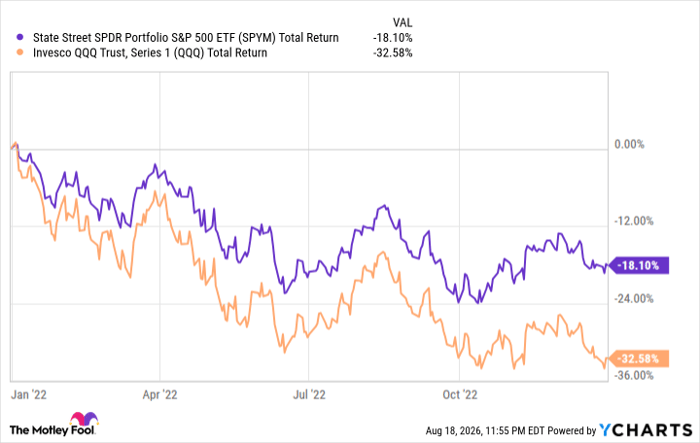
SPYM Total Return Level data by YCharts
Why buy SPYM S&P 500 ETF in case of recession
There's no guarantee that any stock ETF will outperform the rest of the market during a recession. But if you're concerned about an AI bubble and want to diversify away from the major tech names that have invested so heavily in AI technology, buying an S&P 500 ETF might be a safer recession-proof investment than a tech-heavy ETF.
The State Street SPDR Portfolio S&P 500 ETF has delivered average annual returns of 11.26% for the past 20 years since its inception in November 2005. Those 20 years have included some tough times for the economy, like the global financial crisis, Great Recession, and the pandemic. But despite the temporary downturns, this fund has kept delivering strong wealth-building returns for long-term investors.
Buying an S&P 500 ETF is usually a good move for the long run, even if there's an AI bubble and a recession in the next few years.
Where to invest $1,000 right now
When our analyst team has a stock tip, it can pay to listen. After all, Stock Advisor’s total average return is 973%* — a market-crushing outperformance compared to 213% for the S&P 500.
They just revealed what they believe are the 10 best stocks for investors to buy right now, available when you join Stock Advisor.
See the stocks »
*Stock Advisor returns as of August 20, 2026.
Ben Gran has no position in any of the stocks mentioned. The Motley Fool has no position in any of the stocks mentioned. The Motley Fool has a disclosure policy.
Recommended Articles


