


Want to Build Life-Changing Wealth in the Stock Market? History Says This Investing Strategy Has Never Failed.
Key Points
History shows that investing for the long haul is key to building significant wealth.
Despite short-term volatility, the market has a flawless track record of long-term growth.
Small, consistent contributions can potentially add up to $1 million or more over time.
- 10 stocks we like better than S&P 500 Index ›
The stock market is a wealth-building powerhouse, and this year has been another one for the record books.
Both the S&P 500 (SNPINDEX: ^GSPC) and the Dow Jones Industrial Average (DJINDICES: ^DJI) reached new all-time highs earlier in August, and the tech-heavy Nasdaq Composite (NASDAQINDEX: ^IXIC) has surged by close to 18% from its April low.
Missed Nvidia in 2009? This Rare Signal Is Flashing Again. In 2009, a "Double Down" signal flashed for a little-known chipmaker called Nvidia. For the first time in years, that same "Total Conviction" signal is flashing for a company 1/100th the size of Nvidia. Continue »
However, volatility is a concern among many investors. Between the ongoing war in Iran, uncertainty around a potential AI bubble, and stubbornly high inflation testing the Federal Reserve, there's no shortage of catalysts for a downturn.
Fortunately, history says that no matter what may be coming for the market, there's a foolproof way to generate life-changing wealth. Here's how.

Image source: Getty Images.
A long-term outlook is key to maximizing your earnings
In the short term, the stock market can be incredibly volatile. Over the past two decades alone, the U.S. has faced the dot-com bubble burst, the Great Recession, the COVID-19 crash, and the 2022 bear market.
Each of those downturns was brutal in its own way. The dot-com bubble led to one of the longest bear markets in U.S. history, for example, while the Great Recession was the most severe economic downturn post-World War II, and the COVID-19 crash was the fastest on record.
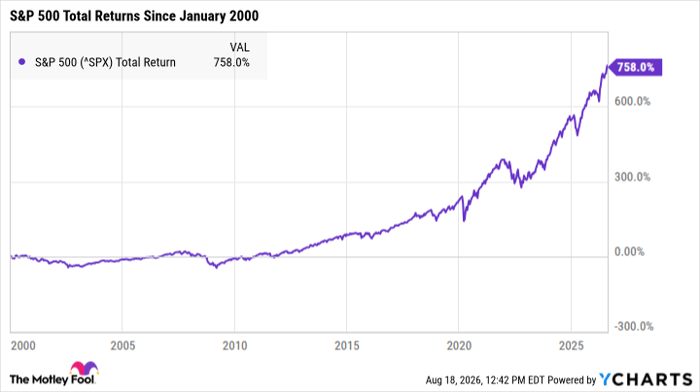
^SPX data by YCharts
Yet despite all of this volatility, the S&P 500 has soared by 758% since January 2000. That means that if you'd invested $10,000 in an S&P 500 ETF back then and never contributed another dollar, you'd have close to $86,000 by today.
This trend has been consistent throughout history, too. Analysts at Crestmont Research studied the S&P 500's rolling 20-year total returns since 1919, and they found that every single period has ended in positive total returns.
In other words, if you'd invested in the S&P 500 at any point over the past century and held your investment for 20 years, you'd have made money -- no matter how volatile the market was in that time.
What it takes to generate $1 million in the stock market
Your exact earning potential in the stock market will depend on a variety of factors -- primarily, the investments you choose. Not all stocks will thrive over the long haul, and if you're investing in risky companies with shaky fundamentals, you could end up losing more than you gain.
Strong stocks from healthy businesses are more likely to experience long-term growth, and one simple way to invest in many of these stocks at once is through an S&P 500 ETF. This type of investment tracks the S&P 500 index, providing diversified exposure to 500 of the largest U.S. companies across all market sectors.
Historically, the S&P 500 has earned an average annual return of around 10%. While there's no guarantee it will continue earning returns at that rate, it's reasonable to expect somewhat similar performance going forward based on decades of data.
If you were to invest, say, $200 per month while earning a 10% average annual return, here's approximately how those contributions could add up over time:
| Number of Years | Total Portfolio Value |
|---|---|
| 20 | $137,000 |
| 25 | $236,000 |
| 30 | $395,000 |
| 35 | $650,000 |
| 40 | $1,062,000 |
Data source: Author's calculations via investor.gov.
Again, these figures are only estimates, as nobody can predict exactly how the market will perform over time.
However, decades of history suggest that by keeping a long-term outlook and investing consistently, it's possible to build a portfolio worth over $1 million. With larger monthly contributions or higher-earning investments, you could earn substantially more over time.
Should you buy stock in S&P 500 Index right now?
Before you buy stock in S&P 500 Index, consider this:
The Motley Fool Stock Advisor analyst team just identified what they believe are the 10 best stocks for investors to buy now… and S&P 500 Index wasn’t one of them. The 10 stocks that made the cut could produce monster returns in the coming years.
Consider when Netflix made this list on December 17, 2004... if you invested $1,000 at the time of our recommendation, you’d have $419,408!* Or when Nvidia made this list on April 15, 2005... if you invested $1,000 at the time of our recommendation, you’d have $1,348,694!*
Now, it’s worth noting Stock Advisor’s total average return is 966% — a market-crushing outperformance compared to 213% for the S&P 500. Don't miss the latest top 10 list, available with Stock Advisor, and join an investing community built by individual investors for individual investors.
See the 10 stocks »
*Stock Advisor returns as of August 20, 2026.
Katie Brockman has no position in any of the stocks mentioned. The Motley Fool has no position in any of the stocks mentioned. The Motley Fool has a disclosure policy.
Recommended Articles


