


Merck Stock Jumps on Phase 3 Cancer Vaccine Win as Keytruda Risk Eases
TradingKey - Merck & Co. (NYSE: MRK) added to its oncology pipeline on August 20. On August 19, Merck and Moderna released positive results from the third phase of the intismeran autogene study, for which patients with high-risk melanoma, who had undergone surgical resection, received intismeran autogene without additional treatment, as an adjuvant to KEYTRUDA.
MRK increased by approximately 12% with the announcement, and even touched a new record high. Such a rapid increase in the stock price reflects the addition of intismeran autogene as a possible additional revenue stream of oncology, as Merck will begin to see loss of revenue due to patent expirations of KEYTRUDA in the coming years.
The companies have not made the third phase results fully public, and overall survival results remain immature. The timing of regulatory review, the cost of manufacturing and pricing are also unknown.
Phase 3 Melanoma Trial Meets Both Primary Endpoints
The INTerpath-001 trial recruited 1,137 patients with completely resected Stage IIB-IV melanoma. The combination of intismeran autogene and KEYTRUDA demonstrated clinical efficacy and statistically significant improvements in Recurrence Free Survival and Distant Metastasis Free Survival, respectively. The safety profile remained consistent with previously reported findings.
Intismeran autogene is not a preventive vaccine. It is an individualized neoantigen therapy manufactured based on the genetic profile of the patient’s tumor. The therapy is designed to synthetically encode up to 34 neoantigens to facilitate the training of the immune system against cancer cells.
Merck and Moderna intend to present detailed Phase 3 results at a planned medical meeting and will meet with international regulatory agencies to discuss regulatory submissions.
Phase 2b Data Provided Earlier Evidence
In the announcement, Merck highlights some early phase 3 data along with some long-term phase 2b KEYNOTE-942 data. With 5 years of follow up, the addition of KEYTRUDA to intismeran resulted in a 49% reduction in the risk of death or recurrence and a 59% reduction in the risk of death from distant metastasis.
While these data support the phase 3 trial, the numerical data from the new phase 3 trial will be required to determine whether the magnitude of benefit will be the same for a larger patient population. Merck and Moderna are also studying intismeran in lung, bladder, kidney, pancreatic and gastric cancers. If the drug is shown to be successful in any of these additional cancers it would significantly increase the market for this drug.
Q2 Sales Increased 5%
Merck reported 2Q sales as $16.61 billion, an increase of 5% over the same period last year, and above the $16.36 billion analyst consensus reported by LSEG. Sales of KEYTRUDA and KEYTRUDA QLEX were up 5% over the reported sales for the same period to $8.37 billion.
QLEX, the subcutaneous version of pembrolizumab, contributed $463 million. This therapeutic indication accounted for over half of the revenue from Merck’s operations and demonstrates both its strength in the market and potential concentration risk.
WINREVAIR sales were $588 million, an increase of 75% over the same period, due to an increase in sales of products in PH. The Animal Health division had sales of $1.78 billion, an increase of 8%. GARDASIL sales were $1.17 billion. CAPVAXIVE sales were $184 million.
Terns Acquisition Produced the Quarterly Loss
Merck reported losses of $0.54 for the second quarter as per Generally Accepted Accounting Principles (GAAP) and $0.13 loss on a non GAAP basis; the primary reason for the losses was an acquisition related charge of $5.7 billion or $2.31 per share, pertaining to Terns Pharmaceuticals. The acquisition brought in MK-4208, formerly TERN-701, for the treatment of chronic myeloid leukemia.
The loss for the quarter does not indicate that Merck’s main revenue stream has been negatively impacted. It is primarily attributable to research related costs and acquisitions.
Merck Raises Its 2026 Sales Outlook
During their analysis, management raised and narrowed their expectations for sales to the range of $66.3 billion to $67.3 billion, from the previous range of $65.8 billion to $67.0 billion. They expect an adjusted operating EPS to be in the range of $2.66 to $2.76, with $3.62 per share from the Cidara Therapeutics acquisition, and $2.31 per share from the Terns acquisition.
They also expect $0.12 per share to be related to the financing of the Terns acquisition and MK-4208. Their expectations also include the repurchase of approximately $3 billion of company stock.
WINREVAIR and LIPFENDRA Support Diversification
A key asset outside of the oncology sector for Merck is now Terns Acquisition; with sales of Terns Acquisition up 75% from last year.
Merck’s LIPFENDRA, an FDA approved PCSK9 Oral inhibitor, is a key asset. The LIPFENDRA approval was expanded in July for use with hypercholesterolemia, along with diet and exercise.LIPFENDRA, now, is the first approved PCSK9 Inhibitor for use in hypercholesterolemia.
In two Phase 3 studies, the drug reduced LDL cholesterol by 56% and 59% respectively when compared to a placebo. This drug still has no evidence for the prevention of cardiovascular events and the studying continues.
HIV Pipeline Provides Another Growth Route
HIV products that are administered daily, weekly and even monthly are being developed by Merck.
In April, the FDA approved IDVYNSO, a once-daily doravirine and islatravir regimen. Alimatravir, an investigational once-monthly oral treatment for HIV pre-exposure prophylaxis, has advanced to Phase 3 development.
Merck has announced that they have entered into licensing agreements to support access to alimatravir in 129 low- and middle-income countries when (should) the medicine be approved.
KEYTRUDA Dependence Remains the Main Risk
With the patent cliffs expected in the coming years, KEYTRUDA remains Merck’s largest product, accounting for the majority of revenue. Once other companies produce biosimilars, sales will decline and, consequently, pricing will decrease.
The patent expirations of KEYTRUDA’s partnered products may boost the franchise through Intismeran, which is designed to create customized treatment options that, together with KEYTRUDA, would provide additional value to patients. Still, the Phase 3 announcement should not be construed to strongly anticipate regulatory approval, and ultimately, revenue potential in the billions.
Based on the outcome of components such as the production cost, efficacy/survival data and a regulatory decision, the product may or may not be important.
MRK Approaches $153 Resistance
Merck (MRK) is currently trading at $152.23 on the four-hour chart, having broken through the resistance level of $140.64 and $144.11, $146.55 and $149.65.
Immediate resistance is at 153.07-153.13. A break above 153.13 would allow the price to reach the $158.61 Fibonacci extension and $162.03.
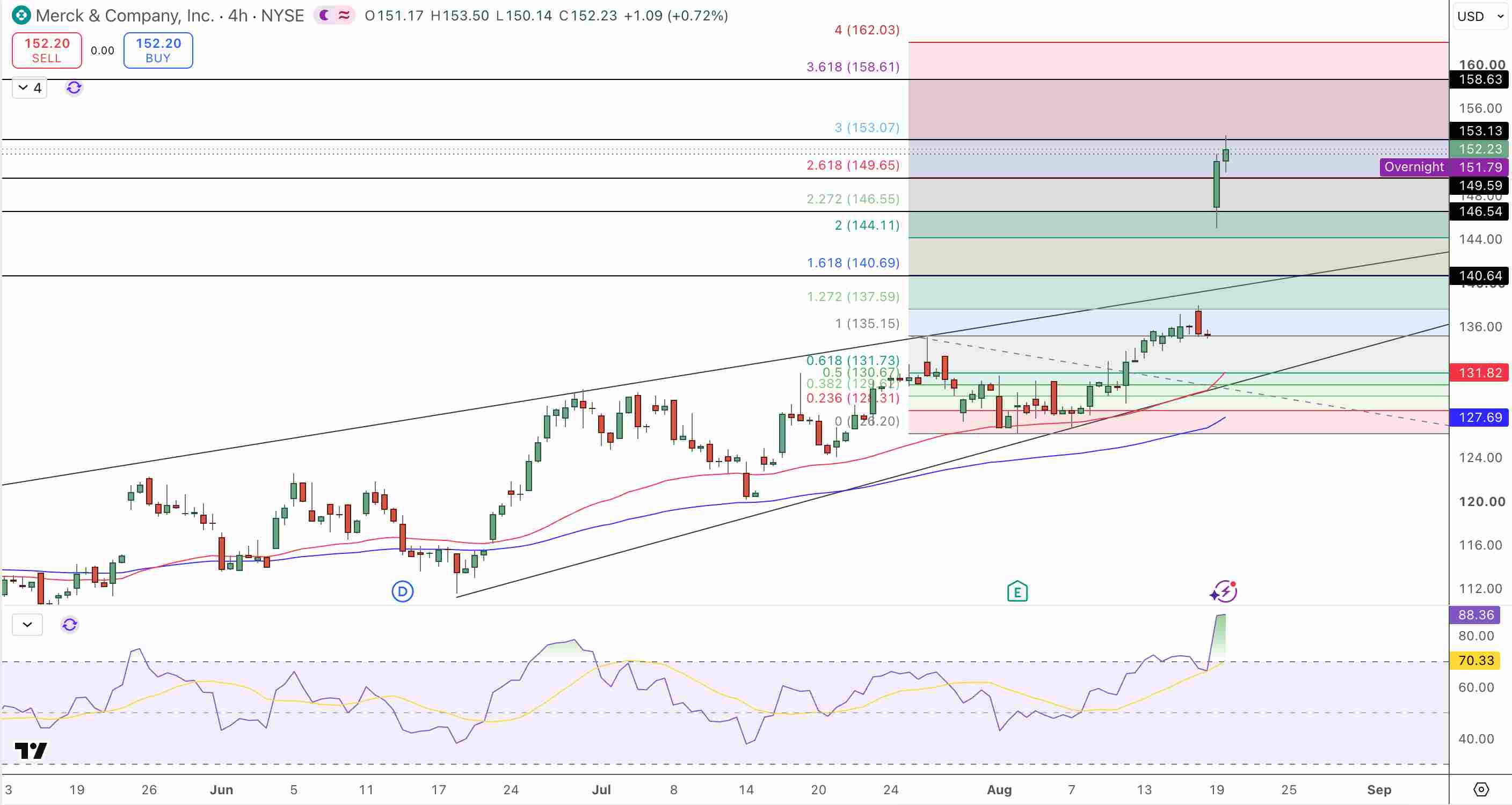
Merck (MRK) Price Forecast - Source: Tradingview
RSI is at around 88, which is far above what could be considered overbought at 70. This is not a sign of a reversal, but it shows that a quick advance in price may be unsustainable.
Support is at 149.59-149.65, 146.54-146.55, 144.11 and 140.64.
Bottom Line
The positive results from the Phase 3 trial of Merck’s melanoma treatment are expected to improve the company’s outlook long-term. Already, Merck has the late-stage asset, KEYTRUDA, as well as WINREVAIR, LIPFENDRA and an expanding HIV treatment pipeline.
KEYTRUDA dependence and the lack of completed Phase 3 data and uncertain timing of regulatory and commercial decisions are the main limitations. MRK is bullish above $146.55, but the RSI at 88 points to an increased risk of consolidation. A position above $153.13 puts $158.61 as the next target. A rejection would cause a pullback to 149.65-146.55. This is analysis, not investment advice.
Recommended Articles


