


Micron Stock Falls 7%, but AI Memory and HBM4 Demand Remain Strong
TradingKey - Micron Technology (NASDAQ: (MU) opened at $940.76 on August 19, down 7% from the previous session. The decrease was part of a broader sell off of semiconductors and was not a result of recently released guidance. The PHLX Semiconductor Index dropped 5% on August 18 with Sandisk down 9%, Nvidia down 2.3% and AMD down 4.3%. Longer term bond yields rising, overvaluations of AI, along with some profit taking after a strong hardware rally were some of the drivers.
Micron’s guidance has not changed. Continued growth and increasing demand for high bandwidth memory, advanced DRAM and data center storage systems continues to create ongoing capital spending and execution risks.
Q3 Revenue Reached a Record $41.46 Billion
The most recent reported fiscal quarter for Micron is the third quarter of fiscal year 2026 which ended on May 28. Micron posted revenue for the quarter of $41.46 billion which was an increase from the previous quarter of $23.86 billion and an increase from the same quarter one year ago of $9.30 billion.
GAAP net income reached $28.24 billion or $24.67 per diluted share. Non-GAAP net income was $28.86 billion for adjusted EPS of $25.11.
Operating cash flow for the quarter was $25.39 billion with adjusted free cash flow of $18.3 billion after $7.1 billion of capital outlay. Micron closed the quarter with $30.2 billion in cash and cash equivalents and marketable securities.
GAAP gross margin was 84.6% compared to 74.4% in the previous quarter and 37.7% in the same quarter one year ago. These numbers are favorable for memory pricing but will create difficult new comparisons for future quarters.
Q4 Guidance Indicates Further Growth
Expecting a midpoint of roughly 21% growth and a possible range of $40-$60 Billion, Micron is projecting a revenue goal of $50 Billion for fiscal Q4. For this fiscal quarter, management’s outlook includes an 86% GAAP and adjusted gross margin, with $30.73-$31 GAAP EPS and an adjusted EPS of $31.
Guidance suggests memory pricing and AI demand were positive when Micron provided its Q4 forecast. We will learn in the next earnings report if the positive demand conditions persisted throughout the quarter.
HBM4 Is Now Shipping in Volume
Micron continues to provide high speed volume shipments of its lead customers' 36GB 12-high HBM4 for their platforms as part of the volume shipment program. Micron also has shipped qualification samples to numerous other customers. The HBM4 provides bandwidth in excess of 2.8 terabytes per second with pin speeds greater than 11 gigabits per second. Packaging density for the next generation sampling remains the focus with Micron's HBM4E expected to hit volume production in 2027.
Micron also has shipped 48GB 16-high HBM4, demonstrating greater packaging density. HBM4 is a focused initiative as NVIDIA's Vera Rubin and other next-gen architectures want more capacity, bandwidth, and energy efficiency.
Inference Expands Memory Requirements
Micron expects the rapid expansion of AI inference, including reasoning-heavy and agent-based systems, to increase memory and storage requirements across the compute stack. In 2023, the inverse was true. Inference focuses on the continuous running of an AI model to provide answers to queries or to run agents and process workloads within the enterprise. Systems of this nature are not solely reliant on accelerators, but use HBM and conventional DRAM and high-speed storage.
For Micron, the memory, storage and the related interconnects can account for more than 50% of the total power consumption of an AI system, depending on the specific workload and configuration. Therefore, even more energy efficient memory could be highly significant as a boom of data centers constrains electricity and cooling.
Strategic Agreements May Improve Revenue Visibility
Micron is using more of its multiyear Strategic Customer Agreements. Compared to traditional short-term memory agreements, these give more predictability to supply and purchasing amounts and price.
In June, Micron signed an agreement with Anthropic for AI architecture design and a supply of memory and storage alongside enterprise adoption of Claude, and a strategic equity investment. In the months after, Micron announced supply agreements with General Motors and several other automotive suppliers.
While these agreements bring more predictability to memory contract cycles, they do not eliminate cyclicality as inevitability dictates they will if AI spending slows or industry capacity outpaces demand.
Manufacturing Expansion Requires Heavy Investment
Micron's goal of spending $250 billion on US manufacturing over the next decade will be costly. Their announced plans to spend $24 billion on a wafer fabrication plan in Singapore over the next decade will also be costly.
Both of these long-term capacity expansions will also be cash burns through the work. The Singapore fabrication plant won't produce wafers until the second half of 2028.
So investors will be watching to see if demand sustains price at a level that will cover construction and the equipment spend.
China Creates Both Competition and Policy Support
DRAM capacity is growing with new plants in China, adding competition to Micron. Some of that competition may be in spaces where there are lower barriers in terms of technology and manufacturing. There was some policy support for Micron on August 17 after it was reported that the Trump Administration told Apple and other US technology companies not to source memory from Chinese manufacturers. Micron was up by 4.1% for that trading day, but lost all gains as the broader chip sector sold off. The restrictions put in place may help protect supply to US companies, but China is still a long term competitive risk and concern.
Micron Wins Dismissal of YMTC Lawsuit
On August 14, Micron and DCI Group won a dismissal of the lawsuit that YMTC, the other plaintiff, filed against them in a US Federal Court. The plaintiffs claimed that the defendants made claims that linked their products to US national security. With this one legal issue resolved, there are now other legal claims concerning U.S.-China semiconductor relations pending.
MU Tests Support After $1,031 Rejection
Micron consolidated at $941.50 on the two-hour after briefly touching $1,030.76. Price is contained within the ascending channel formed after the July lows, although upward momentum haslessened.
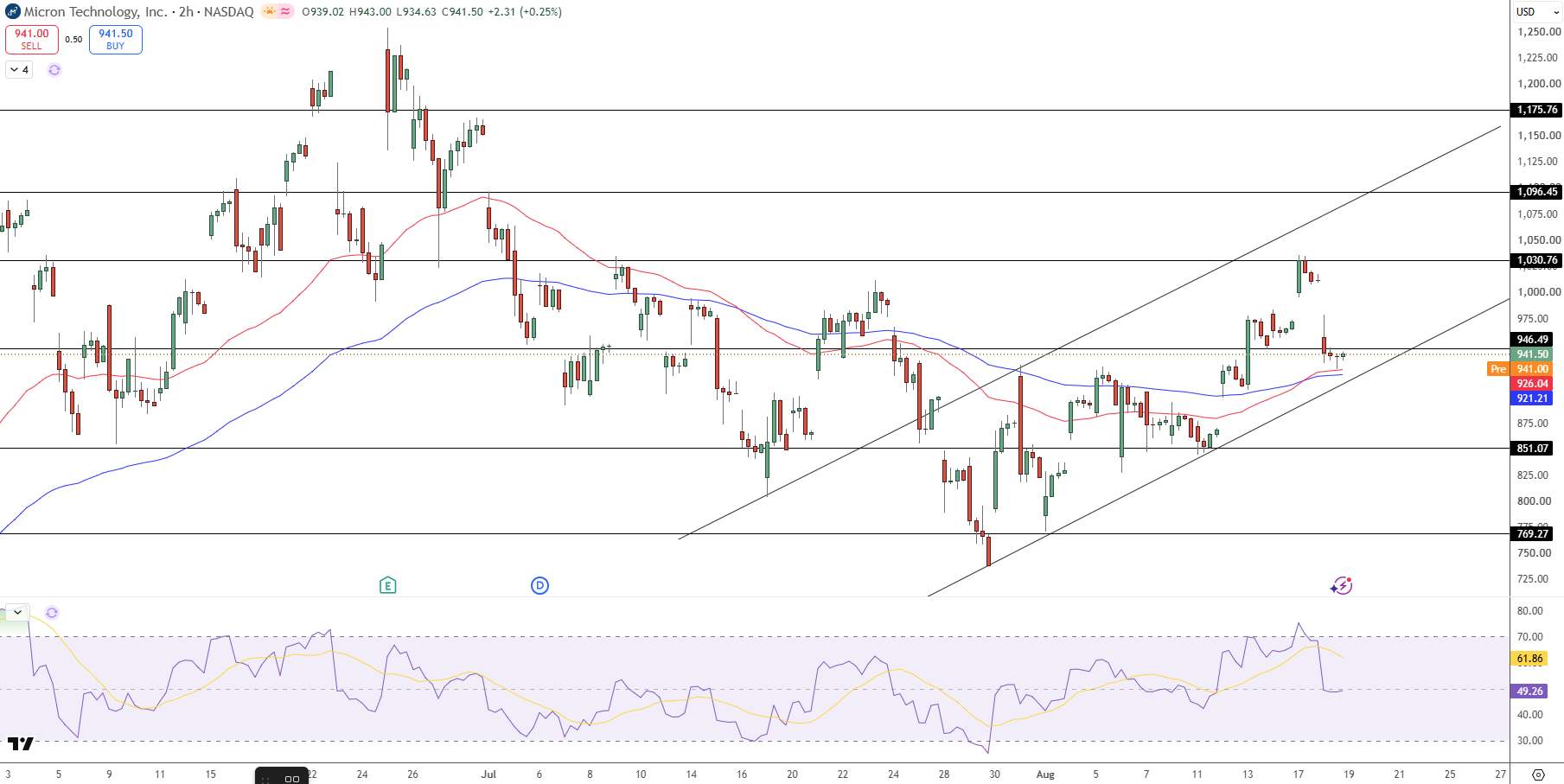
Micron Stock Price Chart - Source: Tradingview
The support zone of 941–946.49 allows MU to collect itself and attempt the $1,030.76 level again. A break above $1,031 would target $1,096.45 and then $1,175.76. RSI is around 49 and has been below the signal line of 62, which indicates a lack of buying pressure.
Beneath $941, the moving averages of $992.60 and $991.21 form the next support cluster along the rising channel. A break below this section would expose the $851.07 level.
Bottom Line
Micron’s 7% decline mirrored the rest of the semiconductor sector and was not a result of weaker company guidance. Strength in the operating environment is supported by company records being broken in Q3 and the expectation of $50 billion in revenue in Q4. There is great volume in shipped HBM4 and multiyear supply contracts.
There are great expectations and a risk of requirment, heavy investment in manufacturing, and intense competition from China and reliance on continued DATACENTER investment. MU is constructive to the downside 921-926, but is has to reach 946.49 to have a better chance of targeting $1,031.
Recommended Articles


