


Microsoft Q4 Strong: Azure +43%, Copilot Embedding, But Capex Tests FCF as $480 Holds Support
TradingKey - For Microsoft(MSFT), the fourth quarter results had Azure growth at 43% (45% constant currency), Microsoft Cloud Services at $54.9 billion, and embedded Copilot across enterprise tools. However, the quarter illustrated a concern for non-Azure-based revenue investors: Microsoft is spending at a faster rate than revenue growth at 18%. Data Center expenses are going up, along with GPU procurement and bargains for secured power agreements and multi-year infrastructure contracts. The focus has changed from whether Microsoft will profit from AI. Azure and Copilot sales confirm this. The focus is whether with the high speeds of capital expenditures and the infrastructure investments and the depreciation expenses of future years, free cash flows will continue.
The Microsoft stock selloff in early August completed the correction and is now testing the 23.6% Fibonacci support at approximately $480. If investors can keep Microsoft above this portion, then the recovery to the $500-$512 range remains possible while we wait for the Federal Reserve's Jackson Hole speeches that will influence the capitability spending of August 21-22. Finally, the next phase of Microsoft's chapter will be the Azure growth margin rates, not the growth margin rates of Copilot.
Azure Growth Accelerated to 43%: Demand Still Exceeds Supply in Key Regions
Microsoft's AI offerings extend beyond Azure. Copilot is becoming more deeply integrated into existing product offerings across the Stacks including Microsoft 365, GitHub, Security Copilot, and Dynamics. The addition of Copilot does not equate to incremental subscription revenue. However, each of these offerings represent massive existing customer bases with the potential for existing users to derive even more value from the products as a result of AI integration.
Microsoft does not need to serve hundreds of millions of new customers to capture revenue from AI. AI-powered Services can increase the value of offerings to existing enterprise customers while increasing price and reducing customer value acquisition.
Copilot Is Embedding Across the Product Stack: From 365 to GitHub to Security
Microsoft’s AI focus includes offerings beyond its Azure infrastructure, and Copilot’s embedding stretches across Microsoft’s software portfolio to include Microsoft 365, GitHub, and security products such as Defender and Sentinel. Copilot uses existing customer bases with products such as Microsoft Dynamics 365, which serves the sales and customer service domains, and amplifies their value and stickiness.
Microsoft will not rely on adding hundreds of millions of customers to create AI revenue. On the contrary, it will rely on its enterprise customers. Copilot’s adoption will create an average revenue increase per enterprise customer, while its security and AI-automation offerings will give Microsoft the edge against its competitors.
OpenAI Partnership: Strategic Asset, But Diversification Matters
Microsoft has a strategic asset in its AI offerings with its Copilot product and large investments in its partnership with OpenAI. However, OpenAI is also a partner to other competitors. This Means Microsoft is also supporting other AI models, such as Google’s, to decrease the company's overall dependence on OpenAI. In this case, customers each have the freedom to choose which model is most appropriate for a specific task.
Power Constraints Are Real: Microsoft Securing Long-Term Electricity Agreements
It’s not just software infrastructure which poses developmental constraints. AI clusters require hundreds of megawatts of power. Microsoft has begun signing long-term power contracts to lock in megawatt-hours before competitors. There are data center power “bottlenecks” because competitors’ data center power usage is increasing and not because architectural limitations have been reached. Microsoft is securing long-term power contracts before other cloud competitors in order to secure a significant portion of the expected future cloud market.
Capex Is Scaling Faster Than Visible Cloud Revenue: The FCF Risk
As the firm builds out its Azure OpenAI and Copilot capacity, as well as capacity for external enterprise workloads, Microsoft is spending over $40 billion each quarter on capital items such as data centers, servers, networking gear, and AI accelerators. This is a primary focus of concern for investors. Strong revenue growth of 18 percent notwithstanding, if capital spending outpaces cash flow from operations, there will be adverse impact on free cash flow over the long term.
This is a primary concern at Meta, Alphabet, and Amazon, as well. Microsoft has the advantage that the demand for Azure is visible and growing. The primary concern is return on capital. Will each new incremental dollar of capital spend generate increased revenue and profit sufficiently in order to justify the cost?
Depreciation Will Eventually Flow Through Income Statement: Margin Watch
The impact of capital expenditures on cash flow is immediate, while the impact of depreciation on margins is realized over time. Over the years of massive capital expenditures, Microsoft has reported high operating margins. This is attributable to high incremental profits of the software businesses and scale of Azure. However, with the pressure from new data centers and the acceleration of depreciation, there will be margin pressure over the next 2 to 3 years. Investors will need to be vigilant.
Cybersecurity Is an Underappreciated Growth Engine: Defender, Sentinel, Entra
Another sales driver is security. Products like Microsoft Defender, Sentinel, Entra, and others, leverage the huge span of the company's enterprise. Security telemetry is one area that is enhanced by AI. Autonomous agents and/or cloud adversaries invent ways to attack cloud environments, most attack automation is done via AI. Microsoft is well-positioned to provide AI-based detection for automated attacks integrated in software used by most enterprises.
MSFT Technical Setup: $480 Support (23.6% Fib), $511.80 Resistance, Higher-Degree Bullish Structure
MSFT is currently testing the 23.6% descending fib at $480.13 on the 4-hour chart. The levels are formed after a recent surge to the upside from $480.13 to $511.80. The important development is that price broke out above a long-term falling trendline. As long as price holds above $480, the breakout remains intact. The RSI values currently are in the mid-50s after being overbought at 70, signaling that price is still above the neutral level of 50.
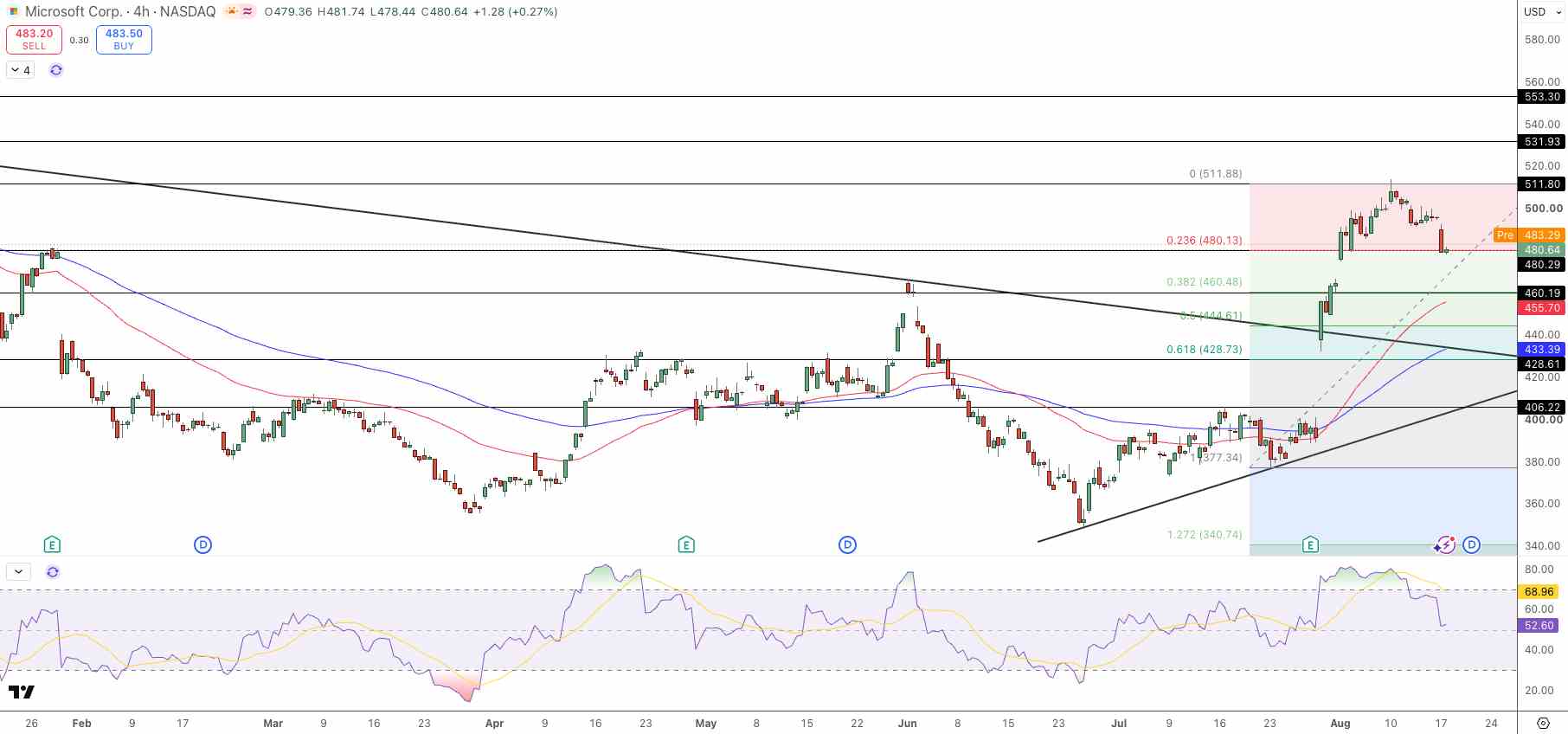
MSFT Price Chart - Source: Tradingview
If price closes above the $511.80 level, there are further resistance levels at $531.93 and $553.30. On the downside, if price breaks below $480, the next support will be at the 38.2% descending fib at $460.48 and would be followed by a shorten moving average at $455.70. Below $455.70, the level at $444.61 will become important.
Key Technical Levels (Through Jackson Hole)
Some key levels to pay attention for before Jackson Hole are the current levels of key support at $480.13 (23.6% descending fib), which need to hold, and previous resistance at $511.80 with an opportunity to retest. Further up, there are resistance levels at $531.93 and $553.30. On the downside, the breakdown levels are at $460.48 (38.2% fib) and $455.70 (50-day EMA) with further support at $444.61. Looking at momentum, the RSI is at 53 showing that price has cooled from overbought levels and crossed above the signal at 69.
Bottom Line
Microsoft hit $90B in revenue for Q4 (up 18%), with a 43% increase (45% cc) in Azure (Cloud $54.9B). Copilot embeds across Office, GitHub, and Security. Solid numbers. Digging in, Microsoft is looking at billions of dollars each quarter on data centers, energy, and graphics cards that have long-term contracts. There will be a lot of pressure on cash flow, and reverse will kick in. From a technical view, MSFT sits at $480, testing the 23.6% support level at $511.80 ($480 support holds). Above $460, a breakout structure is still intact.
With all of this, the main question is if Microsoft can turn their $300+B investment in infrastructure into comparable improvements in margins and FCF. There is strong demand for Azure, but the confidence in this cash flow depends on what happens at the Jackson Hole (Aug 21-22) and the Fed’s comments. If Powell says that the environment will be more friendly to capital spending, then a breakout will more than likely be sustained at $511.80. However, if there is still a lot of uncertainty, then a breakout at $480 could be questioned.
For investors, the 43% growth in Azure and the monetization of Copilot is solid evidence and a strong narrative. However, the capex to revenue ratio is quickly becoming a bigger challenge in valuation. We will see if there is a slowdown in margins and FCF in Q1 FY2027 (Oct earnings). Jackson Hole will set the tone. This is analysis, not investment advice.
Recommended Articles


