


US Stocks Close: Dow Drops 270 Points, SOX Bucks Trend to Gain 1.64%; Memory and Optical Communication Stocks Lead Gains; Micron Rises 4% to Retake $1,000 Mark
TradingKey - The US-Iran ceasefire agreement expired on Monday, with negotiations reaching a stalemate, and the 30-year US Treasury yield hit its highest level since 2007, both weighing on US stocks. All three major indexes fell, while AI hardware stocks bucked the trend to move higher, with memory and optical communication stocks leading the gains.
At the close, the Dow Jones Industrial Average fell 0.51% to 53,459.78; the Nasdaq Composite Index lost 0.32% to 26,644.91; and the S&P 500 Index dropped 0.52% to 7,745.06.
Tech Stock Performance
Micron (MU) rose 4.13% to $1,011.75, returning to $1,000 for the first time in three weeks.
In a note on Friday, Pierre Ferragu, an analyst at U.S. TMT research firm New Street Research, pointed out that investors are asking the wrong questions and argued that Micron Technology's stock still has significant upside potential. Ferragu upgraded Micron Technology's stock rating from "Neutral" to "Buy" and sharply raised his target price to $1,250. The firm forecasts that by 2030, cash on Micron Technology's balance sheet will exceed $600 billion, with annual free cash flow topping $150 billion. Looking ahead, Ferragu believes Micron's market capitalization could reach $2 trillion to $3 trillion by 2030, implying that the market currently severely underestimates the company's long-term earning power.
SanDisk (SNDK) continued its rally, rising 8.88% to $1,786.85.
At its 2026 Investor Day, SanDisk stated that as artificial intelligence (AI) expands further from training to inference, data center demand for high-performance, high-capacity, and low-power storage will increase significantly, expecting the enterprise data center flash total addressable market to expand to 1.2 ZB by 2030. Meanwhile, SanDisk expects revenue to maintain mid-to-high double-digit growth in fiscal years 2028 through 2030, with non-GAAP gross margin remaining at around 80% and adjusted free cash flow margin reaching approximately 50%.
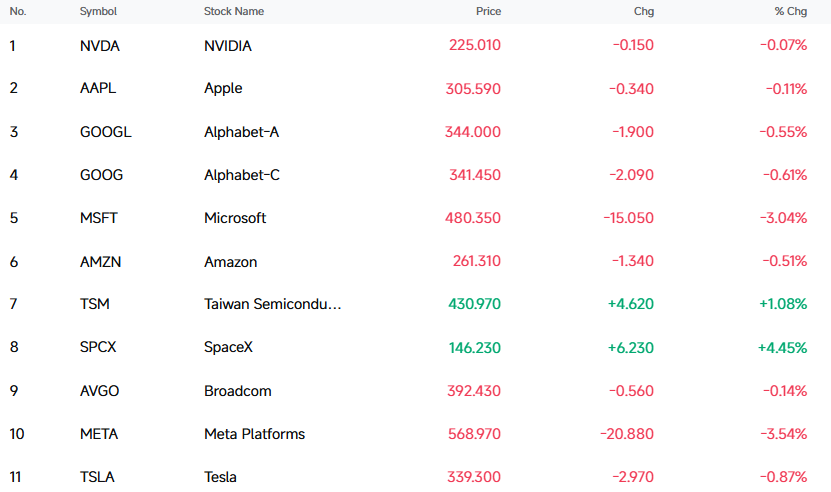
Among mega-cap tech stocks, SpaceX (SPCX) rose 4.45%; on the downside, Meta Platforms (META) fell 3.54%, Microsoft (MSFT) fell 3.04%, Tesla (TSLA) fell 0.87%, Google (GOOGL) fell 0.55%, Amazon (AMZN) fell 0.51%, Broadcom (AVGO) fell 0.14%, Apple (AAPL) fell 0.11%, and Nvidia (NVDA) fell 0.07%.
[Source: FutuBull]
The Philadelphia Semiconductor Index rose 1.64% to 12,621 points. Among its 30 constituents, 19 advanced and 11 declined.
Among memory stocks, SanDisk (SNDK) rose 8.88%, Western Digital (WDC) rose 5.35%, Micron Technology (MU) rose 4.13%, SK Hynix (SKHY) rose 3.04%, and Seagate Technology (STX) rose 2.19%.
Among optical communications stocks, Marvell Technology (MRVL) rose 5.54%, Lumentum (LITE) rose 4.62%, Corning (GLW) rose 4.36%, Ciena (CIEN) rose 3.86%, and Applied Optoelectronics (AAOI) rose 3.07%.
Nvidia announced that its Spectrum-X Ethernet Photonics switch based on co-packaged optics (CPO) technology has officially entered mass production. Compared with traditional pluggable optical module solutions, the new architecture delivers 5x optical power efficiency, 5x AI application execution runtime, and a 10x improvement in reliability, signaling that CPO is transitioning from technical verification to commercial-scale application.
Company News
Nvidia Provides $105 Billion in Credit Support for OpenAI Data Center
Nvidia announced that it will provide up to $105 billion in credit support for a large-scale AI data center campus being built for OpenAI in Pike County, Ohio, and invest $1.5 billion in project developer SB Energy. The project will be built, owned, and operated by SoftBank-backed SB Energy, with OpenAI acting as the primary tenant under a 20-year lease. According to regulatory filings submitted by Nvidia, OpenAI plans to lease up to approximately 8 gigawatts of computing capacity from the campus, with the first batch of 800 megawatts expected to go operational in 2028. The initial phase of the project corresponds to an IT load of approximately 4.25 gigawatts, with Nvidia having the option to further expand its support by about 3.75 gigawatts. The campus will adopt Nvidia's full-stack AI factory platform, making it a key project for its large-scale deployment of AI chips and networking equipment.
Synchrony Financial Partners with OpenAI to Launch ChatGPT Shopping Feature
Synchrony Financial is working with OpenAI to further embed credit cards, consumer financing, and rewards systems into the ChatGPT shopping workflow, allowing consumers to complete purchases directly within the chat window in the future. However, this feature is not yet fully implemented. Maran Nalluswami, Chief Strategy and Business Development Officer at Synchrony, stated that integrating general-purpose credit cards into ChatGPT is expected to take 6 to 12 months; private-label store cards used exclusively with specific retailers will require further coordination with individual brands and may take longer. Issues regarding whether consumers are willing to provide credit card information to AI platforms, as well as how merchants, financial institutions, and AI platforms will distribute transaction fees, rewards, and revenue, also remain to be resolved.
Anthropic's Annualized Revenue Expected to Exceed $65 Billion Ahead of IPO
According to people familiar with the matter, Anthropic PBC's annualized revenue is on track to exceed $65 billion based on current performance projections, representing a growth pace that has more than septupled since the end of last year. The company's revenue run rate—a metric used to project full-year revenue based on shorter time periods—reached $65 billion as of the end of July. Anthropic disclosed these figures during a routine update to investors. The sharp acceleration in revenue further solidifies Anthropic's plans to go public. Both Anthropic and OpenAI have confidentially filed IPO documents, with Anthropic expected to debut on Wall Street as early as this fall, ahead of OpenAI.
Industry & Macro News
Senior Iranian Official: Deadline of Several Weeks Set for US to Fully Implement Memorandum of Understanding
According to Reuters, a senior Iranian official stated that Iran has decided to shift its policy from defense to a "full offense." Pressuring the US or relying on mediators to reach a lasting peace is unrealistic. Iran has set a deadline of several weeks for the US to fully implement the memorandum of understanding. If diplomatic efforts fail, all Iranian entities will be prepared to escalate tensions in the Strait of Hormuz and surrounding areas. Regarding the set timeframe, Iran will convey relevant information to the US and regional countries through mediators. Iran will not wait indefinitely while the US continues its naval blockade.
Trump: US Does Not Seek to Extend Memorandum of Understanding with Iran
US President Donald Trump stated that the US is currently not seeking to extend the memorandum of understanding with Iran. Trump said Iran wants to reach a deal, but will not accept what he deems "necessary" terms. Trump reiterated the idea of declaring the Strait of Hormuz as US territory and reaffirmed that the US controls the strait. He also claimed that the Strait of Hormuz currently remains open and oil prices are trending downward.
US 30-Year Treasury Yield Rises to 19-Year High
The 30-year US Treasury yield rose to 5.31% on Monday, reaching its highest level since 2007 and placing it just steps away from highs seen in the early stages of the global financial crisis. The sell-off in long-term Treasuries was driven by investor concerns over expanding US government spending, increased supply of long-term bonds, and inflation persistently exceeding the Federal Reserve's 2% target. Rising yields mean the US government will have to pay higher interest on new debt, further increasing borrowing costs. As fiscal deficits widen and debt levels climb, markets are demanding higher risk compensation on long-term Treasuries to hedge against risks such as stubbornly high long-term inflation, elevated short-term interest rates, and deteriorating fiscal conditions.
Goldman Sachs: Global Bond Issuance Dropped 16% Year-over-Year Last Week
Goldman Sachs data shows that global bond issuance dropped 16% year-over-year last week, though year-to-date issuance remains 9% higher than the same period last year. Investment-grade corporate bond issuance surged 60%, while high-yield bond issuance fell 41% and leveraged loan issuance plunged 88%. Issuance of financial sector bonds rose 38%, while structured finance issuance dropped 64%. Meanwhile, assets of ETFs tracking the S&P and MSCI indices continued strong growth, rising 32% and 36%, respectively.
Recommended Articles


