


US Stocks Close: Dow Hits New High as Nasdaq Falls 0.83%; Tech Stocks Retreat, Gold Stocks Gain; Nvidia Rises 3.43%, SpaceX Falls 13% After Results
TradingKey - U.S. private-sector jobs increased by 44,000 in July, marking the lowest level since the beginning of this year. Meanwhile, after a four-day strong rally, pullbacks in some tech stocks dragged down the stock indices. The three major U.S. stock indices ended mixed, with the Dow Jones Industrial Average continuing to hit record highs and gold stocks strengthening.
At the close, the Dow Jones Industrial Average rose 0.49% to 54,349.12; the Nasdaq Composite Index fell 0.83% to 26,363.44; and the S&P 500 Index fell 0.17% to 7,723.55.
Tech Stock Performance
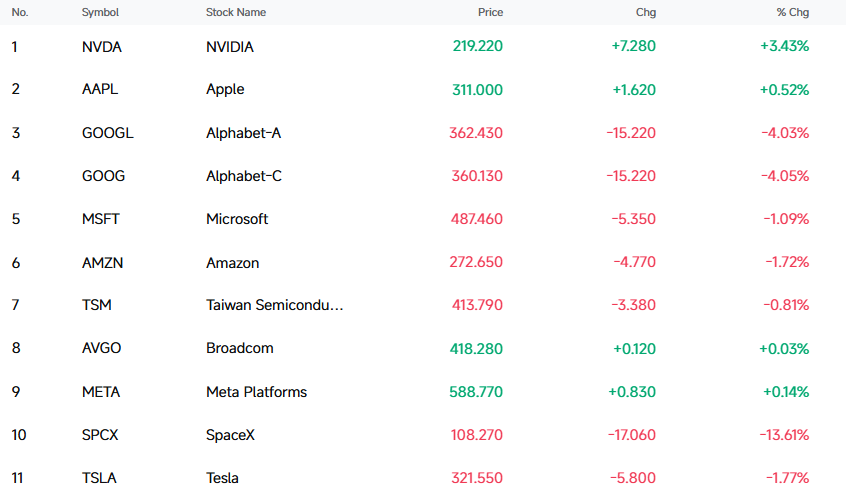
Nvidia (NVDA) rose 3.43% to $219.22, with its market capitalization returning to $5.31 trillion.
During the investor conference call for SpaceX's first quarterly earnings release after going public, CEO Elon Musk announced that the company has decided to exclusively adopt Nvidia technology for its AI computing power infrastructure. Musk stated that SpaceX views Nvidia's Vera Rubin architecture as "the best AI computer at present" and plans to start launching Starmind satellites equipped with Nvidia's Vera Rubin NVL72 rack-scale systems next year, extending AI computing power to low Earth orbit.
Among large-cap tech stocks, Nvidia (NVDA) rose 3.43%, Apple (AAPL) gained 0.52%, Meta Platforms (META) ticked up 0.14%, and Broadcom (AVGO) edged up 0.03%. Conversely, SpaceX (SPCX) slumped 13.61%, Google (GOOGL) dropped 4.03%, Tesla (TSLA) fell 1.77%, Amazon (AMZN) slid 1.72%, and Microsoft (MSFT) declined 1.09%.
[Source: FutuBull]
The Philadelphia Semiconductor Index fell 1.4% to 12,008.88 points. Among its 30 constituents, 9 rose and 21 fell.
Among memory stocks, SanDisk (SNDK) fell 5.40%, Western Digital (WDC) dropped 5.36%, SK Hynix (SKHY) slid 2.17%, and Seagate Technology (STX) slipped 0.91%.
Corporate News
Meta launches its first programming agent, Muse Code, which can work collaboratively with Muse Spark 1.2
Meta Platforms launched its first programming agent, Muse Code, in an attempt to challenge Anthropic and OpenAI. Muse Code is the latest major release since Alexandr Wang took over as Meta's head of artificial intelligence. He leads Meta’s Superintelligence Laboratory (MSL), which is responsible for foundation model development. Muse Code is designed to make it easier for users to develop applications within a single user interface while managing AI-powered agents. The programming agent is currently available in beta or preview, and can work in tandem with Meta's latest AI model, Muse Spark 1.2. Developers can access Muse Code via a pay-as-you-go model, featuring API pricing similar to Muse Spark 1.1 at $1.25 per million input tokens and $4.25 per million output tokens.
Google AI pioneer Jeff Dean departs to launch AI startup
Jeff Dean, one of Google's earliest employees and a core figure responsible for designing the company's artificial intelligence strategy over the past 15 years, is leaving the company to launch an AI startup focused on the field of scientific discovery. Dean joined Google in 1999 as its 30th employee. He will serve as chief executive officer of Discovery Loop, a new public-benefit corporation. The company aims to accelerate technological progress by automating complex, multi-step scientific and engineering tasks. Joining Dean in co-founding the venture are Google veterans Oriol Vinyals, Quoc Le, and Sanjay Ghemawat. Together, the four have driven significant advances in mathematics and protein structures and are among the most highly cited researchers globally. The departures of these talents, including Dean, from Google further compound the company's recent AI brain drain.
Over half of Microsoft's AI revenue comes from OpenAI
Microsoft's latest disclosure reveals that the majority of its artificial intelligence revenue is derived from OpenAI. In a filing last week, Microsoft stated that for the fiscal year ending in June, its sales from OpenAI reached $24.1 billion. Microsoft CEO Satya Nadella previously stated that by the end of the March quarter, the company's annualized AI revenue run rate was on track to reach $37 billion. This disclosure indicates that OpenAI contributed over half—and potentially around 70%—of Microsoft's actual AI sales in the most recent fiscal year. Under the agreement between the two companies, OpenAI pays Microsoft for computing power, costs related to AI model development, and a share of certain revenues.
Anthropic confirms formation of chip team to develop in-house chips for Claude
AI startup Anthropic is building a team to design its own AI chips amid rapidly growing demand for its AI models, Business Insider reported. According to job postings and a company statement, Anthropic is recruiting engineers to design custom chips for its Claude AI models. Meanwhile, an Anthropic spokesperson confirmed that the company is assembling an in-house chip team to develop specialized chips for Claude, marking the first time the company has publicly acknowledged the plans. The spokesperson added that Anthropic will co-design hardware and AI models to enable Claude to 'run faster and more efficiently at the scale customers need.' However, the spokesperson also noted that Anthropic will pursue a 'multi-chip strategy,' meaning hardware from Amazon Web Services (AWS), Google, Nvidia, and AMD will remain vital components of the AI lab's plans to scale its computing capacity.
Industry and Macro News
Iran Seeks to Charge Strait-Transit Vessels Fees of 5% to 7% of Cargo Value
According to Reuters on Wednesday, citing a senior Iranian source and two regional officials, a proposed Iran-Oman agreement would give Iran control over vessels entering the Gulf through the Strait of Hormuz, representing one of the largest concessions won by Iran to date. Iran subsequently stated that vessels entering and leaving the Gulf will pass through Iranian waters. Regional sources said details remain to be finalized regarding how "control" is defined. An Iranian source said the current draft agreement on the table envisions Iran controlling vessels entering the Gulf through the strait, with one of the primary disputes being what role Iran should play regarding outbound vessels. Iran's deputy foreign minister later stated: "The route is designed in such a way that both the inbound and outbound routes for commercial vessels will pass through Iranian territorial waters." Senior Iranian officials revealed that Iran is seeking to charge vessels using the strait a fee equivalent to 5% to 7% of their cargo value, while Oman is discussing a lower fee of around 3% and Washington wants no fees charged at all. Keeping the fee payments nominally voluntary could be a way to break the deadlock, though shipping companies may feel compelled to pay for passage under the threat of potential Iranian attacks.
Iranian and Omani Negotiators Have Completed Draft of Hormuz Agreement
Two regional officials told the Associated Press on Wednesday that Iranian and Omani negotiators have agreed on a draft agreement, which is currently awaiting final approval from Iran's Supreme Leader, the AP reported. The officials, who are familiar with the negotiations, said the potential agreement is aimed at serving as an interim solution to the dispute between the U.S. and Iran over shipping in the Strait of Hormuz. They noted that the agreement is linked to a deal reached between the U.S. and Iran in June, which was intended to end the conflict and reopen the strait, but ultimately did not last. They added that this potential agreement would pave the way for the U.S. and Iran to resume negotiations toward a final deal on Tehran's nuclear program.
Fed's Kashkari: Now Is the Time to Start Raising Rates Gradually
Minneapolis Fed President Neel Kashkari, a 2026 voting member of the Federal Open Market Committee (FOMC), said the Fed should now "start raising" interest rates gradually to lower inflation and avoid the need for larger increases in the future. Kashkari was one of three voting members who supported a 25-basis-point hike at last week's FOMC meeting. He stated that with robust corporate earnings and resilient consumer and labor markets, there is no evidence that monetary policy is significantly restrictive, meaning it is time to start raising rates gradually. He emphasized that this is not an advocacy for large rate hikes, but rather a preference for "small steps" to avoid being forced into aggressive tightening later if inflation becomes entrenched. He added that he is uncertain about what action the FOMC will take in September, noting that upcoming data will play a crucial role. Meanwhile, Kashkari said Fed Chair Warsh did not pressure him and had told him: "Do what you think is right for the economy."
US ADP Private Payrolls Miss Estimates as Hiring Momentum Slows
U.S. companies added fewer jobs than expected in July, indicating that hiring momentum is cooling somewhat after a recent period of strong growth. According to data released by ADP on Wednesday, U.S. private sector employment increased by 44,000 in July, the lowest level since the beginning of this year. However, despite the slower pace of hiring, the report showed that wage growth for job changers accelerated to its highest rate in nearly a year. The data indicates that the U.S. labor market remains stable, supported by strong business and consumer demand. If Friday's nonfarm payrolls report confirms this trend, the recent employment trajectory will mean Fed officials can remain focused on stubbornly high inflation.
Recommended Articles


