


Prediction: This Brilliant ETF Will Crush the S&P 500 Over the Next 30 Years
Key Points
If you have decades left to invest, you can put your money into higher-risk, higher-reward opportunities to enhance your returns.
One of the best ways to do that is by investing in growth stocks.
The Vanguard Morningstar Growth ETF (VUG) targets companies generating strong earnings & revenue growth and high return on assets.
- 10 stocks we like better than Vanguard Morningstar Growth ETF ›
Trying to outperform the S&P 500 (SNPINDEX: ^GSPC) consistently over time is a difficult task. Over long periods, even professional managers struggle to do it. But if you can capture the right theme, maintain the discipline to ride out market volatility, and keep costs low, it is possible.
The one fund that I think has a legitimate chance to outperform the broader market over the next 30 years is the Vanguard Morningstar Growth ETF (NYSEMKT: VUG).
Missed Nvidia in 2009? This Rare Signal Is Flashing Again. In 2009, a "Double Down" signal flashed for a little-known chipmaker called Nvidia. For the first time in years, that same "Total Conviction" signal is flashing for a company 1/100th the size of Nvidia. Continue »
How VUG captures economic growth stories
The long-term investment case for growth stocks is pretty straightforward. These are usually the companies driving the fastest earnings growth in the U.S. economy. Today, it's artificial intelligence (AI) stocks. A decade ago, it was cybersecurity stocks. And 25 years ago, it was the internet.
Image source: Getty Images.
Even though the theme or technology changes, the Vanguard Growth ETF can evolve its portfolio to reflect what's growing at the time. Its methodology, which considers past and forecast earnings growth rates, sales per share, and return on assets (ROA), helps ensure it targets growth stories wherever they come from.
But the growth story comes with a trade-off. These stocks often come with above-average volatility. Investors need to be comfortable with that and willing to ride out the highs and lows to give themselves the best chance of outperforming the market.
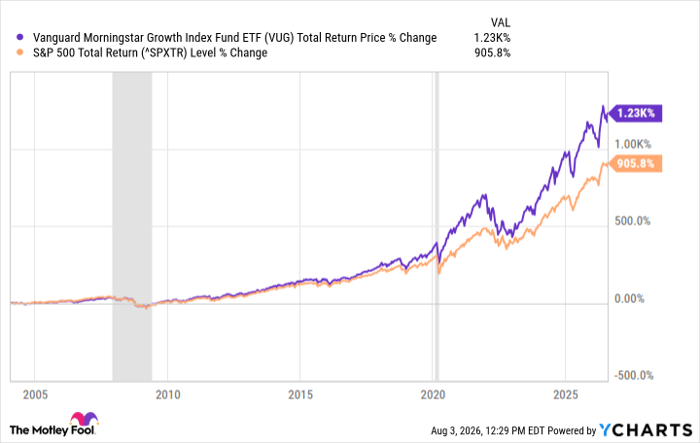
If you had been willing to do that throughout the 2000s, the returns would have been fantastic.
Data by YCharts.
Since its inception in 2004, the Vanguard Morningstar Growth ETF would have beaten the S&P 500 by a margin of 1,230% to 905%. That's an outperformance of roughly 1.5 percentage points annually over more than 20 years.
How VUG fits into a portfolio
The Vanguard Morningstar Growth ETF isn't designed to be a core portfolio position. Right now, roughly 70% of the portfolio is tech, and you don't want a single sector driving your portfolio's performance.
Having something like the Vanguard S&P 500 ETF (NYSEMKT: VOO) or the Vanguard Morningstar Total Stock Market ETF (NYSEMKT: VTI) as the foundation of your portfolio, giving a 10%-15% allocation to growth stocks can make sense. It makes more sense if you're younger and have years, if not decades, of investing time ahead. Having time to recover from deep or prolonged downturns is key to realizing some of the potential returns growth stocks offer.
Past performance is no guarantee of future results, but it can act as a guide. A lot can happen over the course of 30 years, and we're likely to see things that we haven't even thought of yet. Investing in growth and innovation over time is one of the best ways to give yourself a chance to outperform the market.
Should you buy stock in Vanguard Morningstar Growth ETF right now?
Before you buy stock in Vanguard Morningstar Growth ETF, consider this:
The Motley Fool Stock Advisor analyst team just identified what they believe are the 10 best stocks for investors to buy now… and Vanguard Morningstar Growth ETF wasn’t one of them. The 10 stocks that made the cut could produce monster returns in the coming years.
Consider when Netflix made this list on December 17, 2004... if you invested $1,000 at the time of our recommendation, you’d have $395,463!* Or when Nvidia made this list on April 15, 2005... if you invested $1,000 at the time of our recommendation, you’d have $1,268,290!*
Now, it’s worth noting Stock Advisor’s total average return is 927% — a market-crushing outperformance compared to 211% for the S&P 500. Don't miss the latest top 10 list, available with Stock Advisor, and join an investing community built by individual investors for individual investors.
See the 10 stocks »
*Stock Advisor returns as of August 4, 2026.
David Dierking has positions in Vanguard Morningstar Total Stock Market ETF. The Motley Fool has positions in and recommends Vanguard Morningstar Growth ETF and Vanguard S&P 500 ETF. The Motley Fool has a disclosure policy.
Recommended Articles


