


Microsoft vs. Meta Platforms: Which Is the Better Magnificent Seven Stock to Buy Right Now?
Key Points
Meta stock fell following its latest report due to concerns about its heavy AI spending that's pressuring its cash flow.
Microsoft, on the other hand, is being prudent with its spending, and this explains why the stock jumped after its quarterly results.
- 10 stocks we like better than Microsoft ›
Tech giants Microsoft (NASDAQ: MSFT) and Meta Platforms (NASDAQ: META) have posted a disappointing stock market performance so far in 2026, with shares of both companies in the red as of this writing.
While Meta Platforms is down 14% this year, Microsoft has dropped 2%. Both Magnificent Seven stocks recently reported their quarterly results, and there was a stark contrast in the way the market reacted to their earnings reports. Let's see why that was the case.
Where to invest $1,000 right now? Our analyst team just revealed what they believe are the 10 best stocks to buy right now, when you join Stock Advisor. See the stocks »
Image source: The Motley Fool.
Microsoft stock soars after a solid report
Shares of Microsoft popped more than 15% after the company released its fiscal 2026 fourth-quarter results (for the three months ended June 30) on July 29. Investors were happy with Microsoft's forecast that it will remain cash flow positive in fiscal 2027 despite investments in infrastructure to meet the growing demand for its artificial intelligence (AI) services.
Microsoft projects $175 billion in capex for calendar 2026, below the $190 billion analyst estimate. It is also worth noting that Microsoft management remarked on the latest earnings call that its fiscal 2027 capex will increase year over year. So, the company's focus on prudently spending cash to build AI infrastructure has boosted investors' confidence in the stock, which explains the post-earnings pop.
Microsoft posted $332 billion in revenue in fiscal 2026, up by 18% from the prior year. Additionally, the company's non-GAAP earnings per share (EPS) increased by 22% year over year to $17.28. The tech giant has a large enough backlog to sustain healthy growth over the long run. It reported $678 billion in commercial remaining performance obligation (RPO) last quarter. The metric, which refers to the total value of contracts yet to be fulfilled at the end of a quarter, increased by 84%.
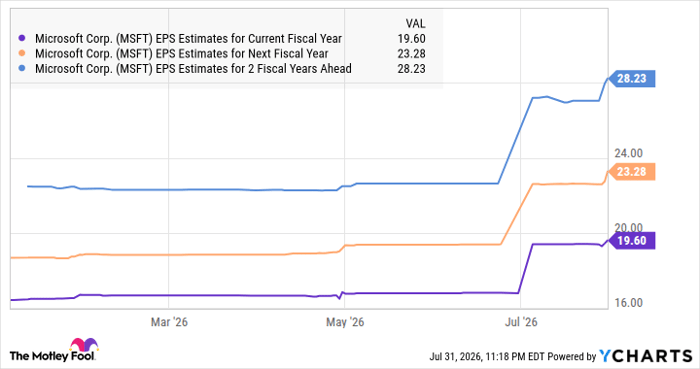
This tremendous backlog should support robust growth in Microsoft's cloud business over the long run, while the company's focus on keeping spending at reasonable levels should support bottom-line growth. This is why analysts have become bullish about Microsoft's earnings growth prospects.
Data by YCharts
The chart above indicates that Microsoft's earnings growth will eventually accelerate, which could set this tech stock up for healthy long-term gains.
Meta's aggressive spending has spooked investors
Meta released its second-quarter results on July 29, the same day as Microsoft, but its stock headed in the opposite direction and fell over 9% the following day. It was easy to see why that was the case.
Though Meta's Q2 revenue increased 28% year over year to $60.8 billion, its net income fell 14%. Meta's earnings per share of $6.18 landed well below the $7.22 consensus estimate. The company's aggressive AI infrastructure build-out led to a severe dent in the free cash flow, which fell to $784 million from $8.55 billion a year ago.
CEO Mark Zuckerberg pointed out on an earnings call with analysts that the company will "continue to invest aggressively in infrastructure" to support the growing demand for AI in its products and services. The company has narrowed its 2026 capex guidance to a range of $130 billion to $145 billion from the earlier range of $125 billion to $145 billion.
The higher floor suggests a 90% increase in capex this year at the midpoint, compared to last year's outlay of $72.2 billion. This increased spending explains why analysts have been reducing their bottom-line estimates for Meta. Consensus estimates project a 3% increase in Meta's earnings per share in 2026 to $32.12.
The earnings estimate was slightly higher at $33.07 per share a week ago. The EPS estimate for 2027 has also moved lower over the past week. So, the negative analyst sentiment could continue to weigh on Meta stock. Does this mean Microsoft is the better buy right now?
Which Magnificent Seven stock should you buy right now?
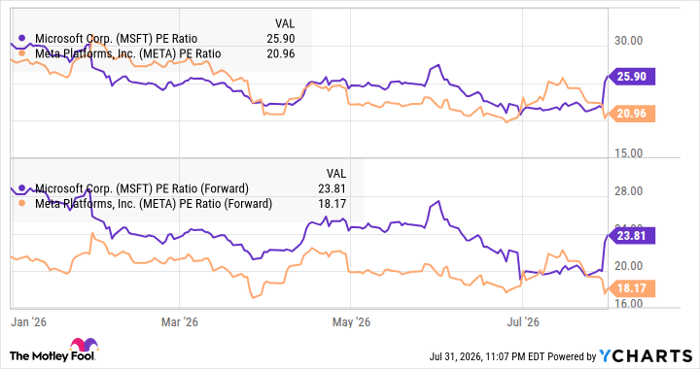
The discussion above indicates that Microsoft is currently poised to deliver stronger earnings growth than Meta. Also, investor sentiment is in Microsoft's favor following its latest quarterly report. Moreover, both stocks are almost in the same position when their valuations are considered, with Microsoft being slightly more expensive of the two.
Data by YCharts
So, it is easy to see that Microsoft is the better tech giant to buy right now, as its ability to deliver healthy earnings growth and attractive valuation should help it outperform Meta Platforms.
Should you buy stock in Microsoft right now?
Before you buy stock in Microsoft, consider this:
The Motley Fool Stock Advisor analyst team just identified what they believe are the 10 best stocks for investors to buy now… and Microsoft wasn’t one of them. The 10 stocks that made the cut could produce monster returns in the coming years.
Consider when Netflix made this list on December 17, 2004... if you invested $1,000 at the time of our recommendation, you’d have $386,727!* Or when Nvidia made this list on April 15, 2005... if you invested $1,000 at the time of our recommendation, you’d have $1,232,139!*
Now, it’s worth noting Stock Advisor’s total average return is 906% — a market-crushing outperformance compared to 208% for the S&P 500. Don't miss the latest top 10 list, available with Stock Advisor, and join an investing community built by individual investors for individual investors.
See the 10 stocks »
*Stock Advisor returns as of August 2, 2026.
Harsh Chauhan has no position in any of the stocks mentioned. The Motley Fool has positions in and recommends Meta Platforms and Microsoft. The Motley Fool has a disclosure policy.
Recommended Articles


