


Warren Buffett Passed on This Stock for Over 7 Years. Greg Abel May Not Wait Any Longer.
Key Points
MercadoLibre offers the benefits of Amazon without the massive spending on capital expenditures.
Berkshire once invested in other Latin American fintech companies.
MercadoLibre's willingness to sacrifice short-term profitability to build the business may appeal to Greg Abel.
- 10 stocks we like better than MercadoLibre ›
The investment thinking of Berkshire Hathaway may have changed over seven years ago in early 2019, when one of Warren Buffett's lieutenants bought shares in Amazon. Buffett called himself an "idiot" for not buying this stock years earlier.
However, Berkshire soured on the stock as capital expenditures (capex) surged, and the company sold the last of its Amazon shares in the first quarter of 2026.
Where to invest $1,000 right now? Our analyst team just revealed what they believe are the 10 best stocks to buy right now, when you join Stock Advisor. See the stocks »
Fortunately, a similar company fits this philosophy without the need for massive capex. Knowing that, Buffett's successor, Greg Abel, could decide that MercadoLibre (NASDAQ: MELI) is a "Berkshire-worthy" stock. Here's why.
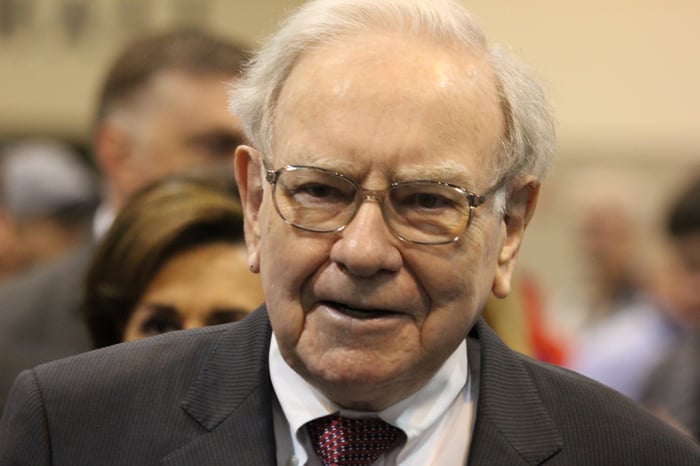
Former Berkshire Hathaway CEO Warren Buffett. Image source: The Motley Fool.
Why MercadoLibre?
MercadoLibre retains many of the characteristics of Amazon without the need for massive capex. Both companies are conglomerates that started out in e-commerce. Instead of moving into the cloud, MercadoLibre has begun enterprises related to fintech and logistics.
Consequently, it spent only about $1.3 billion in capex over the trailing 12 months. That is more than 99% less than the nearly $152 billion Amazon spent in the same period. Even though MercadoLibre has invested in AI and has incorporated it into its business, the company does not need to spend on the technology as if it were a hyperscaler.
Admittedly, MercadoLibre investors take on the significant economic and political risks that come with doing business in Latin America. But the company has thrived in part by turning those risks into business opportunities, and those needs helped inspire the creation of its fintech and logistics businesses.
Moreover, Berkshire has experience with Latin America, specifically in fintech. It was an early investor in Brazilian fintech StoneCo and the Latin American digital bank Nu Holdings. That background should help it better understand Mercado Pago, the enterprise driving MercadoLibre's fastest growth.
Betting on MercadoLibre's turnaround
Additionally, MercadoLibre stock is on sale, trading at a 29% discount to its mid-2025 peak. More importantly, Berkshire should take note of the company's growth potential and its sacrifice of some short-term profit to stoke more long-term growth.
In the first quarter of 2026, MercadoLibre's revenue of $8.8 billion grew by 49% year over year. And given the 44% revenue increase in 2025, its growth is not an anomaly.
However, its efforts to build competitive advantages have hurt profitability. In e-commerce, MercadoLibre faces competition from large enterprises like Amazon and Sea Limited, as well as numerous small businesses. Thus, it has cut its margins through efforts like lowering free shipping minimums in Brazil.
On the fintech side of the business, it has dramatically increased its loan volume. Unfortunately, that also increased the number of bad loans, forcing it to more than double its provision for doubtful accounts. Consequently, net income of $417 million fell 16% over the previous year. This came after the meager 5% yearly profit increase in 2025.
Fortunately, MercadoLibre can compensate for the lower margins over time by increasing sales. The company also made greater efforts to make its AI assistant more proactive, which could help reduce loan losses.
Investors can buy the fintech pivot for around 49 times earnings right now. That is well above the 29 average P/E ratio for the S&P 500, but well below the approximate 80 times earnings that Berkshire likely paid for Amazon in Q1 2019.
That reinforces the view that buying MercadoLibre now would allow it to pay a "fair price" for a "wonderful company," a priority for Buffett during his years running Berkshire.
MercadoLibre as a Berkshire Hathaway holding
Berkshire Hathaway has made no public moves to buy MercadoLibre stock, but the stock easily fits into the investment criteria it established for a similar stock more than seven years ago.
MercadoLibre has shown it can thrive in a difficult environment by turning Latin America's challenges into opportunities. Also, Berkshire's prior experience in that region's fintech business makes MercadoLibre an appropriate holding.
Moreover, MercadoLibre's apparent willingness to sacrifice profitability to build market share could appeal to Abel and others on Berkshire's investment team. Since a 49 P/E ratio is arguably a fair price for this wonderful business, it is likely most Berkshire shareholders would welcome an investment in the consumer discretionary stock.
Should you buy stock in MercadoLibre right now?
Before you buy stock in MercadoLibre, consider this:
The Motley Fool Stock Advisor analyst team just identified what they believe are the 10 best stocks for investors to buy now… and MercadoLibre wasn’t one of them. The 10 stocks that made the cut could produce monster returns in the coming years.
Consider when Netflix made this list on December 17, 2004... if you invested $1,000 at the time of our recommendation, you’d have $386,727!* Or when Nvidia made this list on April 15, 2005... if you invested $1,000 at the time of our recommendation, you’d have $1,232,139!*
Now, it’s worth noting Stock Advisor’s total average return is 906% — a market-crushing outperformance compared to 208% for the S&P 500. Don't miss the latest top 10 list, available with Stock Advisor, and join an investing community built by individual investors for individual investors.
See the 10 stocks »
*Stock Advisor returns as of August 2, 2026.
Will Healy has positions in Berkshire Hathaway, MercadoLibre, Nu Holdings, and Sea Limited. The Motley Fool has positions in and recommends Amazon, Berkshire Hathaway, MercadoLibre, Nu Holdings, Sea Limited, and StoneCo. The Motley Fool has a disclosure policy.
Recommended Articles


