


President Donald Trump Just Threw the Federal Reserve Under the Bus Yet Again Over Interest Rates
Key Points
Although the Dow Jones Industrial Average, S&P 500, and Nasdaq Composite are having another banner year, the prospect of higher interest rates has become a real concern.
President Trump has made a habit of throwing the current Fed chair and/or the FOMC under the bus for not slashing interest rates.
However, two of the president's policies are precisely why the FOMC can't entertain the prospect of rate cuts -- and it's worrisome news for Wall Street.
- 10 stocks we like better than S&P 500 Index ›
With five months left, 2026 has shaped up as another banner year for the stock market. The iconic Dow Jones Industrial Average (DJINDICES: ^DJI), broad-based S&P 500 (SNPINDEX: ^GSPC), and innovation-driven Nasdaq Composite (NASDAQINDEX: ^IXIC) have rallied 10%, 9%, and 7%, respectively, since the beginning of the year.
Above-average annualized returns are nothing new with President Donald Trump in the White House. While the stock market advances under most presidents, the annualized returns of Wall Street's major stock indexes under Trump have outpaced most other presidents since the late 1890s. But this trend may not last much longer if the Federal Reserve raises interest rates.
Where to invest $1,000 right now? Our analyst team just revealed what they believe are the 10 best stocks to buy right now, when you join Stock Advisor. See the stocks »
Although the Federal Open Market Committee (FOMC) -- the 12-person body, including Fed Chair Kevin Warsh, responsible for setting the nation's monetary policy -- acts independently within the U.S. government, this hasn't stopped President Trump from critiquing his new Fed chair and/or the FOMC about their decisions on interest rates.
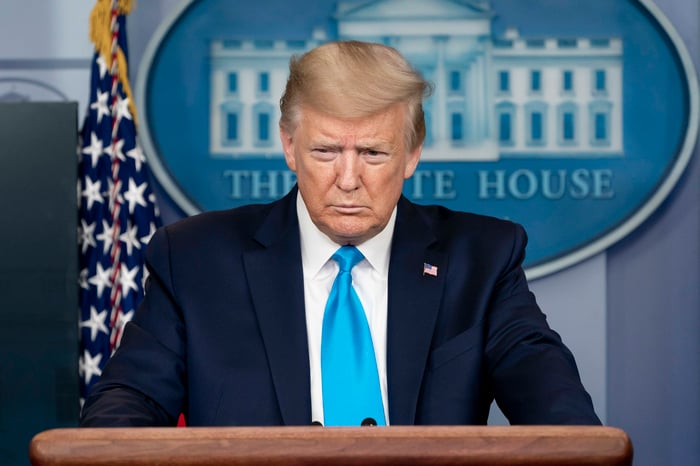
President Trump delivering remarks. Image source: Official White House Photo by Andrea Hanks, courtesy of the National Archives.
Donald Trump has made a habit of throwing his Fed chair and/or the FOMC under the bus
Shortly after Trump was inaugurated for his second, non-consecutive term on Jan. 20, 2025, he began publicly feuding with then-Fed Chair Jerome Powell (whom he appointed during his first term). Although the Powell-led FOMC lowered the federal funds target rate on six occasions from September 2024 to December 2025, to its current range of 3.5% to 3.75%, the president has opined that interest rates should be reduced to 1% or lower.
While Trump hasn't offered any specifics behind his push for lower interest rates, there are three main catalysts to cheaper borrowing costs:
- Lowering lending rates would likely spur hiring, which may reduce the unemployment rate.
- Access to cheap capital would fuel the artificial intelligence (AI) data center build-out, which has been the stock market's No. 1 catalyst.
- Reduced borrowing costs would make it easier for the U.S. to service its $39.7 trillion in national debt (as of July 28).
If you thought the May 22 swearing-in of Trump's handpicked successor to Powell, Kevin Warsh, would stop Trump's criticisms of America's foremost financial institution, you'd be mistaken.
President Trump called on the Federal Reserve to lower interest rates, saying the US should have the lowest interest rate in the world https://t.co/gPGIv91Qu2 pic.twitter.com/OEvJzaAKdA
-- Reuters Business (@ReutersBiz) July 27, 2026
Mere hours after Warsh's White House swearing-in ceremony, Trump told an audience at a New York community college that, "We're going to get interest rates down quickly... everybody's gonna be happy."
On July 2, in an interview with CNBC's Joe Kernen at the White House, the president noted that, "he's [Warsh] got a board that's maybe a little bit hostile... and maybe a board that wants to do the wrong things."
This past week, Trump threw the FOMC under the bus yet again. While speaking to reporters on Air Force One, the president proclaimed,
Kevin's fantastic, but he's got a board, and the board members are very political.... You need the consent of some people that have perhaps bad intentions. Rates should be lowered. This country could be at 8%, 9%, 10%, 12% GDP. That's what it should be.
While the president continues to frame FOMC policymakers as holding back the U.S. economy, it's Donald Trump's own policies that are making things so challenging for the central bank.
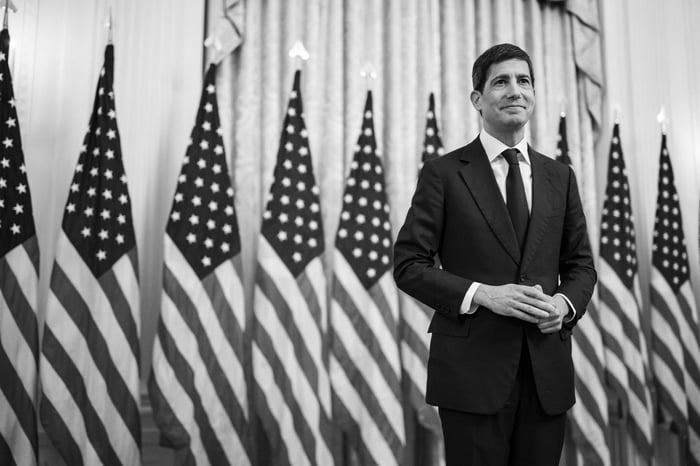
Kevin Warsh and the FOMC face a tough task with elevated inflation. Image source: Official White House Photo by Daniel Torok.
Trump's policies are precisely why interest rates can't be lowered
Some degree of inflation is perfectly normal and healthy for a growing economy. When consumer spending is climbing, businesses should possess a modest level of pricing power over their goods and services.
However, two of President Trump's policies have pushed trailing 12-month (TTM) inflation well beyond the FOMC's long-standing 2% target.
Trump's tariff and trade policy is the first measure responsible for lifting consumer prices. Even though the U.S. Supreme Court struck down the president's sweeping global tariffs and higher reciprocal tariffs in February 2026, he and his administration have relied on different rules to reimpose sweeping tariffs on dozens of countries.
Adding duties to unfinished imported goods, such as steel, can increase production costs, which are then passed on to consumers.
The Trump-led Iran war is the second, and considerably more impactful, policy that's increasing the prevailing inflation rate. Not long after Trump OK'd attacks against Iran, the latter closed the Strait of Hormuz to most commercial vessels. Approximately one-fifth of the world's petroleum liquids passes through the Strait of Hormuz each day.
BREAKING: May CPI inflation rises to 4.2%, the highest level since April 2023.
-- The Kobeissi Letter (@KobeissiLetter) June 10, 2026
Core CPI inflation also rises to 2.9%, the highest since September 2025.
Inflation in the US is officially back above 4% and more than double the Fed's target.
Odds of Fed rate hikes are rising.
The largest energy supply disruption in modern history sent fuel prices and the TTM inflation rate soaring to a three-year high of 4.2% in May.
Neither of the president's policies offers a quick resolution to above-average inflation. Trump remains insistent on using tariffs to promote domestic manufacturing, and the inflationary effects of the Iran war have begun spilling over into the broader economy. In other words, Warsh and his FOMC colleagues have little choice but to seriously consider a rate-hiking cycle to stabilize prices.
Higher interest rates may be Wall Street's death knell. The AI data center build-out is being partially financed through corporate debt offerings. If borrowing becomes costlier and this infrastructure build-out slows in any meaningful way, it could force investors to rethink AI growth rates and the otherworldly valuations assigned to AI stocks (and the broader market).
Should you buy stock in S&P 500 Index right now?
Before you buy stock in S&P 500 Index, consider this:
The Motley Fool Stock Advisor analyst team just identified what they believe are the 10 best stocks for investors to buy now… and S&P 500 Index wasn’t one of them. The 10 stocks that made the cut could produce monster returns in the coming years.
Consider when Netflix made this list on December 17, 2004... if you invested $1,000 at the time of our recommendation, you’d have $386,727!* Or when Nvidia made this list on April 15, 2005... if you invested $1,000 at the time of our recommendation, you’d have $1,232,139!*
Now, it’s worth noting Stock Advisor’s total average return is 906% — a market-crushing outperformance compared to 208% for the S&P 500. Don't miss the latest top 10 list, available with Stock Advisor, and join an investing community built by individual investors for individual investors.
See the 10 stocks »
*Stock Advisor returns as of August 1, 2026.
Sean Williams has no position in any of the stocks mentioned. The Motley Fool has no position in any of the stocks mentioned. The Motley Fool has a disclosure policy.
Recommended Articles


