


A Sizable "Trump Bump" for Social Security's 2027 COLA May Put America's Leading Retirement Program in Dire Straits
Key Points
President Donald Trump's policies are lifting inflation, which in turn is resulting in larger annual raises for Social Security recipients.
Independent estimates suggest that Social Security's cost-of-living adjustment (COLA) will range from 3.7% to 3.8% in 2027.
Outsize COLAs can drain the Old-Age and Survivors Insurance trust fund's asset reserves faster than initially forecast.
- The $23,760 Social Security bonus most retirees completely overlook ›
Making history is something America's leading retirement program, Social Security, does on a fairly regular basis. Last year, the average monthly retired-worker benefit surpassed $2,000 for the first time since the Social Security Act was signed into law in August 1935.
In 2027, Social Security payouts are set to make history, once again, courtesy of President Donald Trump. The president's policies are expected to deliver an outsize "Trump bump" to Social Security's 2027 cost-of-living adjustment (COLA) -- i.e., the "raise" passed along annually to help beneficiaries offset the effects of inflation.
Where to invest $1,000 right now? Our analyst team just revealed what they believe are the 10 best stocks to buy right now, when you join Stock Advisor. See the stocks »
But one of the largest projected raises since the early 1990s will come at a potentially steep cost to Social Security and its current/future beneficiaries.

President Trump delivering remarks. Image source: Official White House Photo by Daniel Torok.
Donald Trump's policies are set to beef up Social Security payouts in 2027
This year, Social Security recipients received a 2.8% payout boost, some of which can be traced to President Trump's tariff and trade policy. While some degree of inflation is perfectly normal in an expanding economy, the president's sweeping global tariffs and higher reciprocal tariffs, unveiled in early April 2025, ultimately increased consumer prices and modestly lifted Social Security's 2026 COLA.
Next year's cost-of-living adjustment will also feature a Trump bump -- but it'll likely be even more pronounced.
On the one hand, tariffs continue to influence prices. A little over a week ago, the Trump administration revealed a new round of tariffs, ranging from 10% to 12.5%, on more than 80 countries. Adding duties to select imported goods should raise production costs for U.S. manufacturers and lead to stickier prices for consumers. In other words, tariffs can modestly boost Social Security's COLA for a second consecutive year.
However, the more notable source of inflation, and the reason Social Security's 2027 raise could be substantially larger than normal, is the Trump-led Iran war.
BREAKING: May CPI inflation rises to 4.2%, the highest level since April 2023.
-- The Kobeissi Letter (@KobeissiLetter) June 10, 2026
Core CPI inflation also rises to 2.9%, the highest since September 2025.
Inflation in the US is officially back above 4% and more than double the Fed's target.
Odds of Fed rate hikes are rising.
Shortly after the president approved military action against Iran on Feb. 28, the latter shut down the Strait of Hormuz to most maritime traffic. This precipitated the largest modern-day energy supply disruption and sent fuel prices soaring. The longer the conflict in the Middle East persists, the more likely it is that fuel prices (and inflation) remain elevated.
We've also seen evidence that Iran-war-driven inflation is affecting more than just energy prices. Businesses are altering shipping routes, changing suppliers, and paying more for petroleum-based products (e.g., plastics and synthetic polymers), which will translate into higher costs for consumers.
According to nonpartisan senior advocacy group The Senior Citizens League, Social Security's 2027 raise is estimated at 3.8%. Meanwhile, independent Social Security and Medicare policy analyst Mary Johnson is forecasting a 2027 COLA of 3.7%.
A Trump-bump-fueled 3.7% or 3.8% cost-of-living adjustment would represent the fifth-largest raise over the last 36 years, topped only by increases of 4.1% (2006), 5.8% (2009), 5.9% (2022), and 8.7% (2023).

Image source: Getty Images.
An epic Trump bump comes at a steep cost to Social Security
While beneficiaries will likely welcome an outsize boost to their monthly payout next year, this Trump bump isn't without consequences.
According to the latest Social Security Board of Trustees Report, the financial outlook for America's leading retirement program is steadily deteriorating. Social Security's long-term (75-year) unfunded obligation ballooned to $29.3 trillion. In short, projected outlays (primarily benefits, but also administrative expenses to oversee Social Security) are expected to exceed income collected by $29.3 trillion through the year 2100.
But this wasn't the biggest issue with the latest Trustees Report. The more immediate concern is the estimated exhaustion of the Old-Age and Survivors Insurance trust fund's (OASI) asset reserves by the fourth quarter of 2032. The OASI's asset reserves represent the excess income collected since inception that's currently invested in special-issue, interest-bearing, government bonds, as required by law.
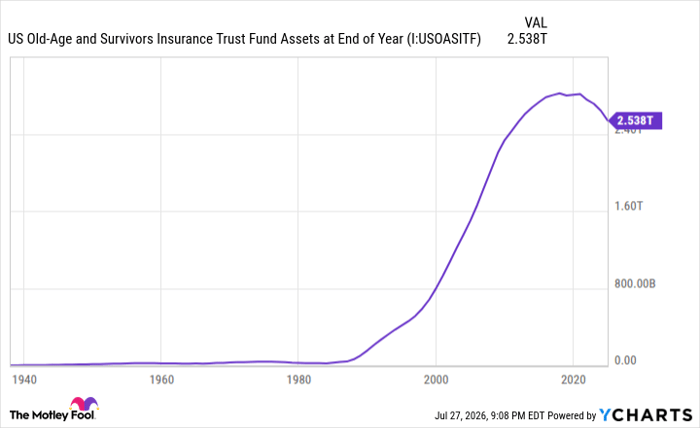
US Old-Age and Survivors Insurance Trust Fund Assets at End of Year data by YCharts.
Although the OASI is in no danger of bankruptcy or halting benefits, a depletion of the OASI's asset reserves would necessitate sweeping benefit cuts of up to 22% for retired workers and survivors of deceased workers.
Here's the catch: The Trustees' estimates are modeled using a laundry list of variables, which includes modest annual COLAs. If next year's epic Trump bump pushes Social Security benefits higher by 3.7% or 3.8%, there's a strong possibility that the OASI's asset reserves will be drained even faster, thereby accelerating the timeline to sweeping benefit cuts for retired workers and survivor beneficiaries.
As a reminder, Social Security's 2026 COLA received a modest Trump bump from the president's tariffs, and the Trustees accelerated the OASI's asset reserve depletion timeline by three months to the fourth quarter of 2032, compared to the previous year's report. The precedent has already been set that outsize COLAs can put Social Security in dire straits.
Until elected officials get serious about strengthening Social Security, bigger annual raises will come at a potentially steep cost to current and future beneficiaries.
The $23,760 Social Security bonus most retirees completely overlook
If you're like most Americans, you're a few years (or more) behind on your retirement savings. But a handful of little-known "Social Security secrets" could help ensure a boost in your retirement income.
One easy trick could pay you as much as $23,760 more... each year! Once you learn how to maximize your Social Security benefits, we think you could retire confidently with the peace of mind we're all after. Join Stock Advisor to learn more about these strategies.
View the "Social Security secrets" »
The Motley Fool has a disclosure policy.
Recommended Articles


