


Kevin Warsh Did Not Impress the Bond Market -- 30-Year Yields Are Up to 5.2%. Here's What This Might Mean for Investors in These 2 ETFs.
Key Points
30-year Treasury bond yields jumped to 5.23% following Fed Chair Kevin Warsh’s news conference on July 29.
Bond investors are worried that the Fed is not focused on reducing inflation.
During the past five years of rising interest rates, the iShares 3-7 Year Treasury Bond ETF has outperformed the iShares 20+ Year Treasury Bond ETF.
- 10 stocks we like better than iShares Trust - iShares 20+ Year Treasury Bond ETF ›
At its most recent meeting on Wednesday, the Federal Reserve voted to leave interest rates unchanged at 3.50% to 3.75%. But in his news conference following that meeting, Federal Reserve Chair Kevin Warsh left bond investors unimpressed.
Even though other Fed officials have recently commented that inflation is still too high, Warsh was seemingly unclear about what it would take for the Fed to raise interest rates in the future. Industry analysts quoted by CNBC described Warsh's press conference as "confusing," "contradictory," and creating "questions about the new chair's credibility" in reducing inflation.
Where to invest $1,000 right now? Our analyst team just revealed what they believe are the 10 best stocks to buy right now, when you join Stock Advisor. See the stocks »

Federal Reserve Chair Kevin Warsh. Image source: Federal Reserve.
If the bond market doesn't believe the Fed is serious about reining in inflation, bond investors will start to demand higher yields on U.S. Treasury bonds. In fact, this is already happening. Immediately following Warsh's news conference on July 29, the 30-year Treasury yield climbed 14 basis points to about 5.23%, its highest level in 19 years.
Higher yields on long-term U.S. Treasuries mean higher borrowing costs for the U.S. government and ultimately for all American businesses and consumers. But higher yields on Treasury bonds can also be bad news for bond investors. If you believe that interest rates are likely to stay high or go higher, buying long-term U.S. Treasury bonds could be a risky choice. Shorter-term Treasuries have recently delivered better returns and could be a safer move for your money.
Let's look at two Treasury bond exchange-traded funds (ETFs) and see which one might be a better choice for your portfolio.
iShares 20+ Year Treasury Bond ETF (TLT): 46 bonds, -6.66% annualized returns for 5 years
The iShares 20+ Year Treasury Bond ETF (NASDAQ: TLT) holds a total of 46 U.S. Treasury bonds that all have a duration of 20 years or longer. The fund's weighted-average maturity is 26.06 years. This bond ETF is earning a 30-day SEC yield of 5.13% as of July 29 and has delivered a trailing-12-month yield of 4.71%.
But despite the high yields, the past few years have been tough for investors in this bond ETF. The fund has delivered negative annualized returns for the past several years: -1.93% in the past 10 years and -6.66% in the past five years.
Over the long term, this fund has delivered better-looking returns. Since the ETF's inception in July 2002, it has delivered annualized returns of 3.68%. But interest rates have been rising since 2022, and when interest rates go up, bond prices go down. Long-term bonds are more vulnerable to interest rate risk. If long-term Treasury yields keep climbing under Warsh, that's going to bring more pain to investors in long-term Treasury ETFs like this one.
iShares 3-7 Year Treasury Bond ETF (IEI): 83 bonds, 0.35% annualized returns for 5 years
If you want to buy shorter-term Treasury bonds, the iShares 3-7 Year Treasury Bond ETF (NASDAQ: IEI) could be a good fit. This bond fund holds a total of 83 intermediate-term U.S. government bonds ranging from three to seven years in length, with a weighted average maturity of 4.7 years. The fund has delivered a trailing-12-month yield of 3.68% and a 30-day SEC yield of 4.23%.
Although this fund's returns have been less than impressive, it hasn't lost money. This intermediate-term bond ETF has delivered annualized returns of 1.2% for the past 10 years, 0.35% for the past five years, and 3.95% for the past three years.
Since the iShares 3-7 Year Treasury Bond ETF's inception in January 2007, it has delivered an average annual return of 2.85%. That's lower than the long-term returns (since inception) of the iShares 20+ Year Treasury Bond ETF. But the 3-7 Year bond fund might be less risky if interest rates keep rising.
Why buy TLT or IEI?
Just as with buying stocks, past performance of a bond ETF does not guarantee future results. The longer-term bond ETF outperformed in 2020 when interest rates were falling amid the pandemic. But in the past 10 years, the 3-7 Year Treasury Bond ETF has delivered much stronger returns.
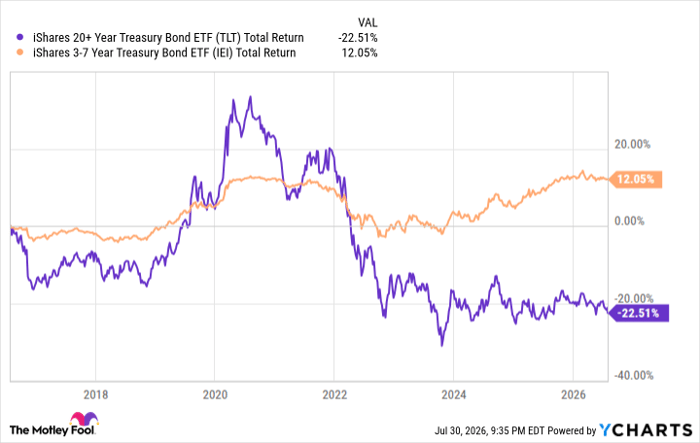
TLT Total Return Level data by YCharts
Neither of these funds ranks among the best Treasury bond ETFs. But if I had to choose one of these two, I would go with the iShares 3-7 Year Treasury Bond ETF because it holds shorter-duration bonds that are less vulnerable to the risks of rising interest rates.
I don't want to lose money on my bond holdings; I want bonds to be the "safe" part of my portfolio. But unless inflation starts to get "back to normal" soon, or Warsh can convince bond investors that the Fed is serious about reducing inflation, long-term Treasury bond ETFs feel too risky for me.
Should you buy stock in iShares Trust - iShares 20+ Year Treasury Bond ETF right now?
Before you buy stock in iShares Trust - iShares 20+ Year Treasury Bond ETF, consider this:
The Motley Fool Stock Advisor analyst team just identified what they believe are the 10 best stocks for investors to buy now… and iShares Trust - iShares 20+ Year Treasury Bond ETF wasn’t one of them. The 10 stocks that made the cut could produce monster returns in the coming years.
Consider when Netflix made this list on December 17, 2004... if you invested $1,000 at the time of our recommendation, you’d have $394,601!* Or when Nvidia made this list on April 15, 2005... if you invested $1,000 at the time of our recommendation, you’d have $1,197,093!*
Now, it’s worth noting Stock Advisor’s total average return is 895% — a market-crushing outperformance compared to 206% for the S&P 500. Don't miss the latest top 10 list, available with Stock Advisor, and join an investing community built by individual investors for individual investors.
See the 10 stocks »
*Stock Advisor returns as of August 1, 2026.
Ben Gran has no position in any of the stocks mentioned. The Motley Fool has no position in any of the stocks mentioned. The Motley Fool has a disclosure policy.
Recommended Articles


