


Amazon vs. Microsoft vs. Alphabet: Which Is the Best Cloud Stock to Buy Now?
Key Points
Amazon, Microsoft, and Alphabet all saw accelerating sales growth in their cloud businesses.
However, Alphabet's cloud revenue is growing (and accelerating) faster.
Alphabet is reasonably valued compared to its peers.
- 10 stocks we like better than Alphabet ›
Earnings season is in full swing, and recently, the three largest hyperscalers released their quarterly updates. Of course, we are talking about the "Big Three" in the cloud computing industry: Amazon (NASDAQ: AMZN), Microsoft (NASDAQ: MSFT), and Alphabet (NASDAQ: GOOG) (NASDAQ: GOOGL). The market was more than satisfied with the first two: Amazon and Microsoft experienced massive post-earnings jumps. It wasn't the case for Alphabet, as the company dipped following its update.
With their earnings in the books, now is as good a time as any to review their investment theses, particularly as it pertains to their positions in the cloud computing market, which should provide them with a powerful long-term tailwind. Which of the three is the best cloud stock to buy right now?
Missed Nvidia in 2009? This Rare Signal Is Flashing Again. In 2009, a "Double Down" signal flashed for a little-known chipmaker called Nvidia. For the first time in years, that same "Total Conviction" signal is flashing for a company 1/100th the size of Nvidia. Continue »
Image source: The Motley Fool.
Similarities and differences
The services Amazon, Microsoft, and Alphabet offer through their respective cloud computing businesses overlap significantly. They all let their customers rent computing power, storage, and software tools instead of building their own data centers, resulting in meaningful cost savings and productivity gains. However, there are differences. Amazon was the industry pioneer and arguably has the broadest cloud platform. Microsoft is particularly attractive to enterprises that already use its products.
Alphabet stands out for its expertise in certain niches, including data analytics and machine learning. This isn't the whole story, but it's a basic overview of where their services diverge. It's also worth pointing out that Amazon has the largest market share, followed by Microsoft.
However, Alphabet is currently growing its cloud computing sales much faster than its peers. In the second quarter, Google Cloud revenue grew 82% year over year. By comparison, Amazon Web Services' (AWS) sales increased by 37% from the year-ago period, and Microsoft Azure climbed 43% year over year (it was the fourth quarter of its fiscal year 2026, ending June 30). Further, while all three experienced accelerating revenue growth in this segment, Google Cloud's was much more impressive, going from 63% in the first quarter to 82% this time around. AWS' sales climbed by 28% in the first quarter, while Microsoft Azure increased 40% in the company's previous period.
Advantage, Alphabet?
Google Cloud is growing faster not just because it is smaller, although that's part of it. But beyond that, a disproportionate number of businesses seem to be choosing Google Cloud to build and run artificial intelligence (AI) applications, making the company one of the big winners of the AI boom. Google Cloud should continue to maintain its faster growth rate, and there are additional arguments in favor of Alphabet. The company dominates its core market of digital advertising. It has a near-monopoly in the internet search category, and its video-sharing platform, YouTube, is an industry leader.
Further, it boasts a wide moat thanks to deep network effects in search. Amazon may be the top player in e-commerce, but it isn't nearly as dominant as Alphabet is in internet search, and its core e-commerce operations are fairly low-margin, whereas advertising is a high-margin business. There is another reason to prefer Alphabet over its two peers right now: Valuation.
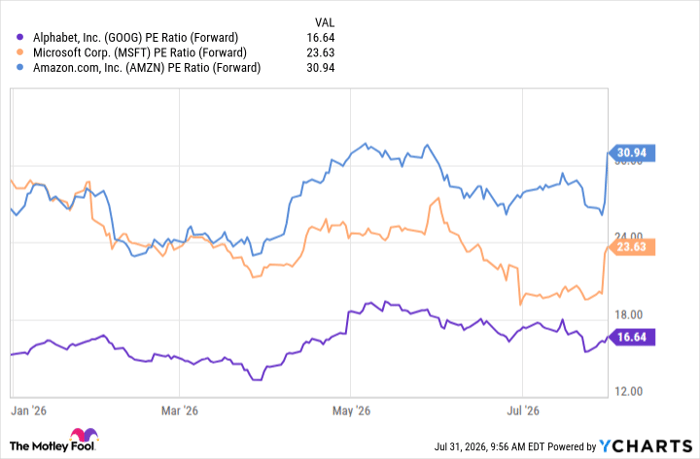
GOOG PE Ratio (Forward) data by YCharts
For context, the average forward price-to-earnings ratio in the S&P 500 right now is 19.4. Alphabet looks like a bargain by comparison. There are, of course, some risks to consider. Notably, Alphabet is now projecting capex between $195 billion and $205 billion for the fiscal year 2026, up from its prior range of $180 billion to $190 billion. The company is spending so much to fuel its AI-related ambitions that its free cash flow in the second quarter turned negative, a first in its history as a publicly traded company.
Some investors worry that Alphabet's spending will come back to haunt it if AI infrastructure spending slows down significantly. That is certainly a possibility, but my view is that Alphabet will continue to capitalize on AI, at least in the medium term. The company ended the second quarter with $514 billion in cloud backlog, partly thanks to its booming AI business. So, Alphabet is the best cloud computing stock to buy right now, given that it is growing faster than its peers, has a stronger position in AI, trades at a more reasonable valuation, and dominates its core, non-AI business. That said, investors can't go wrong with any of these three major hyperscalers. They should all deliver excellent long-term returns.
Should you buy stock in Alphabet right now?
Before you buy stock in Alphabet, consider this:
The Motley Fool Stock Advisor analyst team just identified what they believe are the 10 best stocks for investors to buy now… and Alphabet wasn’t one of them. The 10 stocks that made the cut could produce monster returns in the coming years.
Consider when Netflix made this list on December 17, 2004... if you invested $1,000 at the time of our recommendation, you’d have $394,601!* Or when Nvidia made this list on April 15, 2005... if you invested $1,000 at the time of our recommendation, you’d have $1,197,093!*
Now, it’s worth noting Stock Advisor’s total average return is 895% — a market-crushing outperformance compared to 206% for the S&P 500. Don't miss the latest top 10 list, available with Stock Advisor, and join an investing community built by individual investors for individual investors.
See the 10 stocks »
*Stock Advisor returns as of August 1, 2026.
Prosper Junior Bakiny has positions in Alphabet and Amazon. The Motley Fool has positions in and recommends Alphabet, Amazon, and Microsoft. The Motley Fool has a disclosure policy.
Recommended Articles


