


The Federal Reserve's Latest Interest Rate Decision Featured Something We Haven't Seen in 10 Years, and It Should Rightly Worry Wall Street
Key Points
Much to the chagrin of Wall Street, the FOMC left interest rates unchanged at its latest meeting.
Although a majority of FOMC policymakers voted to hold rates steady, we witnessed three dissents in the same policy direction for the first time since September 2016.
History has shown that Wall Street and investors won't tolerate a fractured Fed.
- 10 stocks we like better than S&P 500 Index ›
Amid the heart of earnings season, the Federal Reserve just delivered one of the most anticipated interest rate decisions in years. With Fed Chair Kevin Warsh shelving forward-looking guidance from Federal Open Market Committee (FOMC) meeting statements, determining what policymakers will do next has become far more challenging.
While a handful of prominent names and financial institutions had postulated that the Fed would raise interest rates, the FOMC ultimately left its federal funds target rate unchanged at 3.5% to 3.75% -- and the Dow Jones Industrial Average (DJINDICES: ^DJI), S&P 500 (SNPINDEX: ^GSPC), and Nasdaq Composite (NASDAQINDEX: ^IXIC) tumbled.
Where to invest $1,000 right now? Our analyst team just revealed what they believe are the 10 best stocks to buy right now, when you join Stock Advisor. See the stocks »
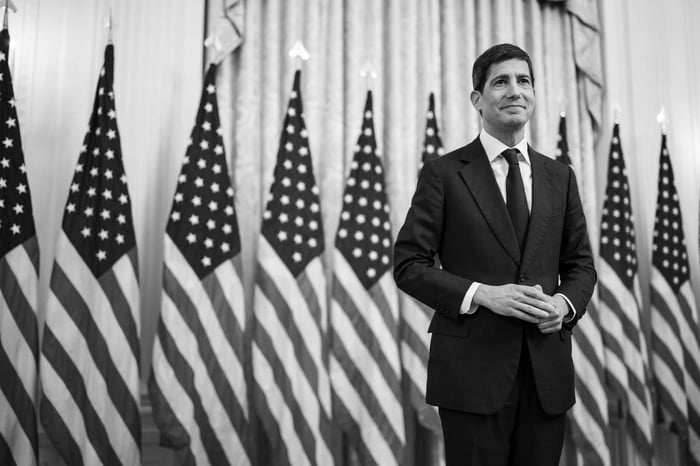
Fed Chair Kevin Warsh has inherited a historically fractured central bank. Image source: Official White House Photo by Daniel Torok.
But leaving interest rates steady is only part of the story. The July FOMC meeting featured something that no one's observed over the last 10 years -- and it should rightly have Wall Street worried.
FOMC dissension just hit a historic (and dubious) milestone
In many ways, this has been a history-making year for Wall Street's foremost financial institution. When Kevin Warsh was sworn in on May 22, he became only the 17th head of the Fed since the central bank's inception in December 1913.
Meanwhile, at Jerome Powell's last meeting as Fed chair in late April, four FOMC members dissented (one favored lowering the federal funds target rate, and three others opposed the inclusion of the easing bias in the FOMC statement). It marked the first time since 1992 that a Fed meeting had four dissents.
It took just two FOMC meetings into Warsh's tenure before history was made, yet again. Though a majority (nine) of policymakers voted to hold rates steady, three FOMC members (Beth Hammack, Neel Kashkari, and Lorie Logan) dissented in favor of a quarter-point rate hike. It's the first time three dissents have occurred in the same policy direction since September 2016.
The FOMC held rates steady, and the vote was 9-3.
-- Nick Timiraos (@NickTimiraos) July 29, 2026
Three bank presidents dissented in favor of a quarter-point rate increase.
It was the first time since 2016 that there were three dissents in the same direction over a policy change. pic.twitter.com/OBnwLJuUmr
The monetary policymaking body of our nation is historically fractured. While the new Fed chair views this family feud as healthy and constructive, the stock market disagrees.
Over several decades, investors have become accustomed to the Fed being behind the curve. Given that policymakers base their decisions on economic data, they're reacting to backward-looking data rather than proactively anticipating what's to come. Wall Street has shown a willingness to give the Fed plenty of proverbial rope when adjusting monetary policy as long as one condition is met: all policymakers are on the same page.
Over the last year, dissents have occurred in all but one meeting (Warsh's first as Fed chair in June). These dissents reflect the challenges of several economic shocks being introduced in succession since the start of the decade (COVID-19 supply chain issues, military conflicts, President Trump's tariffs, and now Iran-war-driven energy supply disruptions).
Ahh... this comment is why the market freaked out.
-- Financelot (@FinanceLancelot) July 29, 2026
Kevin Warsh keeps saying growth is "strong" but his actions and refusal to admit this is a pause, say the complete opposite.
"Shocks" = economic shocks
He's worried about growth (as he should be). https://t.co/VVefIdnOax pic.twitter.com/UO4aj7LTNs
More importantly, a fractured FOMC threatens the institution's credibility. The Fed is commonly viewed as a stabilizing, if not foundational, pillar for Wall Street. Investors will tolerate policymakers being tardy and even the occasional wrong decision. What history has shown investors won't stand for is a policymaking body that isn't prominently unified in its vision.
If this division and uncertainty persist, it'll pose a serious problem for the stock market.
Should you buy stock in S&P 500 Index right now?
Before you buy stock in S&P 500 Index, consider this:
The Motley Fool Stock Advisor analyst team just identified what they believe are the 10 best stocks for investors to buy now… and S&P 500 Index wasn’t one of them. The 10 stocks that made the cut could produce monster returns in the coming years.
Consider when Netflix made this list on December 17, 2004... if you invested $1,000 at the time of our recommendation, you’d have $397,081!* Or when Nvidia made this list on April 15, 2005... if you invested $1,000 at the time of our recommendation, you’d have $1,166,221!*
Now, it’s worth noting Stock Advisor’s total average return is 889% — a market-crushing outperformance compared to 203% for the S&P 500. Don't miss the latest top 10 list, available with Stock Advisor, and join an investing community built by individual investors for individual investors.
See the 10 stocks »
*Stock Advisor returns as of July 31, 2026.
Sean Williams has no position in any of the stocks mentioned. The Motley Fool has no position in any of the stocks mentioned. The Motley Fool has a disclosure policy.
Recommended Articles


