


Amazon Shares Soar 10% After Earnings; Why Investors Are So Excited
TradingKey - As Microsoft ( MSFT) and Google ( GOOGL) sequentially delivered stellar cloud computing report cards, Amazon ( AMZN) also proved with an earnings report that far exceeded expectations that the artificial intelligence wave continues to drive the global cloud computing market into a new round of high-speed growth cycle.
After the market closed on July 30, Eastern Time, Amazon announced its second-quarter 2026 financial results. The company's revenue and earnings both significantly exceeded market expectations, with revenue from its core cloud computing business, AWS, increasing by 37% year-on-year, marking the fastest growth rate since the end of 2021, as well as the fifth consecutive quarter of accelerated growth, further validating that enterprise AI demand remains robust.
Although the company raised its full-year capital expenditure guidance from $200 billion to $220 billion, which led to a net outflow of $7.6 billion in free cash flow over the past 12 months, the market was not concerned.
On the contrary, driven by the sustained high growth of AWS and the rapid commercialization of its AI business, investors are increasingly confident that the massive investment is translating into future growth momentum, sending Amazon's shares up over 9% after-hours.
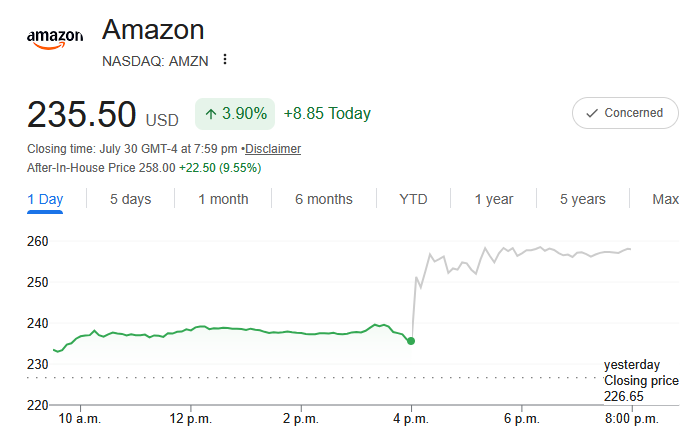
Source: Google Finance
AWS Growth Accelerates as Core Driver of Stock Price Gains
Prior to the earnings release, the market's primary concern was whether AWS could keep pace with the growth rates of Microsoft Azure and Google Cloud, and the final results were significantly better than expected.
AWS's second-quarter revenue grew 36.7% year-over-year to $42.2 billion, higher than the market expectation of approximately $40.5 billion, with its annualized revenue scale reaching $169 billion. Company CEO Andy Jassy stated that this is AWS's fastest growth rate in the past 18 quarters.
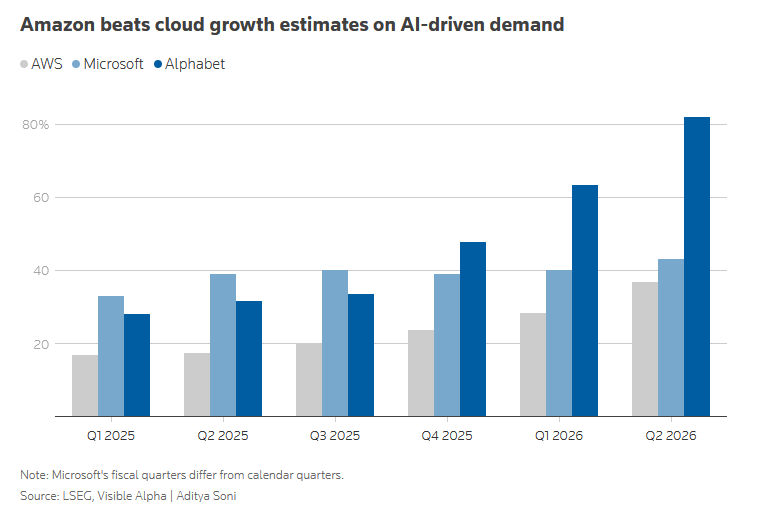
Source: Reuters
More importantly, AWS's growth was not achieved at the expense of profit margins. The segment's second-quarter operating profit reached $16.6 billion, up approximately 64% year-over-year; its operating margin rose to 39.4% from 32.9% in the same period last year. AWS currently contributes about 60% of Amazon's operating profit, and the accelerating growth of the cloud business has had a highly visible driving effect on the group's profitability.
Amazon CEO Andy Jassy stated that AWS is currently in a "thriving" phase, with AI having become the core driver of cloud business growth. As more enterprises deploy generative AI applications, demand for foundational cloud resources such as databases, storage, and CPUs is growing in tandem with GPU computing power, further driving a continuous acceleration in AWS's overall revenue.
Meanwhile, the company disclosed that AWS's current backlog has reached $496 billion, continuing to increase significantly from the previous quarter. These orders, which have not yet translated into revenue, provide high visibility for growth in the coming quarters.
Dan Morgan, portfolio manager at Synovus Trust, believes that the reacceleration of AWS's growth has eased market concerns over its market share being eroded by Microsoft and Google, and also proves that AWS remains a major beneficiary of the global expansion of AI infrastructure.
Why the Market Isn’t Worried as Capex Rises to $220 Billion
Compared to previous market concerns over AI capital expenditures, investor sentiment has clearly shifted this time.
Amazon announced that it has raised its full-year 2026 capital expenditures forecast to $220 billion from the previously projected $200 billion, with the additional investment primarily directed toward AI infrastructure. The company stated that rising memory prices are also a major driver of the increased capex.
Due to the continuous expansion of data centers, the company's free cash flow for the past 12 months shifted from a net inflow of $18.2 billion in the same period last year to a net outflow of $7.6 billion.
However, unlike Alphabet, which previously experienced a stock price pullback after raising its capital expenditures, Amazon has instead been embraced by the market this time.
The reason is that AWS's strong growth has already begun to validate that AI investments can sustainably generate revenue and profit. For investors, capital expenditure is no longer just a cost, but a guarantee of future growth.
Jassy admitted that even with capital expenditures increased to $220 billion, Amazon still will not be able to meet all computing power demand in 2026. Most of the new capacity for 2027 has already been booked by customers, and the company remains equally optimistic about demand in 2028.
Management also explained that data centers are assets with a life cycle of over 30 years, whereas AI servers typically recoup their costs in less than three years; therefore, the current large-scale investments will continue to contribute to returns for many years to come.
Third-Quarter Guidance Slightly Conservative but Market Eyes Long-Term AI Development
Amazon expects third-quarter revenue to be between $197 billion and $202 billion, up 9% to 12% year-over-year, with operating income projected at $22.5 billion to $26.5 billion. Both the revenue guidance and the midpoint of the operating income range were slightly below market expectations.
The company explained that this year's Prime Day was pulled forward to June from its usual timing in July, shifting some sales from the third quarter to the second quarter and thus affecting the year-over-year comparison. Excluding the Prime Day timing shift, third-quarter revenue growth is expected to be nearly 4 percentage points higher.
Investors ultimately chose to shrug off the soft near-term guidance because AWS delivered growth well ahead of expectations, proving that AI capital expenditures are paying off.
Recommended Articles


