


Fed Chair Kevin Warsh Is Stuck Between a Rock and a Hard Place. And It Could Be a Problem for the Market
Key Points
Kevin Warsh frustrated investors with a lack of detail on the Fed's plans to cool inflation.
With tariffs and the Iran war pushing up prices, the Fed's toolbox may be limited.
Warsh's plans to limit Fed communiques could backfire.
- 10 stocks we like better than S&P 500 Index ›
Kevin Warsh didn't come here to make friends.
That much is clear after the new Fed Chair's second FOMC conference. Warsh spent roughly 45 minutes at the lectern, but the question-and-answer session amounted to something like an extended game of "I know you are, but what am I?" Warsh seemed to speak in riddles at times, saying things like, "The historic problem with data dependence is the data and the dependence." He rejected the notion that the no-move rate decision was a pause and generally seemed content to allow markets, such as treasuries, to respond to economic data, rather than the Fed.
Where to invest $1,000 right now? Our analyst team just revealed what they believe are the 10 best stocks to buy right now, when you join Stock Advisor. See the stocks »
The FOMC statement, which has historically contained an analysis of the current economic situation explaining the Fed's thinking on the decision, was nearly an exact reprint of the previous statement in June, showing that Warsh either didn't think any of the data or circumstances the Fed considers had changed meaningfully, or that he ascribes such little value to the statement that he felt it was fair to copy his homework.
If Warsh was hoping for a muted reaction from markets, he didn't get it. The 30-year treasury yield spiked to 5.2%, its highest level since 2008, a reflection that investors believe that inflation above 2% could be here to stay, and stocks tumbled in the last hour of trading on Wednesday, with the S&P 500 (SNPINDEX: ^GSPC) finishing down 1.5% after briefly trading in the green.

Image source: The Federal Reserve.
Warsh's dilemma
The Fed Chair insisted several times during the press conference that the FOMC will deliver price stability, defined as 2% inflation. However, he was mum on the details of how the Fed would accomplish that.
Inflation has been above 2% for five years, and while aggressive rate hikes earlier brought core PCE, the Fed's preferred interest rate gauge, down as low as 2.6%, inflation has started to rise again due in part to the war in Iran.
Warsh did say he didn't see strict trade-offs between the Fed's dual mandate of low inflation and full employment, indicating that he may be interested in using tools other than rate hikes to try to bring prices down.
However, the Fed does not control prices, and its mandate is especially challenging at a time when energy prices are spiking due to the war in Iran and the uncertainty around it. Though energy prices are separate from core inflation, they do influence other categories, and tariffs have added noise to prices as well.
The Fed has no control over foreign policy, trade policy, fiscal policy, or any of the other myriad factors that can affect prices. Warsh acknowledged, "We've got no magic wand," and seemed to ask the market for time to bring prices down.
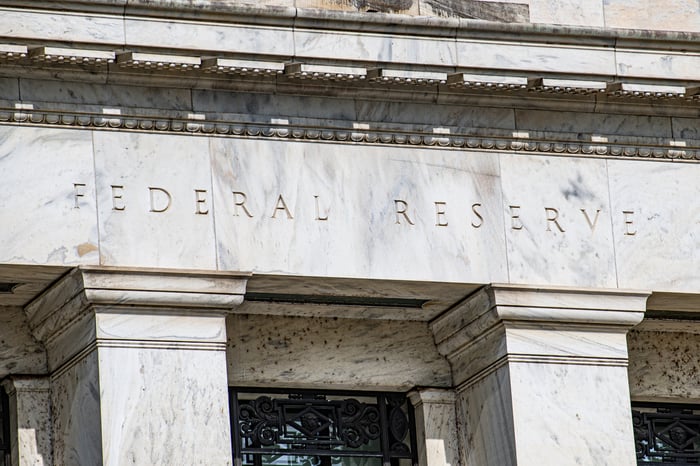
Image source: Getty Images.
Why it could be a problem for markets
Warsh gave investors a whole lot they didn't like on Wednesday. First, the Fed was divided in its vote, 9-3, though there was no explanation for the dissent or what the disagreement was over.
Second, Warsh gave no indication of a plan to lower prices or of what would trigger an interest rate hike; he only said that the Fed was discussing the best methods for doing so and the most useful data.
Finally, Warsh has been openly critical of the Fed's traditional practices of giving forward guidance, such as the "dot plot," and he has even cast doubt on continuing to hold press conferences beyond this year. His wish seems to be for the FOMC to operate as a black box, with no forward guidance, no questions from the press, and a boilerplate statement on the rate decision as if the Fed were an airline announcing emergency protocols pre-flight.
Markets understandably hate that. They hate uncertainty, and they want as much information as they can get. Warsh dislikes that markets react to Fed comments and forecasts, saying he prefers for market participants "to play the ball, not the referee," but a lack of guidance from the Fed will lead to bigger swings in asset prices when rate decisions do come, as investors will have less of an ability to predict them.
Warsh may adapt to the position with time, but he's off to a rough start, and the response in both the bond and stock markets yesterday made that clear.
Investors want clarity and predictability, and Warsh needs to deliver those to earn the credibility he claims. After he muddled and obfuscated through Wednesday's conference, that credibility appears to be drifting away.
Should you buy stock in S&P 500 Index right now?
Before you buy stock in S&P 500 Index, consider this:
The Motley Fool Stock Advisor analyst team just identified what they believe are the 10 best stocks for investors to buy now… and S&P 500 Index wasn’t one of them. The 10 stocks that made the cut could produce monster returns in the coming years.
Consider when Netflix made this list on December 17, 2004... if you invested $1,000 at the time of our recommendation, you’d have $397,081!* Or when Nvidia made this list on April 15, 2005... if you invested $1,000 at the time of our recommendation, you’d have $1,166,221!*
Now, it’s worth noting Stock Advisor’s total average return is 889% — a market-crushing outperformance compared to 203% for the S&P 500. Don't miss the latest top 10 list, available with Stock Advisor, and join an investing community built by individual investors for individual investors.
See the 10 stocks »
*Stock Advisor returns as of July 30, 2026.
Jeremy Bowman has no position in any of the stocks mentioned. The Motley Fool has no position in any of the stocks mentioned. The Motley Fool has a disclosure policy.
Recommended Articles


