


Is SoFi Technologies a Buy After Its Latest Earnings Report?
Key Points
Despite strong member growth, SoFi maintained its full-year adjusted EBITDA and earnings outlook.
The company did raise its guidance for full-year adjusted net revenue.
The tech segment struggled in the quarter.
- 10 stocks we like better than SoFi Technologies ›
The digital bank SoFi Technologies (NASDAQ:SOFI) continues to grow its membership at a fast clip, but recent second-quarter results failed to impress the market.
On July 29, the company reported adjusted earnings per share of $0.12, a penny ahead of Wall Street consensus estimates. Adjusted net revenue of $1.2 billion also beat estimates by about $100 million.
Where to invest $1,000 right now? Our analyst team just revealed what they believe are the 10 best stocks to buy right now, when you join Stock Advisor. See the stocks »
Furthermore, management raised the company’s full-year guidance for adjusted net revenue from $4.66 billion to $4.75-$4.85 billion, while reiterating its guidance for adjusted EBITDA and earnings.
The stock fell roughly 9% on July 29 after the results were released, but had recouped some of those losses as of this writing on July 30.
All in all, SoFi has had a rough year and remains down nearly 42%. Is it a buy after its latest earnings report?

Image source: Getty Images.
Why investors are still not impressed
Wall Street analysts were a bit mixed on the quarter.
KBW analyst Tim Switzer called the quarter a “lower-quality beat,” given that it was largely driven by balance sheet growth.
However, William Blair analyst Andrew Jeffrey sees this as a positive, recommending that investors “aggressively accumulate” the stock, according to MarketWatch.
“A larger balance sheet also efficiently utilizes excess capital and supports the company’s 20% to 30% long-term [return on equity target],” Jeffrey said in a research note.
SoFi’s lending segment, which is largely driven by personal loans, continued to grow revenue quickly, with nearly $725 million in the quarter, up 63% year over year.
Meanwhile, the company’s financial services segment, which includes a range of financial products such as its online brokerage, bank accounts, credit cards, and the new SoFi Plus subscription offering, also continued to grow its contribution profit, up 13% year over year.
However, the tech segment, which includes SoFi’s business-to-business digital payments and core processing platforms, struggled, with revenue down 24% year over year and contribution profit down 65%.
SoFi attributed the drop to the exit of a significant client.
Still don’t love the valuation
SoFi is growing quickly, and some parts of its business, like SoFi Plus, could be compelling over time. But the stock still seems fairly expensive to me at its current valuation, despite the sell-off.
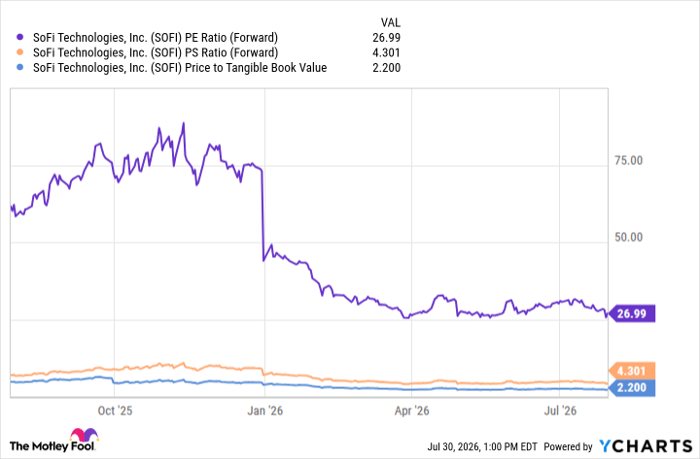
SOFI PE Ratio (Forward) data by YCharts
At its core, SoFi is still a bank, and banks often trade as a multiple of their tangible book value (TBV), which is equity minus intangible assets and goodwill.
The general rule of thumb is that if a bank is earning a 10% return on tangible common equity (ROTCE), it should trade at about one times its TBV.
SoFi currently trades at over two times its TBV, but the bank earned only about a 7% annualized ROTCE through the first half of the year.
To justify a 2x TBV multiple, ROTCE needs to be closer to 20%. The bulls may argue that SoFi is more than just a bank. That may be true, but the tech segment is struggling, and other fee-based income sources still depend on the lending business, so I still find the valuation to be excessive.
I also think the issues raised by short-sellers earlier this year about gain-on-sale loan margins and the loan platform business are valid concerns investors should consider before deciding whether to buy the stock.
Should you buy stock in SoFi Technologies right now?
Before you buy stock in SoFi Technologies, consider this:
The Motley Fool Stock Advisor analyst team just identified what they believe are the 10 best stocks for investors to buy now… and SoFi Technologies wasn’t one of them. The 10 stocks that made the cut could produce monster returns in the coming years.
Consider when Netflix made this list on December 17, 2004... if you invested $1,000 at the time of our recommendation, you’d have $397,081!* Or when Nvidia made this list on April 15, 2005... if you invested $1,000 at the time of our recommendation, you’d have $1,166,221!*
Now, it’s worth noting Stock Advisor’s total average return is 889% — a market-crushing outperformance compared to 203% for the S&P 500. Don't miss the latest top 10 list, available with Stock Advisor, and join an investing community built by individual investors for individual investors.
See the 10 stocks »
*Stock Advisor returns as of July 30, 2026.
Bram Berkowitz has no position in any of the stocks mentioned. The Motley Fool has no position in any of the stocks mentioned. The Motley Fool has a disclosure policy.
Recommended Articles


