


Apple Faces Congressional Pressure Ahead of Earnings: How Will Cook Break the Memory Cost Deadlock?
TradingKey - On the eve of its earnings release, Apple's plan to procure Chinese memory chips was blocked, dragging its stock price lower.
On July 30, 2026, a bipartisan group of U.S. senators issued an ultimatum at a sensitive moment, just as Apple Inc. ( AAPL) was about to release its earnings, formally writing to CEO Tim Cook to demand that Apple commit to completely abandoning the procurement of memory chips from Yangtze Memory Technologies (YMTC) and ChangXin Memory Technologies (CXMT) by August 21. As of press time, Apple was down 0.92% in premarket trading, temporarily trading at $335.07.
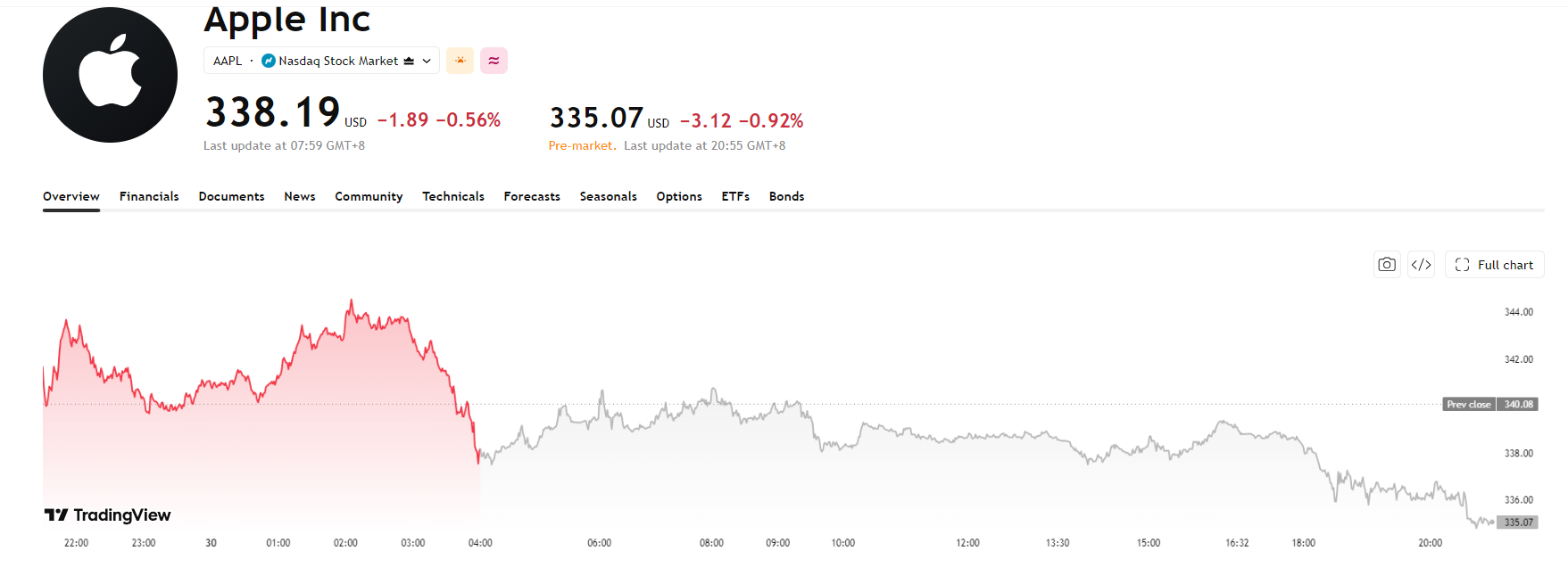 Apple Stock Chart, Source: TradingView
According to a Wall Street Journal report on July 24, Cook had lobbied the Trump administration to apply to use Chinese memory chips equipped with CXMT and YMTC tech under the banner of "broadening supply and easing product constraints." This move immediately met with resistance from Micron Technology, a major domestic U.S. memory manufacturer, which pressed the government under the banner of "protecting American manufacturing."
Now, with Apple warned and blocked by lawmakers, it suggests that Apple has lost this battle to Micron, while directly hitting Apple's biggest current operational pain point: against the backdrop of AI data centers grabbing global memory capacity and giants seeing their gross margins soar, Apple is facing an unprecedented memory cost deadlock. If Cook cannot ultimately reverse the situation, it means Apple will not be able to leverage low-priced Chinese chips to bargain down Micron's products. Consequently, Apple may turn to the South Korean duo of Samsung and SK Hynix to negotiate and play them against each other, while leveraging its massive order volume to secure discounts.
Another strategy is revenue management, which is Cook's greatest strength. When cost reduction is not an option, Apple can raise the starting prices of its products as a matter of course by upgrading base memory specifications, using a higher average selling price (ASP) to safeguard its overall high gross margin target of 47.5% to 48.5%. In fact, Apple already made minor price adjustments to certain Mac, iPad, and Vision Pro models in June, explicitly pointing to rising memory costs as the primary reason.
Apple and its CEO have not yet formally responded to the congressional pressure, which may be addressed or answered during today's upcoming third-quarter fiscal 2026 earnings conference call. Notably, this call will be the last one hosted by Cook before stepping down.
Recommended Articles


