

Cerebras Systems Shares Rise for Three Straight Days, Return to $240: Strategic Partnership Reached With CrowdStrike, CS-3 Inference Speed Exceeds Nvidia by 15 Times

Source Tradingkey

T radingK ey - Nv idia com petitor Cereb ras Sys tems ( C BRS) shares rose for three consec utive day s, retu rning to a one-m onth hig h. As of press t ime, th e stock was up 3.89 % to $2 16.69.

Ce rebras t oday an nounced that it h as teame d up wit h cyber s ecurity giant Cr owdStri ke ( CRWD) to es tablish a strateg ic partn ership. Cerebras represen ts the w orld's f astest A I infere nce comp uting so lution, while Cr owdStri ke repre sents th e indust ry-leadi ng AI-na tive sec urity pl atform. The two companies are joi ning for ces to i ntegrate extreme inferenc e speed with AI -native security capabil ities fo r enterp rise cus tomers d eploying AI at sc ale.
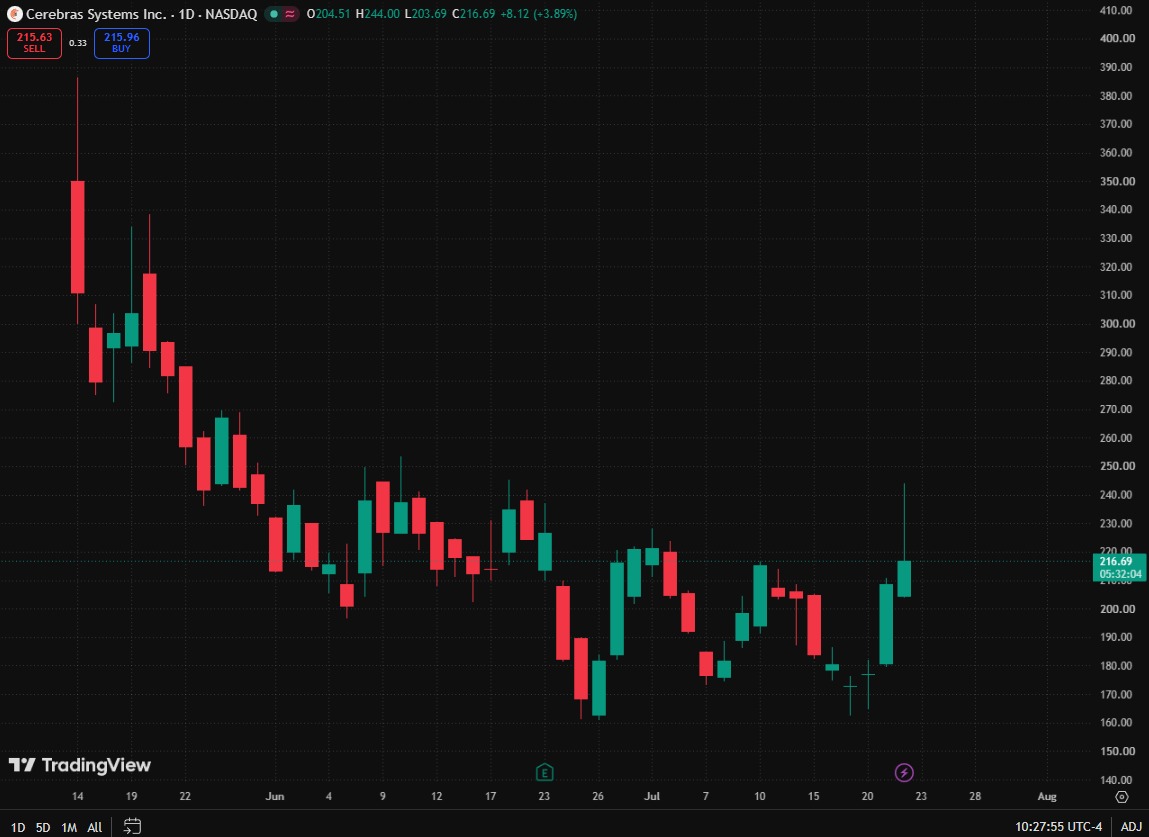
1-97efc42fa06547c8bc3c228d9c5909df

[Source: Trading View]

Un der the partner ship, C rowdStr ike wil l levera ge Cere bras's i nference speed to power i ts Falco n AI De tection and Res ponse ( AIDR); m eanwhile , Cerebr as will standard ize the deployme nt of th e CrowdS trike Fa lcon pla tform to secure i ts own o peration s. The l ogic of both co mpanies is clear : AI is fundame ntally r eshapin g the cy bersecur ity land scape, w ith atta cks beco ming fas ter, mor e target ed, and harder t o detect , while defenders need se curity s ystems c apable o f thinki ng and a cting at machine speed.

Naor Penso, Chief I nformati on Secur ity Offi cer of C erebras, stated in the annou ncement: "Infer ence is the key to reali zing AI' s value, and cybe rsecurit y is one of the s cenarios that dem ands the highest computin g speed. When an attack o ccurs, s ecurity defenses cannot b e held h ostage b y sluggis h AI com puting q ueues. E very mil lisecond counts—i t direct ly deter mines wh ether AI proactive ly stops an attac k or is left to perform a post-mo rtem ana lysis of the eve nt."

What Kind of Company Is Cerebras?

Cerebras's core selling point is: the world's fastest AI inference.

According to company data, the speed of its CS-3 system in specific model inference scenarios can be up to 15 times that of Nvidia's ( NVDA) GPUs; based on calculations by third-party research firm SemiAnalysis, in the Llama 3 70B inference scenario, the total cost of the CS-3 is 32% lower than that of Nvidia's B200, with end-to-end latency reduced by up to 21 times. Cerebras is currently the only manufacturer mass-producing wafer-scale chips and leads in inference speed benchmarks, though Nvidia still dominates the overall AI computing power market.

This speed advantage is particularly critical in the era of AI agents. AI inference workloads are projected to grow at a compound annual growth rate (CAGR) of 79% through 2030, far outpacing the 25% growth rate of training. Inference scenarios require latency to be under 50 milliseconds; an Akamai study shows that 64% of surveyed organizations require response times of less than 250 milliseconds, and 50% consider latency to be the greatest scaling challenge. Entering the agent era, AI models need to process and complete multiple steps, with latency from each step accumulating sequentially—thereby further unlocking growth potential for fast inference solutions.

Meanwhile, the company has signed agreements worth over $20 billion with OpenAI, and multiple GPT models are currently running on the CS-3 system. Starting in the first quarter of 2026, data center costs related to the OpenAI contract will be passed through to OpenAI with a 3% markup.

In addition, Cerebras has partnered with Amazon to combine the latter's Trainium chips with the CS-3, aiming to offer faster inference solutions. Any customer using Amazon Web Services (AWS) can run AI models leveraging Cerebras's computing power—Amazon brings computing capacity and an existing customer base, while Cerebras provides one of the most powerful inference chips.

However, it is worth noting that in its first post-IPO earnings report, Cerebras delivered a financial performance characterized by rapid revenue growth but persistent losses.

During the period, the company's total revenue was approximately $194 million, representing a 94% year-over-year increase. Among this, cloud services revenue surged 178% year-over-year, serving as the primary growth engine, while hardware (CS-3) revenue grew 59% year-over-year. The company expects hardware revenue to continue to decline over the next few quarters, as most of its hardware capacity will be deployed to Cerebras Cloud to fulfill its major contracts.

However, it remains unprofitable, posting a net loss of $2.48 million and a non-GAAP operating loss of $3.5 million. More importantly, the company expects its cloud services profit margins to decline by 10 to 15 percentage points over the next few quarters as it invests heavily in expanding computing capacity.

Overall, with its unique wafer-scale chip architecture, Cerebras has carved out a technological path distinct from Nvidia's in the AI inference track, validating its commercial value through partnerships with OpenAI, Amazon, and CrowdStrike. Yet, behind the high growth lies the reality of persistent losses, heavy debt, and pressured profit margins. Against the backdrop of certain, explosive growth in AI inference demand, whether Cerebras can achieve profitability while scaling up will be the core variable determining its investment value.

Disclaimer: For information purposes only. Past performance is not indicative of future results.
placeholder
Pinduoduo Earnings Incoming: Morgan Stanley Sees Long-Term Profit Potential​Insights – On November 21, Chinese e-commerce giant Pinduoduo (PDD) will release its Q3 2024 earnings.
Author  Mitrade
Nov 20, 2024
​Insights – On November 21, Chinese e-commerce giant Pinduoduo (PDD) will release its Q3 2024 earnings.
placeholder
Elon Musk’s xAI and Neuralink Launch New Funding Rounds​Billionaire Elon Musk recently raised funds for his two high-profile tech companies, xAI and Neuralink.
Author  Insights
Jun 03, 2025
​Billionaire Elon Musk recently raised funds for his two high-profile tech companies, xAI and Neuralink.
placeholder
Bitcoin briefly loses 2025 gains as crypto plunges over the weekend.Bitcoin experienced a sharp decline this weekend, briefly erasing its 2025 gains and dipping below its year-opening value of $93,507. The cryptocurrency fell to a low of $93,029 on Sunday, representing a 25% drop from its all-time high in October. Although it has rebounded slightly to around $94,209, the pressures on the market remain significant. The downturn occurred despite the reopening of the U.S. government on Thursday, which many had hoped would provide essential support for crypto markets. This year initially appeared promising for cryptocurrencies, particularly after the inauguration of President Donald Trump, who has established the most pro-crypto administration thus far. However, ongoing political tensions—including Trump's tariff strategies and the recent government shutdown, lasting a historic 43 days—have contributed to several rapid price pullbacks for Bitcoin throughout the year. Market dynamics are also being influenced by Bitcoin whales—investors holding large amounts of Bitcoin—who have been offloading portions of their assets, consequently stalling price rallies even as positive regulatory developments emerge. Despite these sell-offs, analysts from Glassnode argue that this behavior aligns with typical patterns seen among long-term investors during the concluding stages of bull markets, suggesting it is not indicative of a mass exodus. Notably, Bitcoin is not alone in its struggles, as Ethereum and Solana have also recorded declines of 7.95% and 28.3%, respectively, since the start of the year, while numerous altcoins have faced even steeper losses. Looking ahead, questions linger regarding the viability of the four-year cycle thesis, particularly given the increasing institutional support and regulatory frameworks now in place in the crypto landscape. Matt Hougan, chief investment officer at Bitwise, remains optimistic, suggesting a potential Bitcoin resurgence in 2026 driven by the “debasement trade” thesis and a broader trend toward increased adoption of stablecoins, tokenization, and decentralized finance. Hougan emphasized the soundness of the underlying fundamentals, pointing to a positive outlook for the sector in the longer term.
Author  Mitrade
Nov 17, 2025
Bitcoin experienced a sharp decline this weekend, briefly erasing its 2025 gains and dipping below its year-opening value of $93,507. The cryptocurrency fell to a low of $93,029 on Sunday, representing a 25% drop from its all-time high in October. Although it has rebounded slightly to around $94,209, the pressures on the market remain significant. The downturn occurred despite the reopening of the U.S. government on Thursday, which many had hoped would provide essential support for crypto markets. This year initially appeared promising for cryptocurrencies, particularly after the inauguration of President Donald Trump, who has established the most pro-crypto administration thus far. However, ongoing political tensions—including Trump's tariff strategies and the recent government shutdown, lasting a historic 43 days—have contributed to several rapid price pullbacks for Bitcoin throughout the year. Market dynamics are also being influenced by Bitcoin whales—investors holding large amounts of Bitcoin—who have been offloading portions of their assets, consequently stalling price rallies even as positive regulatory developments emerge. Despite these sell-offs, analysts from Glassnode argue that this behavior aligns with typical patterns seen among long-term investors during the concluding stages of bull markets, suggesting it is not indicative of a mass exodus. Notably, Bitcoin is not alone in its struggles, as Ethereum and Solana have also recorded declines of 7.95% and 28.3%, respectively, since the start of the year, while numerous altcoins have faced even steeper losses. Looking ahead, questions linger regarding the viability of the four-year cycle thesis, particularly given the increasing institutional support and regulatory frameworks now in place in the crypto landscape. Matt Hougan, chief investment officer at Bitwise, remains optimistic, suggesting a potential Bitcoin resurgence in 2026 driven by the “debasement trade” thesis and a broader trend toward increased adoption of stablecoins, tokenization, and decentralized finance. Hougan emphasized the soundness of the underlying fundamentals, pointing to a positive outlook for the sector in the longer term.
placeholder
Gold Price Trend Forecast: Expectations of Easing US-Iran Tensions Boost Gold Prices, $4,070 Becomes Key Level for Bulls and BearsAs of the Asian session on July 21, gold prices ( XAUUSD) staged a rapid intraday rebound, rising 1.56% on the day to touch a high of $4,084.28. From a technical perspective, gold prices
Author  TradingKey
Yesterday 10: 32
As of the Asian session on July 21, gold prices ( XAUUSD) staged a rapid intraday rebound, rising 1.56% on the day to touch a high of $4,084.28. From a technical perspective, gold prices
placeholder
Japanese Yen bears turn cautious near four-decade low amid looming intervention risksThe USD/JPY enters a bullish consolidation phase during the Asian session on Wednesday and holds steady above the 163.00 mark, near its highest level since 1986 set the previous day.
Author  FXStreet
14 hours ago
The USD/JPY enters a bullish consolidation phase during the Asian session on Wednesday and holds steady above the 163.00 mark, near its highest level since 1986 set the previous day.
goTop
quote