


3 Big Reasons to Believe in Rivian Stock Long-Term
Key Points
Rivian's capital discipline has kept shareholder dilution minimal compared to a key rival.
The R2 will help drive a major transition from luxury-niche to mass-market consumers and sales.
High-margin software business opportunities exist thanks to Rivian's advanced software stack and architecture.
- 10 stocks we like better than Rivian Automotive ›
About five years ago, there was a mini gold rush in the electric vehicle (EV) industry. It was due to growing infrastructure support and a flood of public and private funding from investors hoping to get their hands on what might be the next Tesla.
This gold rush ended poorly for many involved: from the more well-known Fisker Automotive, which was supposed to rival Tesla, to the lesser-known companies such as Canoo and Lordstown Motors. Even more capable companies, such as Lucid Group (NASDAQ: LCID), will almost certainly face more funding questions and capital raises within 12 to 18 months.
Where to invest $1,000 right now? Our analyst team just revealed what they believe are the 10 best stocks to buy right now, when you join Stock Advisor. See the stocks »
Rivian Automotive (NASDAQ: RIVN), however, appears to be gaining real traction; here are three reasons to believe in it long-term.
Shareholder dilution
While Lucid and Rivian are similar in many ways, one factor that has separated the two is shareholder dilution. Unlike Lucid, Rivian has been able to protect its shareholders from more severe shareholder dilution due to capital discipline and its strategic joint ventures, such as with Volkswagen.
It also helps to have a little luck on your side. Rivian executed one of the largest initial public offerings in U.S. history by raising roughly $13.7 billion in gross proceeds, which gave the young EV maker a long capital runway. In contrast, Lucid entered the public markets through a SPAC merger that had a lighter cash balance to help pave the way forward.
Another example of how the two differ is that Lucid has relied heavily on Saudi Arabia's Public Investment Fund (PIF), which now owns a controlling stake in the company. While Lucid has repeatedly issued new equity that dilutes existing shareholders, Rivian largely took a different route by leveraging its internal software and electrical stack to ink a $5.8 billion deal with Volkswagen that has helped generate non-dilutive licensing and convertible loans.
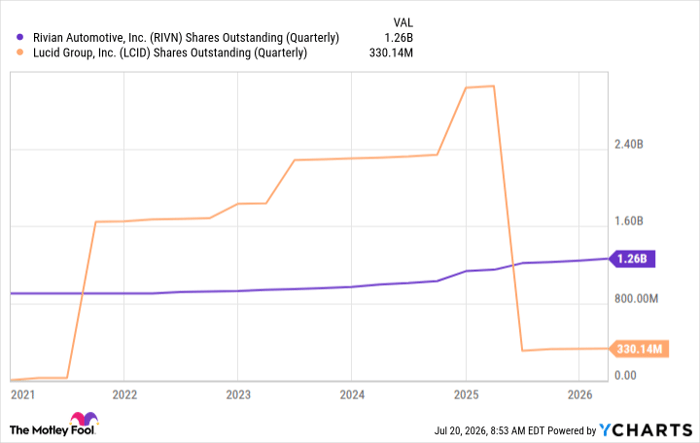
RIVN Shares Outstanding (Quarterly) data by YCharts
You can see in the graph above that Lucid was expanding its shares outstanding much more, until last year when the EV maker executed a 1-for-10 reverse stock split, which reduced its share count to proportionately increase its share price, enabling it to remain listed on the Nasdaq. That's not a great situation to be in. Make no mistake, when considering either of these EV stocks long-term, Rivian is certainly more enticing, even considering only its lesser shareholder dilution.
R2 is a crucial pivot
To say that Rivian's R2 is a crucial pivot point for the business would be an understatement. The R2 marks Rivian's transition from luxury-niche EVs to mass-market production and scale. The young EV maker might not even get enough credit for the efforts it has taken to improve unit economics, which have helped power the company to its first full-year gross profit.
Rivian is taking what it's learned from that process and applying it to the R2. And it's expecting to reduce the manufacturing cost per vehicle by 50% compared to even previous improvements on the R1. Rivian's goal was to aim for nearly $7,500 in gross profit per vehicle; here are a couple of unique examples of how it can drive toward that target:
- Battery and drive units: The new "Maximus" drive unit contains 41% to 43% fewer parts than the previous Enduro system.
- Electronics and harnessing: Rivian cut expensive high-voltage cabling down by a significant 70% and simplified its computing architecture by removing 2.3 miles of wiring, cutting down connectors by 60%, and reducing weight by 40 lbs. Rivian even adjusted the R2 to a unibody structure, which reduced costs by 44% and weight by 37% compared to the R1 body-on-frame style.

Image source: Rivian.
Combine those examples, and many more, with growing scale as the lower price tag enables a mainstream consumer to purchase the R2, and it should have investors feeling optimistic that Rivian can one day be a self-funding and profitable company. Though it still has a long way to go.
High-margin potential
Circling back to Rivian's lucrative joint venture with Volkswagen, it's important for investors to understand the potential of this business. Typically, legacy global automakers like Volkswagen buy parts from suppliers and write their own coding, but the deal with Rivian implies that Volkswagen has admitted its deficiencies in doing so and essentially gave up on its in-house software division.
Volkswagen isn't just buying Rivian motors or interior infotainment screens, either; Rivian is essentially selling its German joint venture partner its vehicle nervous system, operating system, and zonal architecture. This has given Rivian the potential to transform from a pure hardware manufacturer into a business that includes high-margin software and intellectual property licenses.
Thanks in large part to Volkswagen's partnership, Rivian's software segment operates at roughly 37% gross margin, which has become a crucial way to offset early-stage scaling and expenses.
What it all means
Rivian still has a long road ahead to reward long-term shareholders, but these three reasons should give investors the belief that it can achieve that vision. Rivian has separated itself from rivals such as Lucid with capital discipline and the avoidance of severe shareholder dilution, tapped into high-margin software sales and cost-sharing with partnerships, and made significant progress on improving R2 unit economics ahead of the scale it hopes to soon build.
Rivian's road will still be tough, but it certainly has some unique attributes that separate it from many rivals.
Should you buy stock in Rivian Automotive right now?
Before you buy stock in Rivian Automotive, consider this:
The Motley Fool Stock Advisor analyst team just identified what they believe are the 10 best stocks for investors to buy now… and Rivian Automotive wasn’t one of them. The 10 stocks that made the cut could produce monster returns in the coming years.
Consider when Netflix made this list on December 17, 2004... if you invested $1,000 at the time of our recommendation, you’d have $370,332!* Or when Nvidia made this list on April 15, 2005... if you invested $1,000 at the time of our recommendation, you’d have $1,272,280!*
Now, it’s worth noting Stock Advisor’s total average return is 904% — a market-crushing outperformance compared to 208% for the S&P 500. Don't miss the latest top 10 list, available with Stock Advisor, and join an investing community built by individual investors for individual investors.
See the 10 stocks »
*Stock Advisor returns as of July 22, 2026.
Daniel Miller has no position in any of the stocks mentioned. The Motley Fool has positions in and recommends Tesla. The Motley Fool has a disclosure policy.
Recommended Articles


