


GE Vernova Revenue Beats Estimates But Fails to Offset Profit Pressure, Shares Slump Over 10% Pre-Market
TradingKey - Against the backdrop of accelerating global AI data center construction and power infrastructure investment, GE Vernova ( GEV) delivered a quarterly report card featuring strong revenue and record-high orders.
However, as profitability missed market expectations, the company's stock fell over 10% in pre-market trading, having previously risen nearly 7%.
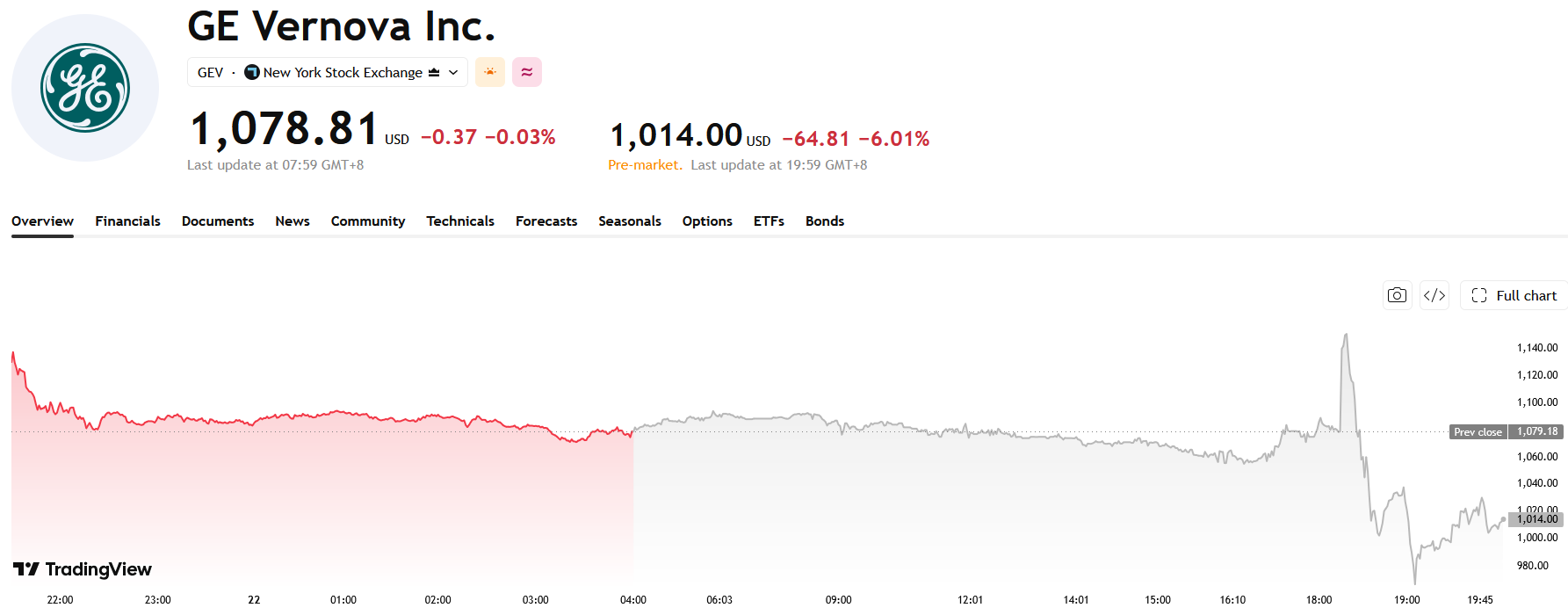
Source: TradingView
According to its financial results, GE Vernova achieved revenue of $11.1 billion in the second quarter, up 22% year-on-year, beating market expectations of $10.73 billion. Adjusted earnings per share (EPS) came in at $2.47, which, despite growing year-on-year, fell short of the $3.04 generally expected by analysts.
Despite the slightly softer earnings, the company still chose to raise its full-year outlook. GE Vernova expects 2026 revenue to reach $45.5 billion to $46.5 billion, higher than the previous forecast range of $44.5 billion to $45.5 billion, with the midpoint also exceeding consensus market expectations.
Meanwhile, the company significantly raised its full-year free cash flow guidance to $11.5 billion to $12.5 billion, far higher than the previously estimated $6.5 billion to $7.5 billion, while keeping its adjusted EBITDA margin target of 12% to 14% unchanged.
Chief Executive Scott Strazik stated that demand from global customers for the company's products and integrated energy solutions continues to grow. Currently, the company's backlog has increased to $176 billion, and revenue, margins, and cash flow all maintain an improving trend, providing strong support for growth over the next several years.
AI Data Centers Drive Sustained Power Business Expansion
The core driver behind GE Vernova's earnings growth remains the surging power demand fueled by artificial intelligence.
As the scale of AI model training and inference continues to expand, data center power consumption is climbing rapidly, making a stable and reliable power supply an essential prerequisite for global tech companies expanding their computing capacity. Compared with renewable energy projects that have longer construction cycles, gas-fired power generation has become an important energy choice for large-scale data centers due to its fast deployment and stable supply, directly driving the continuous growth in demand for GE Vernova's gas power generation equipment.
This quarter, the company's total orders reached $24.2 billion, up 88% year-over-year, setting a record high. Among them, the power segment performed particularly well, with new orders surging 134% year-over-year, including multiple HA-class heavy-duty gas turbines and dozens of aeroderivative gas turbines.
Boosted by this, the scale of gas power generation equipment backlogs and capacity reservation agreements expanded from 100 gigawatts to 116 gigawatts, and the company expects this figure to further rise to over 125 gigawatts by the end of 2026.
Meanwhile, the company is continuously expanding its production capacity to meet rapidly growing market demand. According to plans, its annual gas turbine capacity will reach 20 gigawatts in the third quarter of 2026, subsequently increase to 24 gigawatts in 2028, and is planned to further expand to 30 gigawatts by 2030.
Electrification Business Benefits From AI Wave, Data Center Orders Double
In addition to power generation equipment, the development of AI infrastructure is also driving a rapid increase in demand for power grids and power transmission and distribution equipment.
In the second quarter, GE Vernova's Electrification segment generated revenue of $3.6 billion, up 68% year-over-year, with organic growth of nearly 30%. Profitability also improved significantly, with the EBITDA margin rising by approximately 7 percentage points year-over-year. The company stated that sustained demand growth for grid equipment, transmission systems, and related infrastructure was a key driver of its business expansion.
Notably, data centers have become the fastest-growing customer segment for this business. Year-to-date, the company's cumulative orders from data center customers have surpassed $5 billion, more than doubling the volume of the entire previous year. Meanwhile, the segment's backlog has grown to $40.6 billion, up nearly 70% year-over-year, indicating that future demand remains robust.
As global computing power development gradually extends from GPU procurement to the construction of complete energy systems, grid upgrades, power transmission, and smart distribution equipment are becoming non-negligible new growth points in the AI industry chain.
Wind Power Business Still Under Pressure, Profit Improvement Pace Lags
Compared with the rapid growth of the power and electrification businesses, the wind power segment continued to drag down overall earnings performance. In the second quarter, wind power revenue declined 10% year-over-year to approximately $2 billion, primarily impacted by fewer deliveries of onshore wind equipment and rising costs for offshore projects. During the quarter, the segment's EBITDA loss widened to $275 million, indicating that profitability pressure remains significant.
Order activity was also weak, with quarterly new orders declining approximately 40% year-over-year. Management expects that the wind power business will still experience a low double-digit decline this year, with a full-year EBITDA loss of about $400 million, making any significant improvement unlikely in the near term.
The market consensus is that as the share of high-growth businesses such as gas power and grid equipment continues to rise, the impact of wind power on the company's overall performance is gradually diminishing, though it remains a significant constraint on unlocking profitability in the short term.
Cash Flow Continues to Improve, AI Power Cycle Remains in Market Focus
In the second quarter, the company's cash flow from operating activities reached $5.5 billion, and free cash flow reached $5.1 billion, already exceeding the full-year level of last year, mainly driven by working capital optimization and improved profitability. By the end of the quarter, the company's cash reserves increased to $13.1 billion, up $4.3 billion from the beginning of the year.
Ample cash flow also supported the company's continued advancement of its capital return program. Year-to-date, the company has repurchased a cumulative total of approximately 4.3 million shares and continued to pay quarterly dividends. In addition, the company completed the acquisition of automation firm Robotech Automation to enhance its robotics and automation business capabilities.
However, the company also cautioned that changes in the global trade environment still present certain pressures. Management expects tariff factors to add approximately $100 million to $200 million in costs in 2026, but the related impact has already been incorporated into the full-year forecast and will be partially offset through contract adjustments and cost pass-throughs.
Overall, GE Vernova's current growth narrative is gradually shifting from a traditional power equipment manufacturer to a power infrastructure provider in the AI era. As global data center construction, grid upgrades, and electrification investments continue to advance, the company's record $176 billion backlog also provides high certainty for earnings growth in the coming years.
However, the market is still waiting to see when the rapidly growing backlog can translate into higher profitability, and when the wind power business will truly emerge from its trough, which also remains a key variable determining the company's valuation.
Recommended Articles


