


Dell Stock Forecast: Record AI Orders Put $439 in Focus; What's Next?
TradingKey - Dell Technologies (NYSE: DELL) is still a leading vendor of artificial intelligence infrastructures, however, the initial release contained a few updates that needed to be corrected. Dell's latest quarter was $43.8 billion, not $23.38 billion, and AI server bookings were $24.4 billion, not $12.1 billion. In addition, the company said that it had $16.1 billion of AI server revenues and $51.3 billion of AI server backlogs at the end of the quarter. Dell stock ended July 21 at $404.15, a 6% gain, before rebounded in this week's chart.
Dell Q1 Revenue Jumped 88% to a Record $43.8 Billion
Dell posted record revenue of $43.8 billion for the first quarter of fiscal 2027, up 88% year over year. The growth reflected a massive rise in Infrastructure Solutions Group sales as clients expanded their AI computing.
Infrastructure Solutions Group revenues were approximately $29.0 billion, with sales of AI-optimized servers, traditional servers, networking and storage. Its Client Solutions Group, where Dell's PCs live, was close to $13.7 billion.
The company also reported record income. Non-GAAP diluted EPS was $4.86, and operating cash flow hit a quarterly record of $4.1 billion. Dell stated that the strength of its price, sales, and supply-chain execution enabled it to quickly turn its AI infrastructure growth into higher profit and cash generation.
This is quite different from the $23.38 billion revenue and $2.88 adjusted EPS in the initial draft, which do not match Dell's official fiscal Q1 2027 release.
AI Server Orders Reached $24.4 Billion
Dell said it booked $24.4 billion of AI server orders and had $16.1 billion in AI server revenues in the quarter. Its AI server backlogs rose to a record $51.3 billion, which means it has a much better look at what's coming next.
The customers remain the hyperscalers, cloud providers specialized in AI and enterprises establishing private AI environments. However, it goes beyond just putting up a server or two; Dell's systems bundle accelerators, networking, storage, cooling, software and support into full rack-scale deployments.
This raises revenue per project, but it can also strain gross margins since GPUs make up a big portion of the systems. In that case, Dell will have to prove that bigger sales mean sustainable operating profits rather than top-line growth with limited gains in profitability.
A good illustration of the strength in demand occurred just last month when data-center operator IREN signed on to buy almost $1.6 billion of NVIDIA Blackwell servers from Dell, part of a $3.4 billion, five-year AI cloud-services deal with Dell.
Dell Raises FY2027 AI Server and Revenue Outlook
Dell raised its AI server revenue forecast for fiscal 2027 to around $60 billion after the strong quarter. The company now expects revenue for the year to come between $165 billion and $169 billion, with a midpoint of $167 billion, a 50% increase year over year, far ahead of $105 billion to $109 billion in the original update.
Dell has guided its revenue for the fiscal second quarter between $44 billion and $45 billion, with a midpoint of $44.5 billion. It projects diluted GAAP EPS of about $4.48 and non-GAAP EPS of $4.80. Dell will issue its second-quarter results on September 3, 2026, rather than immediately in July, where the backlog conversion, AI server margins, and demand for the Blackwell-based systems will be updated.
NVIDIA Partnership Supports Enterprise AI Growth
Dell is still one of NVIDIA’s largest infrastructure partners. By bringing PowerEdge servers, Blackwell accelerators, networking, storage and software together, Dell’s AI Factory with NVIDIA is creating solutions that are designed for model training, inference and agent-based workloads.
Additionally, Dell is ramping up its liquid-cooled systems, which are becoming a bigger part of the market as more powerful chips consume more energy and generate more heat than traditional server systems. New AI servers that are part of PowerEdge’s portfolio are expected to be available across 2026 using NVIDIA’s latest technology.
The firm’s customer list extends beyond public cloud companies and includes a broad mix of banks, government bodies, healthcare providers, manufacturers, universities and telecom operators. Many of these customers have been turning to on-prem AI infrastructure for reasons relating to security, latency, economics and data governance. This private market offers Dell a path to grow beyond the biggest technology names.
Commercial PCs Provide a Secondary Catalyst
While AI servers make up the bulk of Dell’s growth, PCs remain an important part of the business. Businesses are trading up for new PCs with AI capabilities and getting rid of older devices.
This cycle is less compelling than AI-server demand, and consumer sales are still struggling. However, corporate renewal could stabilize revenue for Dell’s Client Solutions group while the firm ramps its server business.
The reason this matters is that Dell doesn’t need to see a surge in PC sales to boost results. A modest uptick in corporate device turnover is enough to drive growth for Client Solutions and provide recurring revenue while Dell’s AI servers provide the majority of the company’s revenue growth.
What Are the Main Risks for Dell Stock?
One risk is customer concentration. The firm may rely heavily on a few hyperscalers or managed service providers for large orders for AI servers, which could cause Dell’s quarterly results to fluctuate depending on delivery timing.
Another concern is component pricing. Blackwell chips, high-bandwidth memory and networking products are all expensive at the moment, and supply constraints could result in a slowdown of backlog turnover. While additional availability may be good news for Dell, it could also lead to greater competition and margin pressure.
Dell faces off against competitors like Super Micro Computer, Hewlett Packard Enterprise, Lenovo and custom builds for the major cloud platforms. Super Micro’s latest earnings update, which included revised guidance and more than $60 billion of orders, sent Dell shares higher but also underscored that the scale of competition that the firm faces in the AI infrastructure market is very significant.
Dell Technical Analysis: Breakout Targets $439
As the two-hour chart provided shows, Dell has surged above its symmetrical triangle pattern and reclaimed both the 50-EMA at $407.09 and the 100-EMA at $405.11. The price has also breached former resistance near $416.02.
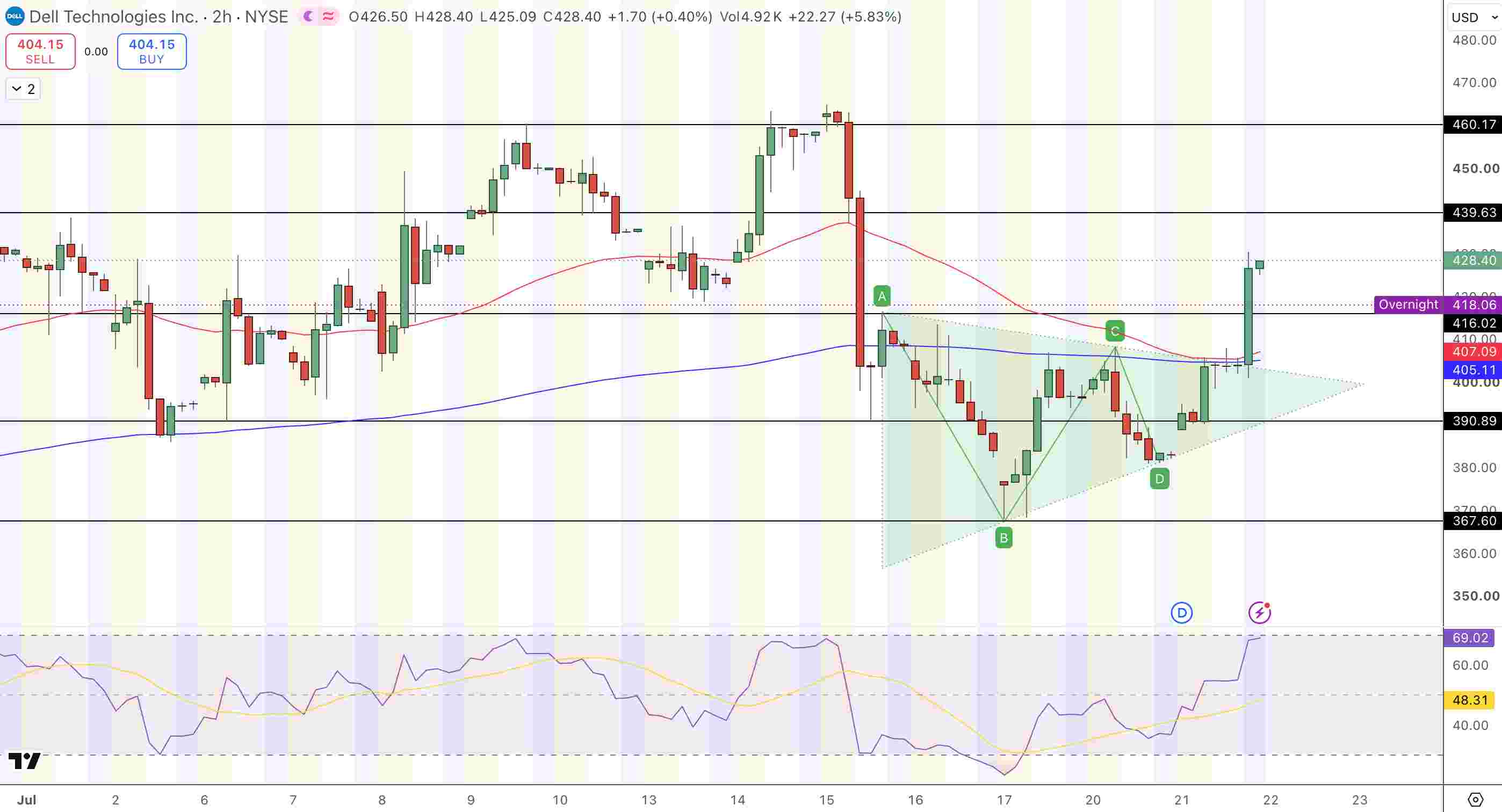
Dell Stock Forecast: Price Chart - Source: Tradingview
The stock holding a firm foothold above $416.02 is required to confirm this breakout and keep the $439.63 level in play. A follow-through move above that price level would have the door open for a push toward the prior high near $460.17. RSI at 69 suggests strong upside momentum but implies that the stock is heading into overbought territory.
That implies further consolidation could ensue without negating the bullish case. Below $416.02, $405 is next in line on the way down. A close beneath the $405 mark could undermine this breakout setup and open the door for a fall toward $390.89.
Bottom Line
Dell’s official first-quarter numbers were far better than the first draft we published, showing record revenue of $43.8 billion, AI server bookings of $24.4 billion, AI server revenue of $16.1 billion recognized and backlog of $51.3 billion. The firm raised full-year sales guidance to $165 to $169 billion and expects some $60 billion of AI server revenue.
The investment argument for Dell now turns to backlog conversion, margins and continuing corporate spending on AI technology. From a technical perspective, a sustained rally above $416.02 targets $439.63, while a drop below $405 would challenge the case.
Recommended Articles


