


Is It Too Late to Buy Johnson & Johnson After Its Blowout Earnings Report?
Key Points
The healthcare giant is on track to report full-year revenue of more than $100 billion.
The company raised guidance for annual revenue and earnings per share.
- 10 stocks we like better than Johnson & Johnson ›
Johnson & Johnson (NYSE: JNJ) has been a top-performing stock this year. Investors, in many cases rotating out of riskier assets, have looked for companies with a strong track record of earnings growth, solid competitive positions, and a revenue stream they can count on -- and J&J fits the bill.
As a healthcare player, J&J sells pharmaceuticals and medical devices that ensure a certain level of revenue, as patients need their procedures no matter what direction the stock market takes. Over time, the company's in-house research and acquisitions have built a market-leading portfolio that has kept earnings climbing. Investors, concerned about geopolitical uncertainties and risks to the artificial intelligence (AI) growth story, turned to J&J in the first half, sending the stock to a 22% gain.
Missed Nvidia in 2009? This Rare Signal Is Flashing Again. In 2009, a "Double Down" signal flashed for a little-known chipmaker called Nvidia. For the first time in years, that same "Total Conviction" signal is flashing for a company 1/100th the size of Nvidia. Continue »
Last week, J&J delivered a blowout earnings report and increased full-year forecasts. But is it too late to buy this healthcare giant? Let's find out.

Image source: Getty Images.
A household name
You might know J&J best for consumer products that you regularly use, from Band-Aid brand bandages to Tylenol. They've made J&J a household name. But the company actually spun off its consumer health business, which includes these products, as Kenvue a few years ago. This was in an effort to boost growth, with the idea of dedicating all of its resources to the higher-growth areas of pharmaceuticals and medtech.
The Kenvue spinoff came at a key moment, as J&J prepared to lose exclusivity of its blockbuster immunology drug Stelara. At its peak in 2024, Stelara brought in more than $10 billion. But the impending entry of rivals meant that Stelara sales would drop drastically.
J&J's move was a wise one, and the latest quarter illustrates this. Solid performance from immunology drug Tremfya and leading multiple myeloma drug Darzalex compensated for Stelara declines and drove more than 6% growth to $25 billion in total revenue -- keeping J&J on track to reach its goal of $100 billion in annual revenue. Darzalex revenue jumped 18% to more than $4.2 billion in the quarter, while Tremfya soared 72% to $2 billion.
A recent headwind
J&J faced one headwind in particular in the quarter. The medtech division saw some weakness -- in an interview with CNBC, chief financial officer Joseph Wolk said sales of Abiomed heart pumps slipped after the release of a study questioning the use of Impella pumps during some high-risk procedures. Wolk said J&J plans to release data in the first half of next year that should alleviate concerns. It's important to remember that the company has 28 products or platforms that bring in revenue of at least $1 billion, offering it the fuel needed for ongoing growth.
J&J increased its full-year sales guidance to $101.1 billion at the midpoint from the previous estimate of $100.8. And it boosted adjusted earnings per share guidance to $11.68 at the midpoint from $11.55.
Should you buy J&J?
Now, let's return to our question: Is it too late to buy shares of this healthcare giant after its strong run so far this year?
Today, J&J isn't dirt cheap. In fact, it's trading close to its highest in relation to forward earnings estimates.
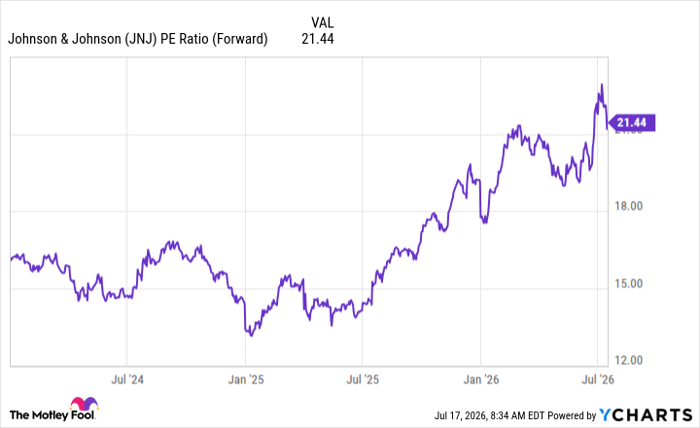
JNJ PE Ratio (Forward) data by YCharts
It's possible that, given this valuation level, the stock may dip in the weeks or months to come, offering investors a better buying opportunity. Value investors, for example, probably should wait before jumping to get in on J&J stock at this level.
That said, it's important to note that J&J offers investors many strengths, from its broad portfolio of blockbuster products to leadership in key treatment areas such as multiple myeloma and immunology, through the two top drugs mentioned above. J&J is also a Dividend King, having increased its dividend payments for more than 50 consecutive years. So, investors focused on dividend growth may find it worthwhile to buy shares of J&J even at today's valuation -- it's high, but not outrageous.
All of this means your investment style and priorities should guide your decision. The best news of all is that this top pharma stock likely has room to run over the long term.
Should you buy stock in Johnson & Johnson right now?
Before you buy stock in Johnson & Johnson, consider this:
The Motley Fool Stock Advisor analyst team just identified what they believe are the 10 best stocks for investors to buy now… and Johnson & Johnson wasn’t one of them. The 10 stocks that made the cut could produce monster returns in the coming years.
Consider when Netflix made this list on December 17, 2004... if you invested $1,000 at the time of our recommendation, you’d have $371,842!* Or when Nvidia made this list on April 15, 2005... if you invested $1,000 at the time of our recommendation, you’d have $1,244,783!*
Now, it’s worth noting Stock Advisor’s total average return is 900% — a market-crushing outperformance compared to 207% for the S&P 500. Don't miss the latest top 10 list, available with Stock Advisor, and join an investing community built by individual investors for individual investors.
See the 10 stocks »
*Stock Advisor returns as of July 19, 2026.
Adria Cimino has no position in any of the stocks mentioned. The Motley Fool recommends Johnson & Johnson and Kenvue. The Motley Fool has a disclosure policy.
Recommended Articles


