


In 7 Words, Kevin Warsh Just Sent the Clearest Signal Yet About Where Interest Rates Are Headed in 2026
Key Points
Warsh has vowed to take a more hands-off approach regarding communication with the market.
However, at a recent Central Bank forum, Warsh provided some clues into his thoughts.
- These 10 stocks could mint the next wave of millionaires ›
With his tenure just about a month and a half old, new Federal Reserve Chair Kevin Warsh has been fairly tight-lipped about his views on the economy and where he thinks interest rates should go.
This is, of course, by design, as Warsh has made it clear that he wants the Fed to take more of a back seat when it comes to how communicative the Fed is to the market, believing markets function more efficiently when they digest economic data on their own rather than worrying about how the Fed will react.
Where to invest $1,000 right now? Our analyst team just revealed what they believe are the 10 best stocks to buy right now, when you join Stock Advisor. See the stocks »
While nothing is set in stone, Warsh just sent the clearest signal yet about where interest rates are headed with these seven words.
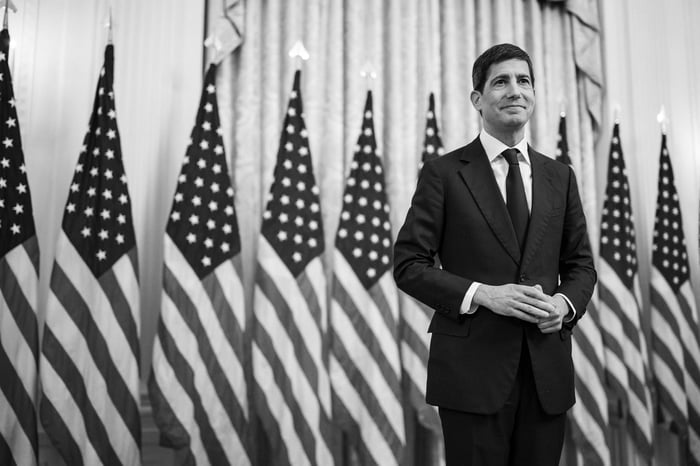
Image source: Official White House photo of Kevin Warsh by Daniel Torok.
Why it's hard to know exactly how Warsh feels about rates
After President Donald Trump nominated Warsh, many believed Warsh would try to appease Trump, who has been a staunch advocate for the Fed to lower rates further. In a Wall Street Journal op-ed prior to his confirmation, Warsh discussed how artificial intelligence (AI) could be "a significant disinflationary force," leading Fed watchers to believe he would use this as his main pitch to achieve lower rates.
Warsh has also talked about viewing inflation through a different lens, known as the "trimmed averages" approach. Under this method, the prices with the most extreme changes are removed from the basket when calculating overall price changes in the economy.
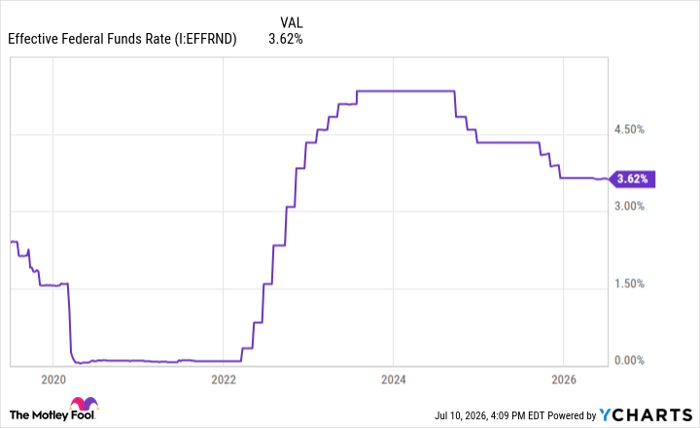
Effective Federal Funds Rate data by YCharts.
In February of 2026, the Federal Reserve Bank of Dallas calculated a trimmed-mean rate for the Fed's preferred inflation gauge, the Personal Consumption Expenditures (PCE) Price Index. It would have been nearly a half-point lower than the headline PCE rate of 2.8%.
So, if Warsh were to focus on trimmed averages, he could argue that the economy is actually a lot closer to the Fed's 2% inflation target than people think. However, since becoming chair, Warsh has had a much more hawkish attitude.
The market thinks a rate hike is coming...and for good reason
At his first Federal Open Market Committee (FOMC) meeting as chair in mid-June, Warsh made it clear that he is focused on achieving price stability, which led investors to believe he may be more hawkish than initially expected. At a recent Central Banking forum, Warsh once again spoke with similar sentiment.
"We're all in the price stability business, that might not be our only business, but if there was a common thing I heard over the last couple of days, it was open-mindedness on these questions of AI, open-mindedness on productivity, but we've all looked around, and we've seen that prices are too high," Warsh told CNBC.
It's those last seven words that are the clearest signal yet about where interest rates are headed, and the market is clearly listening. As of this writing on July 10, the market now sees a roughly 52% chance that the Fed will raise interest rates by a quarter-point at its September meeting, with another quarter-point increase projected in March of 2027.
Of course, Warsh is only one member of the FOMC; there are 19 members, 12 of whom vote. We also know from the Fed's recently released June meeting minutes that FOMC members remain divided on what the Fed should do regarding interest rates.
Things can also change quickly. The Iran war has driven oil prices higher, which tends to trickle down to most other areas of the economy. Meanwhile, the labor market, which had been the primary argument for lowering rates, has stabilized somewhat in recent months, though the data can also change quickly.
I remain skeptical whether Warsh actually supports higher rates. A rate hike can take six months to work its way through the economy, so if the Fed acts too soon and the Iran war dies down and prices fall, a rate hike will be viewed as a mistake and could add financial strain on consumers and businesses.
While I have my doubts, those seven words from Warsh at the recent forum are the clearest signal that he views prices as too high, and the easiest way to rein them in is to hike rates.
Where to invest $1,000 right now
When our analyst team has a stock tip, it can pay to listen. After all, Stock Advisor’s total average return is 929%* — a market-crushing outperformance compared to 211% for the S&P 500.
They just revealed what they believe are the 10 best stocks for investors to buy right now, available when you join Stock Advisor.
See the stocks »
*Stock Advisor returns as of July 13, 2026.
The Motley Fool has a disclosure policy.
Recommended Articles


