

Rivian Just Did What Investors Despised Lucid for. How Bad Is It?

Source The Motley Fool

Key Points

  • Shareholder dilution is common with young companies and can often be justified.

  • Lucid has a history of repeatedly raising capital and diluting shareholders.

  • Rivian has been more cautious in raising capital thanks to its large IPO and joint ventures.

  • 10 stocks we like better than Rivian Automotive ›

When investors are considering young electric vehicle (EV) stocks, Rivian Automotive (NASDAQ: RIVN) and Lucid Group (NASDAQ: LCID) often pop up. Both Rivian and Lucid have proved capable of developing compelling vehicles, albeit at lofty prices initially, and they have advanced EV technology and software.

More recently, Rivian achieved its first full-year gross profit in 2025, while Lucid has struggled to improve its unit economics, further separating the two in favor of Rivian. That said, Rivian just did something that Lucid investors groan about: raising capital and diluting shareholders. Does this change how investors should view the two?

Missed Nvidia in 2009? This Rare Signal Is Flashing Again. In 2009, a "Double Down" signal flashed for a little-known chipmaker called Nvidia. For the first time in years, that same "Total Conviction" signal is flashing for a company 1/100th the size of Nvidia. Continue »

History shows the trend

A little Investing 101: Shareholder dilution is simply the decrease in a shareholder's existing ownership percentage due to a company issuing new shares of stock for raising capital and employee compensation, among other factors. You can argue that investors are OK with some dilution because in theory, the company now has more capital to pursue growth, which in turn improves its investment potential.

The drawbacks are lower earnings per share and reduced voting power. That's important to remember, because shareholder dilution might have made some Rivian investors cringe recently when it announced a public offering of 75 million shares of common stock, worth roughly $1.5 billion. This added capital comes at a cost, which works out to about 6% dilution.

The good news for Rivian investors is that the young EV maker has been reserved about raising capital and diluting shareholders. That's primarily because of its large initial public offering's cash cushion, and later capital injections from joint ventures such as one with Volkswagen – also a driving force behind Rivian's full-year gross profit – and a $6.6 billion loan facility from the U.S. Department of Energy.

In the graph below, you can better see the longer-term trend between Rivian and Lucid.
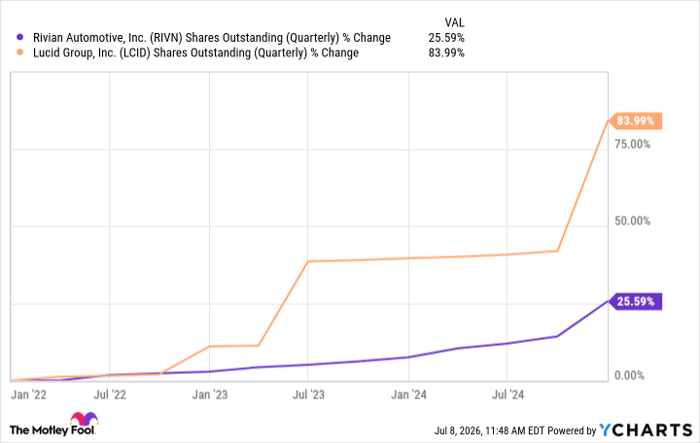
RIVN Shares Outstanding (Quarterly) Chart

RIVN Shares Outstanding (Quarterly); data by YCharts.

The graph above was cut off at the beginning of 2025 because shortly thereafter, Lucid performed a 1-for-10 reverse stock split, drastically shrinking its share count and potentially misleading investors who don't account for that (the graph could not).

A different way to look at it is to take Lucid's reported 1.644 billion shares outstanding after its public debut via a merger with a special purpose acquisition company. Adjusted for the split, that equates to a current figure of 164.4 million shares, compared to its current total of outstanding shares of about 390.26 million, giving us a total increased share count of around 137%. In comparison, Rivian's lifetime share-count increase sits at about 58%, including the recent July offering.

Is it justified?

Simply put, this is dilution. Mathematically speaking, it's simply not good news for existing investors. That said, you can put a public relations spin on it, making this capital raise fairly easy to get behind for investors.

Rivian is entering a capital-intensive stretch as it ramps up production of its recently launched R2 and builds its Atlanta, Georgia, factory. Management broke ground on it late in 2025 and will begin vertical construction this year, with R2 and R3 production expected in 2028.

Management's primary focus is a successful and (crossing fingers) a nearly flawless R2 production ramp up. This capital raise will remove any potential liquidity concerns as the automaker also accelerates investments into research and development for autonomous-driving technology.

Rivian's R2

Image source: Rivian.

It's also fair to say that Rivian has separated itself in a positive way from Lucid. The young EV maker has built more scale through volume of sales, as well as consistently improved unit economics to help drive gross profits, and it has diluted shareholders far less than one of its primary rivals.

Rivian, especially considering its history of shying away from capital raises, is at a justifiable point in time for a capital raise. As a bonus, the shares had a bit of a rally before executing this, optimizing the value raised.

Should you buy stock in Rivian Automotive right now?

Before you buy stock in Rivian Automotive, consider this:

The Motley Fool Stock Advisor analyst team just identified what they believe are the 10 best stocks for investors to buy now… and Rivian Automotive wasn’t one of them. The 10 stocks that made the cut could produce monster returns in the coming years.

Consider when Netflix made this list on December 17, 2004... if you invested $1,000 at the time of our recommendation, you’d have $395,679!* Or when Nvidia made this list on April 15, 2005... if you invested $1,000 at the time of our recommendation, you’d have $1,294,805!*

Now, it’s worth noting Stock Advisor’s total average return is 929% — a market-crushing outperformance compared to 211% for the S&P 500. Don't miss the latest top 10 list, available with Stock Advisor, and join an investing community built by individual investors for individual investors.

See the 10 stocks »

*Stock Advisor returns as of July 11, 2026.

Daniel Miller has no position in any of the stocks mentioned. The Motley Fool has no position in any of the stocks mentioned. The Motley Fool has a disclosure policy.

Disclaimer: For information purposes only. Past performance is not indicative of future results.
placeholder
Bitcoin CME gaps at $35,000, $27,000 and $21,000, which one gets filled first?Prioritize filling the $27,000 gap and even try higher.
Author  FXStreet
Aug 22, 2023
Prioritize filling the $27,000 gap and even try higher.
placeholder
Bitcoin briefly loses 2025 gains as crypto plunges over the weekend.Bitcoin experienced a sharp decline this weekend, briefly erasing its 2025 gains and dipping below its year-opening value of $93,507. The cryptocurrency fell to a low of $93,029 on Sunday, representing a 25% drop from its all-time high in October. Although it has rebounded slightly to around $94,209, the pressures on the market remain significant. The downturn occurred despite the reopening of the U.S. government on Thursday, which many had hoped would provide essential support for crypto markets. This year initially appeared promising for cryptocurrencies, particularly after the inauguration of President Donald Trump, who has established the most pro-crypto administration thus far. However, ongoing political tensions—including Trump's tariff strategies and the recent government shutdown, lasting a historic 43 days—have contributed to several rapid price pullbacks for Bitcoin throughout the year. Market dynamics are also being influenced by Bitcoin whales—investors holding large amounts of Bitcoin—who have been offloading portions of their assets, consequently stalling price rallies even as positive regulatory developments emerge. Despite these sell-offs, analysts from Glassnode argue that this behavior aligns with typical patterns seen among long-term investors during the concluding stages of bull markets, suggesting it is not indicative of a mass exodus. Notably, Bitcoin is not alone in its struggles, as Ethereum and Solana have also recorded declines of 7.95% and 28.3%, respectively, since the start of the year, while numerous altcoins have faced even steeper losses. Looking ahead, questions linger regarding the viability of the four-year cycle thesis, particularly given the increasing institutional support and regulatory frameworks now in place in the crypto landscape. Matt Hougan, chief investment officer at Bitwise, remains optimistic, suggesting a potential Bitcoin resurgence in 2026 driven by the “debasement trade” thesis and a broader trend toward increased adoption of stablecoins, tokenization, and decentralized finance. Hougan emphasized the soundness of the underlying fundamentals, pointing to a positive outlook for the sector in the longer term.
Author  Mitrade
Nov 17, 2025
Bitcoin experienced a sharp decline this weekend, briefly erasing its 2025 gains and dipping below its year-opening value of $93,507. The cryptocurrency fell to a low of $93,029 on Sunday, representing a 25% drop from its all-time high in October. Although it has rebounded slightly to around $94,209, the pressures on the market remain significant. The downturn occurred despite the reopening of the U.S. government on Thursday, which many had hoped would provide essential support for crypto markets. This year initially appeared promising for cryptocurrencies, particularly after the inauguration of President Donald Trump, who has established the most pro-crypto administration thus far. However, ongoing political tensions—including Trump's tariff strategies and the recent government shutdown, lasting a historic 43 days—have contributed to several rapid price pullbacks for Bitcoin throughout the year. Market dynamics are also being influenced by Bitcoin whales—investors holding large amounts of Bitcoin—who have been offloading portions of their assets, consequently stalling price rallies even as positive regulatory developments emerge. Despite these sell-offs, analysts from Glassnode argue that this behavior aligns with typical patterns seen among long-term investors during the concluding stages of bull markets, suggesting it is not indicative of a mass exodus. Notably, Bitcoin is not alone in its struggles, as Ethereum and Solana have also recorded declines of 7.95% and 28.3%, respectively, since the start of the year, while numerous altcoins have faced even steeper losses. Looking ahead, questions linger regarding the viability of the four-year cycle thesis, particularly given the increasing institutional support and regulatory frameworks now in place in the crypto landscape. Matt Hougan, chief investment officer at Bitwise, remains optimistic, suggesting a potential Bitcoin resurgence in 2026 driven by the “debasement trade” thesis and a broader trend toward increased adoption of stablecoins, tokenization, and decentralized finance. Hougan emphasized the soundness of the underlying fundamentals, pointing to a positive outlook for the sector in the longer term.
placeholder
Bitcoin Price Forecast: BTC slips below $64,000 as hawkish Fed stance weighs on risk appetiteBitcoin (BTC) remains under pressure, extending its correction, trading below $64,000 at the time of writing on Thursday. The US Federal Reserve (Fed) left interest rates unchanged but struck a hawkish tone on Wednesday, dampening the risk sentiment.
Author  FXStreet
Jun 18, Thu
Bitcoin (BTC) remains under pressure, extending its correction, trading below $64,000 at the time of writing on Thursday. The US Federal Reserve (Fed) left interest rates unchanged but struck a hawkish tone on Wednesday, dampening the risk sentiment.
placeholder
WTI consolidates below $72.00 as traders monitor geopolitical developmentsWest Texas Intermediate (WTI) – the benchmark US Crude Oil price – steadies during the Asian session on Friday, stalling the previous day's downfall amid mixed messaging from the US and Iran.
Author  FXStreet
Yesterday 01: 25
West Texas Intermediate (WTI) – the benchmark US Crude Oil price – steadies during the Asian session on Friday, stalling the previous day's downfall amid mixed messaging from the US and Iran.
placeholder
Gold recovers above $4,100 as traders assess US-Iran conflict Gold price (XAU/USD) rebounds to around $4,120 during the early Asian session on Friday. The precious metal edges higher as traders weigh a resumption of war in the Middle East.
Author  FXStreet
Yesterday 01: 28
Gold price (XAU/USD) rebounds to around $4,120 during the early Asian session on Friday. The precious metal edges higher as traders weigh a resumption of war in the Middle East.
goTop
quote