

Prediction: This Magnificent Growth Stock Is Going to Double by 2027, and Here's the Math That Shows How

Source The Motley Fool

Key Points

  • Duolingo's stock has plummeted by more than 75% from its peak on concerns that AI could disrupt its digital language education business.

  • The company has proven it can use AI to improve its platform, and it recently outlined a plan to nearly double its user base by 2028.

  • Duolingo stock is trading at a compelling valuation right now, potentially paving the way for blistering returns in both the short and long terms.

  • 10 stocks we like better than Duolingo ›

Duolingo (NASDAQ: DUOL) operates the world's largest digital language education platform. Its stock surged during 2024 and 2025 to hit a record high of about $540 in May of last year, but it has since plummeted by more than 75% amid concerns that artificial intelligence-powered translation tools could reduce demand for language lessons.

Plus, Duolingo's executive team recently made a business decision to prioritize user growth over the next couple of years, at the expense of monetization. As a result, Wall Street is pricing in less revenue and earnings growth, which has further contributed to the stock's decline.

Where to invest $1,000 right now? Our analyst team just revealed what they believe are the 10 best stocks to buy right now, when you join Stock Advisor. See the stocks »

However, I think the sell-off is overdone. Duolingo has already proven it can use AI to improve its platform, and focusing on user growth in the near term could lead to significantly higher revenue over the long term. The stock is now incredibly cheap, so here's why I predict it will double by the time 2027 rolls around.

A desk with language books, a globe, and stationary upon it amid a warmly lit setting.

Image source: Getty Images.

AI could be a tailwind, not a risk, for Duolingo

Duolingo's mobile-first approach and highly interactive lessons are the secrets to its success. Around 56.5 million people used its app every single day during the first quarter, and while most of them were free users whom the company monetized through advertising, 12.5 million users were paying for subscriptions to unlock extra features.

A growing number of those features are powered by AI. Users who pay for a Super Duolingo or Duolingo Max plan can access Video Call, which features a digital avatar that helps them practice their foreign language speaking skills. During the first quarter, the number of spoken words per user who engaged with this tool more than doubled compared to the year-ago period, so it's clearly proving to be popular.

Because of the success of Video Call, Duolingo plans to introduce more speaking-based lessons for free users to increase the platform's popularity. This is one of the ways the company is sacrificing monetization in the short run: Making speaking-based tools more widely available will diminish the value of paid features like Video Call, but it could significantly increase the platform's overall user base in the long run.

A growing user base will be a net positive over the long term

Management's decision to sacrifice monetization in favor of faster user growth is already having a negative impact on Duolingo's financial performance. Revenue increased by 27% year over year during the first quarter, which was a solid result at face value, but a deceleration from its 38% growth in the same quarter of 2025.

That might sound like bad news, but management believes its strategic shift could lead to Duolingo's daily active user base nearly doubling to 100 million by 2028. Theoretically, a larger user base will make the platform harder to disrupt, so it will be more defensible against new competitors. Moreover, when the company decides to focus on monetization again in the future, it will have more overall users whom it can attempt to convert into paying subscribers.

If Duolingo converts free users into subscribers in 2028 at the same rate as it did in 2025, then we can assume its paying user base and annualized revenue will also eventually double from current levels. At that point, investors who sold Duolingo stock during its recent decline might wish they had held on.

Why Duolingo stock could double in the next six months

Since Duolingo's management team is focused on a two-year plan, I don't expect the company's financial results to shoot the lights out in the near term. My prediction that the stock could double by 2027 is based mostly on its valuation -- in other words, I think the stock overshot to the downside, and is poised to recover some ground now that the dust has settled.

Duolingo stock is trading at a price-to-sales (P/S) ratio of just 5.7 as I write this, which is a significant discount to its average of 15.5 since going public in 2021. Even if the stock doubled from here, it would still have a below-average P/S ratio of 11.4.
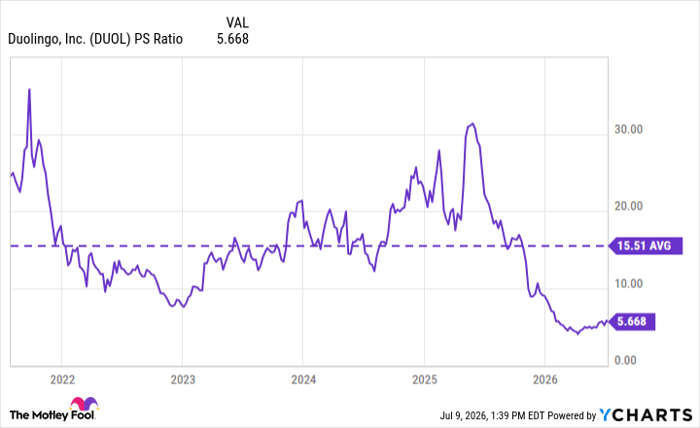
DUOL PS Ratio Chart

DUOL PS Ratio data by YCharts.

Plus, based on Duolingo's trailing-12-month earnings of $8.74 per share, its stock is trading at a P/E ratio of 15.3, which is significantly cheaper than the broader market. The stock would have to more than double just to match the P/E of the Nasdaq-100 index, which is currently 35.2.

In summary, I think the sell-off in Duolingo stock is way overdone, and as long as the company doesn't dramatically miss Wall Street's expectations in its next couple of quarters, investors who buy it at around the current level could enjoy solid short-term and long-term rewards.

Should you buy stock in Duolingo right now?

Before you buy stock in Duolingo, consider this:

The Motley Fool Stock Advisor analyst team just identified what they believe are the 10 best stocks for investors to buy now… and Duolingo wasn’t one of them. The 10 stocks that made the cut could produce monster returns in the coming years.

Consider when Netflix made this list on December 17, 2004... if you invested $1,000 at the time of our recommendation, you’d have $395,679!* Or when Nvidia made this list on April 15, 2005... if you invested $1,000 at the time of our recommendation, you’d have $1,294,805!*

Now, it’s worth noting Stock Advisor’s total average return is 929% — a market-crushing outperformance compared to 211% for the S&P 500. Don't miss the latest top 10 list, available with Stock Advisor, and join an investing community built by individual investors for individual investors.

See the 10 stocks »

*Stock Advisor returns as of July 11, 2026.

Anthony Di Pizio has positions in Duolingo. The Motley Fool has positions in and recommends Duolingo. The Motley Fool has a disclosure policy.

Disclaimer: For information purposes only. Past performance is not indicative of future results.
placeholder
Bitcoin CME gaps at $35,000, $27,000 and $21,000, which one gets filled first?Prioritize filling the $27,000 gap and even try higher.
Author  FXStreet
Aug 22, 2023
Prioritize filling the $27,000 gap and even try higher.
placeholder
Bitcoin briefly loses 2025 gains as crypto plunges over the weekend.Bitcoin experienced a sharp decline this weekend, briefly erasing its 2025 gains and dipping below its year-opening value of $93,507. The cryptocurrency fell to a low of $93,029 on Sunday, representing a 25% drop from its all-time high in October. Although it has rebounded slightly to around $94,209, the pressures on the market remain significant. The downturn occurred despite the reopening of the U.S. government on Thursday, which many had hoped would provide essential support for crypto markets. This year initially appeared promising for cryptocurrencies, particularly after the inauguration of President Donald Trump, who has established the most pro-crypto administration thus far. However, ongoing political tensions—including Trump's tariff strategies and the recent government shutdown, lasting a historic 43 days—have contributed to several rapid price pullbacks for Bitcoin throughout the year. Market dynamics are also being influenced by Bitcoin whales—investors holding large amounts of Bitcoin—who have been offloading portions of their assets, consequently stalling price rallies even as positive regulatory developments emerge. Despite these sell-offs, analysts from Glassnode argue that this behavior aligns with typical patterns seen among long-term investors during the concluding stages of bull markets, suggesting it is not indicative of a mass exodus. Notably, Bitcoin is not alone in its struggles, as Ethereum and Solana have also recorded declines of 7.95% and 28.3%, respectively, since the start of the year, while numerous altcoins have faced even steeper losses. Looking ahead, questions linger regarding the viability of the four-year cycle thesis, particularly given the increasing institutional support and regulatory frameworks now in place in the crypto landscape. Matt Hougan, chief investment officer at Bitwise, remains optimistic, suggesting a potential Bitcoin resurgence in 2026 driven by the “debasement trade” thesis and a broader trend toward increased adoption of stablecoins, tokenization, and decentralized finance. Hougan emphasized the soundness of the underlying fundamentals, pointing to a positive outlook for the sector in the longer term.
Author  Mitrade
Nov 17, 2025
Bitcoin experienced a sharp decline this weekend, briefly erasing its 2025 gains and dipping below its year-opening value of $93,507. The cryptocurrency fell to a low of $93,029 on Sunday, representing a 25% drop from its all-time high in October. Although it has rebounded slightly to around $94,209, the pressures on the market remain significant. The downturn occurred despite the reopening of the U.S. government on Thursday, which many had hoped would provide essential support for crypto markets. This year initially appeared promising for cryptocurrencies, particularly after the inauguration of President Donald Trump, who has established the most pro-crypto administration thus far. However, ongoing political tensions—including Trump's tariff strategies and the recent government shutdown, lasting a historic 43 days—have contributed to several rapid price pullbacks for Bitcoin throughout the year. Market dynamics are also being influenced by Bitcoin whales—investors holding large amounts of Bitcoin—who have been offloading portions of their assets, consequently stalling price rallies even as positive regulatory developments emerge. Despite these sell-offs, analysts from Glassnode argue that this behavior aligns with typical patterns seen among long-term investors during the concluding stages of bull markets, suggesting it is not indicative of a mass exodus. Notably, Bitcoin is not alone in its struggles, as Ethereum and Solana have also recorded declines of 7.95% and 28.3%, respectively, since the start of the year, while numerous altcoins have faced even steeper losses. Looking ahead, questions linger regarding the viability of the four-year cycle thesis, particularly given the increasing institutional support and regulatory frameworks now in place in the crypto landscape. Matt Hougan, chief investment officer at Bitwise, remains optimistic, suggesting a potential Bitcoin resurgence in 2026 driven by the “debasement trade” thesis and a broader trend toward increased adoption of stablecoins, tokenization, and decentralized finance. Hougan emphasized the soundness of the underlying fundamentals, pointing to a positive outlook for the sector in the longer term.
placeholder
Bitcoin Price Forecast: BTC slips below $64,000 as hawkish Fed stance weighs on risk appetiteBitcoin (BTC) remains under pressure, extending its correction, trading below $64,000 at the time of writing on Thursday. The US Federal Reserve (Fed) left interest rates unchanged but struck a hawkish tone on Wednesday, dampening the risk sentiment.
Author  FXStreet
Jun 18, Thu
Bitcoin (BTC) remains under pressure, extending its correction, trading below $64,000 at the time of writing on Thursday. The US Federal Reserve (Fed) left interest rates unchanged but struck a hawkish tone on Wednesday, dampening the risk sentiment.
placeholder
WTI consolidates below $72.00 as traders monitor geopolitical developmentsWest Texas Intermediate (WTI) – the benchmark US Crude Oil price – steadies during the Asian session on Friday, stalling the previous day's downfall amid mixed messaging from the US and Iran.
Author  FXStreet
Yesterday 01: 25
West Texas Intermediate (WTI) – the benchmark US Crude Oil price – steadies during the Asian session on Friday, stalling the previous day's downfall amid mixed messaging from the US and Iran.
placeholder
Gold recovers above $4,100 as traders assess US-Iran conflict Gold price (XAU/USD) rebounds to around $4,120 during the early Asian session on Friday. The precious metal edges higher as traders weigh a resumption of war in the Middle East.
Author  FXStreet
Yesterday 01: 28
Gold price (XAU/USD) rebounds to around $4,120 during the early Asian session on Friday. The precious metal edges higher as traders weigh a resumption of war in the Middle East.
goTop
quote