

3 Phenomenal Artificial Intelligence (AI) Stocks to Buy Before They Report Earnings

Source The Motley Fool

Key Points

  • Microsoft's stock has been weak in 2026.

  • A new Meta Platforms business unit could send the stock higher.

  • TSMC's language could set the tone for other AI stocks.

  • 10 stocks we like better than Microsoft ›

As the calendar reaches mid-July, earnings season is ramping up. Over the next few weeks, investors will hear from some of the most important companies in the market, and it could set the tone for the next few months.

I think the news over the next few weeks will be mostly positive for artificial intelligence (AI) investors and signal a trend toward increased AI spending for the remainder of 2026 and into 2027. If that's the case, there are several stocks worth buying now before they report earnings.

Where to invest $1,000 right now? Our analyst team just revealed what they believe are the 10 best stocks to buy right now, when you join Stock Advisor. See the stocks »

Three at the top of my list are Microsoft (NASDAQ: MSFT), Meta Platforms (NASDAQ: META), and Taiwan Semiconductor Manufacturing (NYSE: TSM). Each of these has a different reason for excitement, and investors should at least pay attention to all of them, if not buy shares beforehand in anticipation of a post-earnings spike.

Investor looking at earnings reports.

Image source: Getty Images.

1. Microsoft

Microsoft stock has had an atrocious 2026, falling nearly 21% from year-end levels. Its first two earnings reports delivered in 2026 were poorly received, but I think the market will come around this time.

Microsoft's earnings weren't even remotely bad during its last announcements, as it announced incredible AI growth and a strong cloud computing performance. In fiscal 2026's Q3 (ended March 31, 2026), revenue rose 18% year over year, and earnings per share (EPS) increased 23%. That would normally earn Microsoft a premium valuation compared to the market.

And yet, Microsoft's stock performance actually trails the S&P 500 (SNPINDEX: ^GSPC), with the S&P 500 trading at 21.7 times forward earnings, while Microsoft trades at only 20 times forward earnings.

If Microsoft can report more of the same as it did in the last quarter, I think the market will come to its senses and realize this is a screaming deal, and investors will happily buy it following earnings. That makes now the perfect time to buy Microsoft stock, as this deal won't last forever.

2. Meta Platforms

The market likes Meta Platforms' stock even less, as it trades for 18.7 times forward earnings despite growing at a 33% pace last quarter. While investors will want to know how Meta's advertising business is doing and how its AI progress is going, what's stealing the spotlight right now is Meta's plans to launch a cloud computing product.

This is what separates Meta from the other AI hyperscalers: they all have cloud computing businesses that help fund their AI build-out. If investors get positive confirmation of Meta's impending cloud business launch, the stock could pop, as it would have a lot of excess capacity to rent out.

Regardless of what Meta does with a cloud business, the stock is cheap, and the business is growing at a solid pace. I think that makes Meta a compelling buy at these levels, as it could easily see a multi-digit pop if it unveils a new cloud computing platform during its earnings call.

3. Taiwan Semiconductor Manufacturing

Last is Taiwan Semiconductor Manufacturing, aka TSMC, which reports earnings on July 16. TSMC is the primary chip foundry that nearly every big firm uses, and it has an excellent pulse on the health of AI chip demand. If it comes out and says chip demand is growing and it cannot meet it, the market may rally behind it. I expect that to be the case, as there have been no signs of AI hyperscalers changing course.

TSMC is the most expensive stock in this trio, trading at 27.5 times forward earnings -- where Microsoft used to trade.
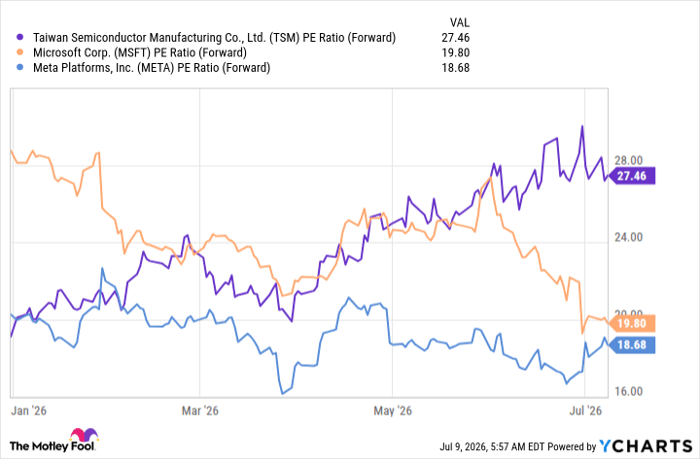
TSM PE Ratio (Forward) Chart

Data by YCharts.

Although this is expensive, I think it's appropriate considering Taiwan Semiconductor's market position, dominance, and superior execution to others in its industry. Taiwan Semiconductor Manufacturing still has multiple years left of growth if the AI build-out is truly just getting started, and I'd expect management to reaffirm those projections during its quarterly call.

Should you buy stock in Microsoft right now?

Before you buy stock in Microsoft, consider this:

The Motley Fool Stock Advisor analyst team just identified what they believe are the 10 best stocks for investors to buy now… and Microsoft wasn’t one of them. The 10 stocks that made the cut could produce monster returns in the coming years.

Consider when Netflix made this list on December 17, 2004... if you invested $1,000 at the time of our recommendation, you’d have $407,004!* Or when Nvidia made this list on April 15, 2005... if you invested $1,000 at the time of our recommendation, you’d have $1,244,599!*

Now, it’s worth noting Stock Advisor’s total average return is 924% — a market-crushing outperformance compared to 210% for the S&P 500. Don't miss the latest top 10 list, available with Stock Advisor, and join an investing community built by individual investors for individual investors.

See the 10 stocks »

*Stock Advisor returns as of July 11, 2026.

Keithen Drury has positions in Meta Platforms, Microsoft, and Taiwan Semiconductor Manufacturing. The Motley Fool has positions in and recommends Meta Platforms, Microsoft, and Taiwan Semiconductor Manufacturing. The Motley Fool has a disclosure policy.

Disclaimer: For information purposes only. Past performance is not indicative of future results.
placeholder
Bitcoin CME gaps at $35,000, $27,000 and $21,000, which one gets filled first?Prioritize filling the $27,000 gap and even try higher.
Author  FXStreet
Aug 22, 2023
Prioritize filling the $27,000 gap and even try higher.
placeholder
Bitcoin briefly loses 2025 gains as crypto plunges over the weekend.Bitcoin experienced a sharp decline this weekend, briefly erasing its 2025 gains and dipping below its year-opening value of $93,507. The cryptocurrency fell to a low of $93,029 on Sunday, representing a 25% drop from its all-time high in October. Although it has rebounded slightly to around $94,209, the pressures on the market remain significant. The downturn occurred despite the reopening of the U.S. government on Thursday, which many had hoped would provide essential support for crypto markets. This year initially appeared promising for cryptocurrencies, particularly after the inauguration of President Donald Trump, who has established the most pro-crypto administration thus far. However, ongoing political tensions—including Trump's tariff strategies and the recent government shutdown, lasting a historic 43 days—have contributed to several rapid price pullbacks for Bitcoin throughout the year. Market dynamics are also being influenced by Bitcoin whales—investors holding large amounts of Bitcoin—who have been offloading portions of their assets, consequently stalling price rallies even as positive regulatory developments emerge. Despite these sell-offs, analysts from Glassnode argue that this behavior aligns with typical patterns seen among long-term investors during the concluding stages of bull markets, suggesting it is not indicative of a mass exodus. Notably, Bitcoin is not alone in its struggles, as Ethereum and Solana have also recorded declines of 7.95% and 28.3%, respectively, since the start of the year, while numerous altcoins have faced even steeper losses. Looking ahead, questions linger regarding the viability of the four-year cycle thesis, particularly given the increasing institutional support and regulatory frameworks now in place in the crypto landscape. Matt Hougan, chief investment officer at Bitwise, remains optimistic, suggesting a potential Bitcoin resurgence in 2026 driven by the “debasement trade” thesis and a broader trend toward increased adoption of stablecoins, tokenization, and decentralized finance. Hougan emphasized the soundness of the underlying fundamentals, pointing to a positive outlook for the sector in the longer term.
Author  Mitrade
Nov 17, 2025
Bitcoin experienced a sharp decline this weekend, briefly erasing its 2025 gains and dipping below its year-opening value of $93,507. The cryptocurrency fell to a low of $93,029 on Sunday, representing a 25% drop from its all-time high in October. Although it has rebounded slightly to around $94,209, the pressures on the market remain significant. The downturn occurred despite the reopening of the U.S. government on Thursday, which many had hoped would provide essential support for crypto markets. This year initially appeared promising for cryptocurrencies, particularly after the inauguration of President Donald Trump, who has established the most pro-crypto administration thus far. However, ongoing political tensions—including Trump's tariff strategies and the recent government shutdown, lasting a historic 43 days—have contributed to several rapid price pullbacks for Bitcoin throughout the year. Market dynamics are also being influenced by Bitcoin whales—investors holding large amounts of Bitcoin—who have been offloading portions of their assets, consequently stalling price rallies even as positive regulatory developments emerge. Despite these sell-offs, analysts from Glassnode argue that this behavior aligns with typical patterns seen among long-term investors during the concluding stages of bull markets, suggesting it is not indicative of a mass exodus. Notably, Bitcoin is not alone in its struggles, as Ethereum and Solana have also recorded declines of 7.95% and 28.3%, respectively, since the start of the year, while numerous altcoins have faced even steeper losses. Looking ahead, questions linger regarding the viability of the four-year cycle thesis, particularly given the increasing institutional support and regulatory frameworks now in place in the crypto landscape. Matt Hougan, chief investment officer at Bitwise, remains optimistic, suggesting a potential Bitcoin resurgence in 2026 driven by the “debasement trade” thesis and a broader trend toward increased adoption of stablecoins, tokenization, and decentralized finance. Hougan emphasized the soundness of the underlying fundamentals, pointing to a positive outlook for the sector in the longer term.
placeholder
Bitcoin Price Forecast: BTC slips below $64,000 as hawkish Fed stance weighs on risk appetiteBitcoin (BTC) remains under pressure, extending its correction, trading below $64,000 at the time of writing on Thursday. The US Federal Reserve (Fed) left interest rates unchanged but struck a hawkish tone on Wednesday, dampening the risk sentiment.
Author  FXStreet
Jun 18, Thu
Bitcoin (BTC) remains under pressure, extending its correction, trading below $64,000 at the time of writing on Thursday. The US Federal Reserve (Fed) left interest rates unchanged but struck a hawkish tone on Wednesday, dampening the risk sentiment.
placeholder
WTI consolidates below $72.00 as traders monitor geopolitical developmentsWest Texas Intermediate (WTI) – the benchmark US Crude Oil price – steadies during the Asian session on Friday, stalling the previous day's downfall amid mixed messaging from the US and Iran.
Author  FXStreet
Yesterday 01: 25
West Texas Intermediate (WTI) – the benchmark US Crude Oil price – steadies during the Asian session on Friday, stalling the previous day's downfall amid mixed messaging from the US and Iran.
placeholder
Gold recovers above $4,100 as traders assess US-Iran conflict Gold price (XAU/USD) rebounds to around $4,120 during the early Asian session on Friday. The precious metal edges higher as traders weigh a resumption of war in the Middle East.
Author  FXStreet
Yesterday 01: 28
Gold price (XAU/USD) rebounds to around $4,120 during the early Asian session on Friday. The precious metal edges higher as traders weigh a resumption of war in the Middle East.
goTop
quote